
The global momentum for artificial intelligence is also being adopted in the electrical network, bringing forth advancements such as predictive maintenance. In parallel, the energy sector is transitioning to a cleaner, more sustainable network to meet decarbonization and ESG goals. Utilities worldwide are aggressively investing in renewable infrastructure, decentralizing the grid, and maximizing its resilience.
Thus, in this evolving landscape, utilities must quickly adapt to intelligent systems such as predictive maintenance not only to maximize grid efficiency but also to ensure that their clean energy integration contributes to grid reliability and modernization initiatives.
In this blog, we will explore the importance of clean energy and why predictive maintenance is becoming an indispensable asset for clean energy infrastructure reliability.
What is Clean Energy?
Clean energy is the adoption of renewable sources such as wind, hydro, or solar to generate electricity with minimal greenhouse gas emissions and environmental impact. Its ultimate goal is to help utilities combat the climate crisis and promote a more sustainable future for power grids.
Clean energy involves both installing and upgrading power systems to accommodate the integration of renewable energy into the grid. Unlike traditional baseload power plants such as coal or natural gas, renewable energy sources provide the variability required for the adoption of intelligent grid modernization technologies.
According to the Dimension Market Research market report, the global renewable energy market is estimated to grow at a CAGR of 8.9% and reach $3.1 trillion by 2034. For the 2024-25 financial year, Australia’s Clean Energy Finance Corporation pledged ~A$4.7 billion (~$2.3 billion) to renewable projects and grid enhancement technologies, such as predictive maintenance.
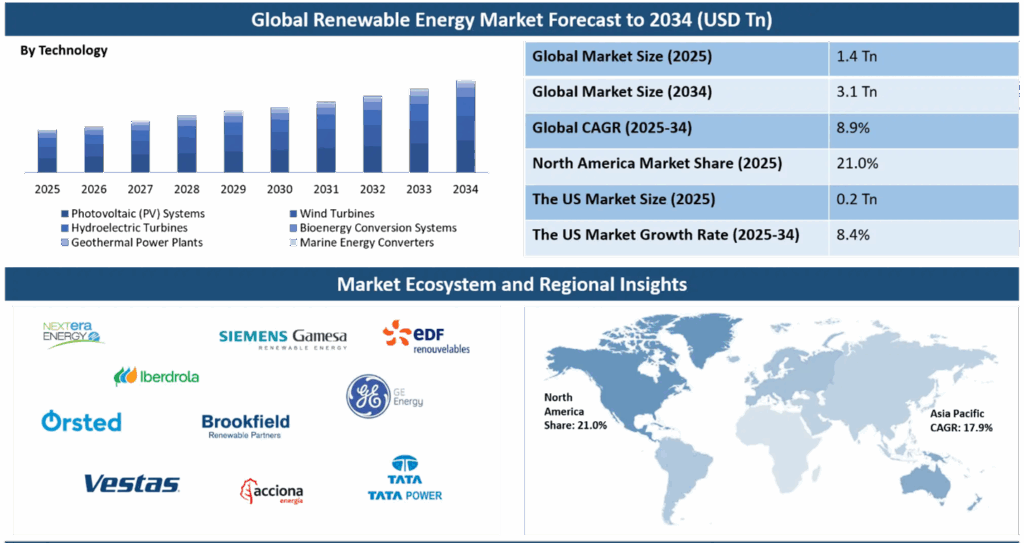
Image Reference: Renewable Energy Market by Dimension Market Research
This global trend also reflects the growing policy and transformational support for clean energy.
However, as with any new addition, integrating renewable energy introduces operational and maintenance complexities into the grid that cannot be dynamically managed by reactive or condition-based maintenance alone.
Why is Predictive Maintenance Important for Clean Energy?
The introduction of large volumes of renewable sources into existing power grids significantly alters the traditional operations of the network. With conventional resources, such as fossil-fuel plants, electrical system failures can be predicted as the output is dispatchable. But with renewable sources, especially solar and wind, monitoring is highly dynamic and multi-factor dependent.
Clean energy further introduces challenges like:
- Intermittent Generation: Voltage fluctuations & frequency instability in critical electrical infrastructure.
- Distributed energy resources (DERs): Bidirectional power flow cannot be managed by traditional maintenance strategies.
- Operational Complexity: Rapid changes in generation must balance supply and demand in real-time.
- Increased Failure Rates: Dynamic fluctuations lead to increased stress in electrical equipment.
To mitigate these challenges and future-proof their grids, utilities must shift their maintenance strategies from reactive, condition-based to predictive maintenance. This shift in intelligence will not only enhance clean energy ROI but also maximize its reliability.
How does predictive maintenance ensure failure prevention in clean energy systems?
Predictive maintenance centralizes real-time data from condition-based monitoring systems, including sensors and monitors, and applies advanced algorithms to derive data-driven insights.
Unlike reactive maintenance systems that only intervene after a failure has occurred, or condition-based monitoring that follows scheduled maintenance based on asset conditions, predictive maintenance uses real-time operational data.
A typical predictive maintenance framework looks like:
- IIoT Sensors– Continuous and highly precise data collection from critical asset conditions such as temperature, partial discharge, and SF6.
- Edge Devices– For pre-processing data and securely communicating it to a centralized platform using advanced protocols.
- Asset Performance Management (APM) System– A centralized platform that integrates all real-time and historical field data across multiple siloed systems to ensure predictive maintenance.
- Predictive Models- A core feature of APM that applies AI/ML algorithms and indicators for failure forecasting, trend analysis, pattern recognition, and data-driven insights.
- Automated Alarms & Alerts– To inform field engineers, operators, and asset experts when there is a deviation from normal asset behavior. This ensures teams act early and intervene even before the fault escalates.
For clean energy systems, this translates into predictive maintenance, ensuring reliable and efficient operations even under dynamic conditions and variability.
Advantages of Predictive Maintenance for Clean Energy Reliability
Predictive maintenance systems, such as Rugged Monitoring’s APM, RM EYE, empower utilities in their smart grid initiatives by employing artificial intelligence, digital twin technology, and data-driven capabilities.
Reduce Unplanned Downtime
Unplanned downtime caused by equipment failure poses a significant risk to grid stability and diminishes the effective capacity of clean energy resources. But with predictive maintenance, utilities can mitigate critical issues such as unusual vibrations in wind turbines or thermal stress in solar inverters. Through data-driven insights and automated alerts, utilities maintain uninterrupted operations, ensuring reliable power delivery and ultimately enhancing customer satisfaction.
Enhancing Equipment Lifespan
Clean energy assets are capital-intensive and replacing them prematurely can jeopardize overall ROI. With predictive maintenance, utilities can optimize repair scheduling and prevent minor issues from escalating into major faults. Thus, maximizing the useful life of critical assets and lowering lifecycle costs. This allows for timely maintenance, preserving overall plant efficiency and increasing ROI.
Improving Performance and Efficiency
Predictive maintenance also supports broader operational strategies beyond individual clean energy resources. By correlating real-time sensor data with performance indicators (such as generation output, weather conditions, and electrical stress), operators can fine-tune the entire grid’s performance to deliver higher uptime and capacity utilization.
Moreover, advanced analytics help utilities anticipate maintenance windows to align with forecasted low-generation periods, minimizing disruption to clean energy output.
Supporting Clean Energy Flexibility and Stability
Clean energy variability requires grid operators to dynamically adjust system settings, reserve margins, and load balancing mechanisms. Predictive maintenance contributes to this flexibility by ensuring that critical grid assets remain in optimal condition. Through real-time insights, predictive maintenance allows operators to plan around potential vulnerabilities and integrate distributed renewable resources with higher confidence.
Furthermore, predictive analytics can be integrated with grid modernization and digitalization platforms to automate responses to predict stress conditions, strengthening overall system stability.
Enabling Digital and Smart Grid Evolution
Modern grids are becoming digitalized ecosystems with interconnected assets, advanced telemetry, and automated controls. Predictive maintenance is a foundational element of digitalization, enabling utilities to convert raw operational data into actionable intelligence.
In addition to modernization, which is projected to expand significantly over the coming decade, predictive maintenance reflects the need for tools that support both reliability and sustainability objectives.
By embedding platforms such as RM EYE into grid operation workflows, utilities gain a strategic advantage. An AI-enabled, data-driven view of asset health and system performance, aligned with the demands of clean energy integration.
Predictive Maintenance is a Strategic Enabler for Clean Energy Reliability
Clean energy is transforming the global electrical network from generation to distribution. With strong investment momentum and growing installed capacity across renewable technologies, utilities are poised to move toward a low-carbon future. Yet, the operational complexity introduced by variable and distributed clean energy sources challenges traditional maintenance practices and grid reliability paradigms.
Predictive maintenance is essential to addressing these challenges. By utilizing data analytics, real-time monitoring, and predictive modeling, power system operators can anticipate failures, optimize asset health, and ensure seamless integration of renewable generation. In doing so, predictive maintenance not only enhances the reliability of clean energy infrastructure but also supports the broader objective of a resilient, efficient, and sustainable electrical grid.
As global clean energy markets expand and grid modernization matures, predictive maintenance will remain a strategic enabler for reliable, future-ready power systems.
Talk to our Predictive Maintenance Expert to learn more about how RM EYE can be your strategic enabler.