Online Partial Discharge Monitoring | Rugged Monitoring
PARTIAL DISCHARGE MONITORING

Online partial discharge monitoring for transformers, switchgear, GIS and cables and more.

Find insulation defects early, while they are still a maintenance job and not a failure. Our PD201 and PD211 monitors watch your high-voltage assets around the clock and send the data to RM EYE.

Built for utilities, industrial plants, refineries and data centres that run medium and high-voltage assets.

RMRM EYE – Partial Discharge AnalyticsLive
PD Activity – Transformer T-01In Service
PRPD Pattern
PD Severity
68pC+26%
PD Trend (30 d)
Alerts
PD activity rising

T-01 (HV Bushing A) · 2 min ago

Sample data
  • 4 / 8 ChannelsAll captured at the same time, no multiplexing

  • HF + UHFHF (0.01 to 50 MHz) and UHF (300 to 2000 MHz) options

  • Open ProtocolsIEC 61850, Modbus TCP/IP, DNP3 and MQTT

  • −30°C to +50°COperating temperature

The problem

How do you detect partial discharge before a transformer or switchgear fails?

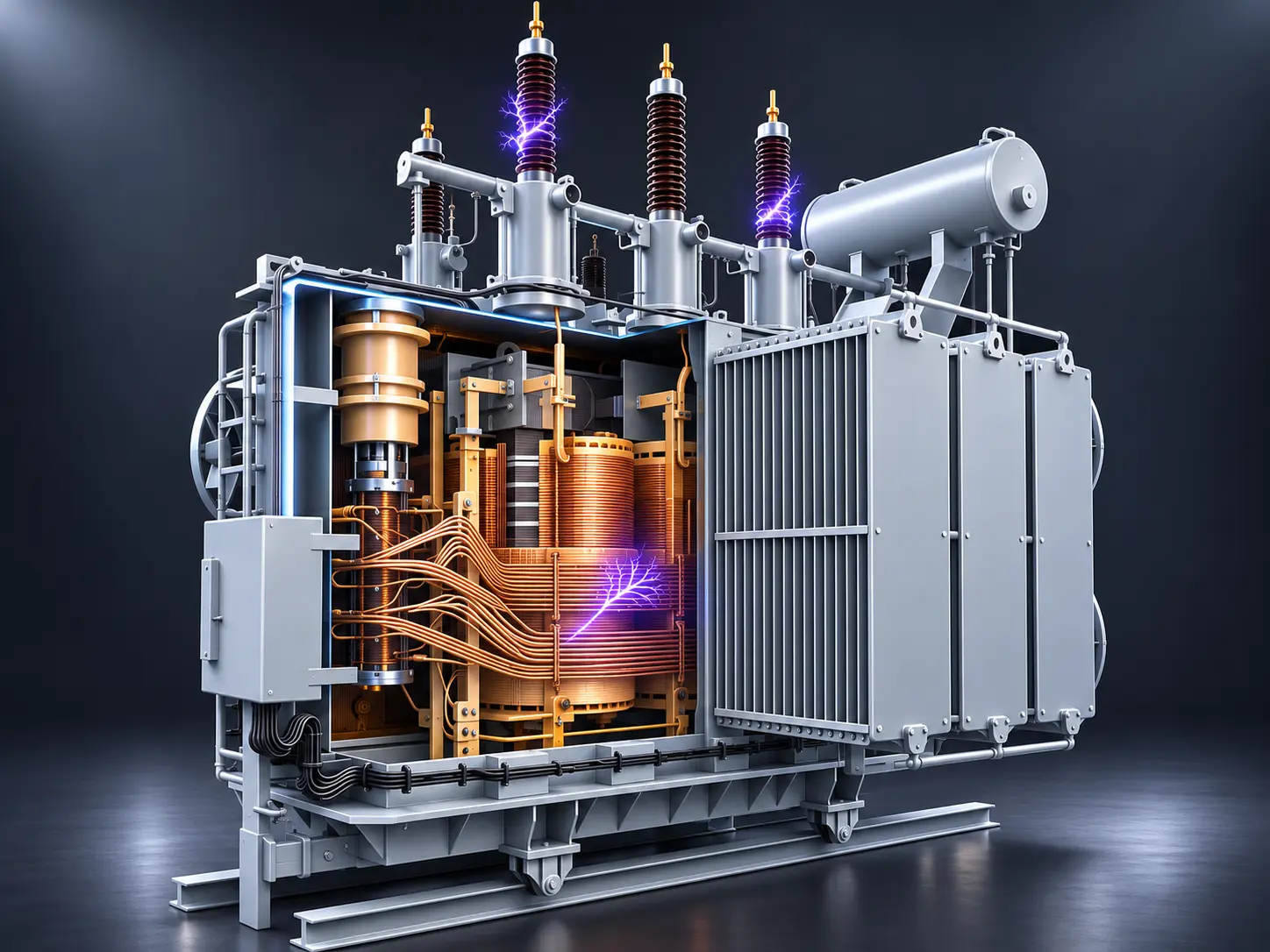
Partial discharge (PD) is a small, localized electrical discharge that occurs within weakened insulation, often in air gaps, voids, contaminated surfaces, or loose connections. It does not usually cause an immediate trip or visible fault, so the transformer or switchgear can continue operating while the defect develops unnoticed.

Each discharge pulse damages the insulation a little more. Over time, the activity can become more frequent and more energetic, leading to tracking, carbonization, insulation breakdown, and ultimately an unplanned failure. The challenge is identifying this early-stage warning sign while the issue is still manageable, rather than discovering it after it has caused an outage
Contact our team

Periodic offline tests only give you a snapshot. If the defect starts between two test dates, you won't see it until the next shutdown, or until it fails.

Online PD monitoring fixes that. Sensors stay on the asset, the monitor captures every discharge pulse continuously, and you get an alert when the activity starts to rise. You see the trend, not just one reading, so you can plan the repair at a time that suits you.

How online PD monitoring works

You see the trend, not just one reading.

  1. UHF PD sensor mounted on a transformer flange
    STEP 01

    Sensors on your asset

    HF or UHF sensors stay on the asset

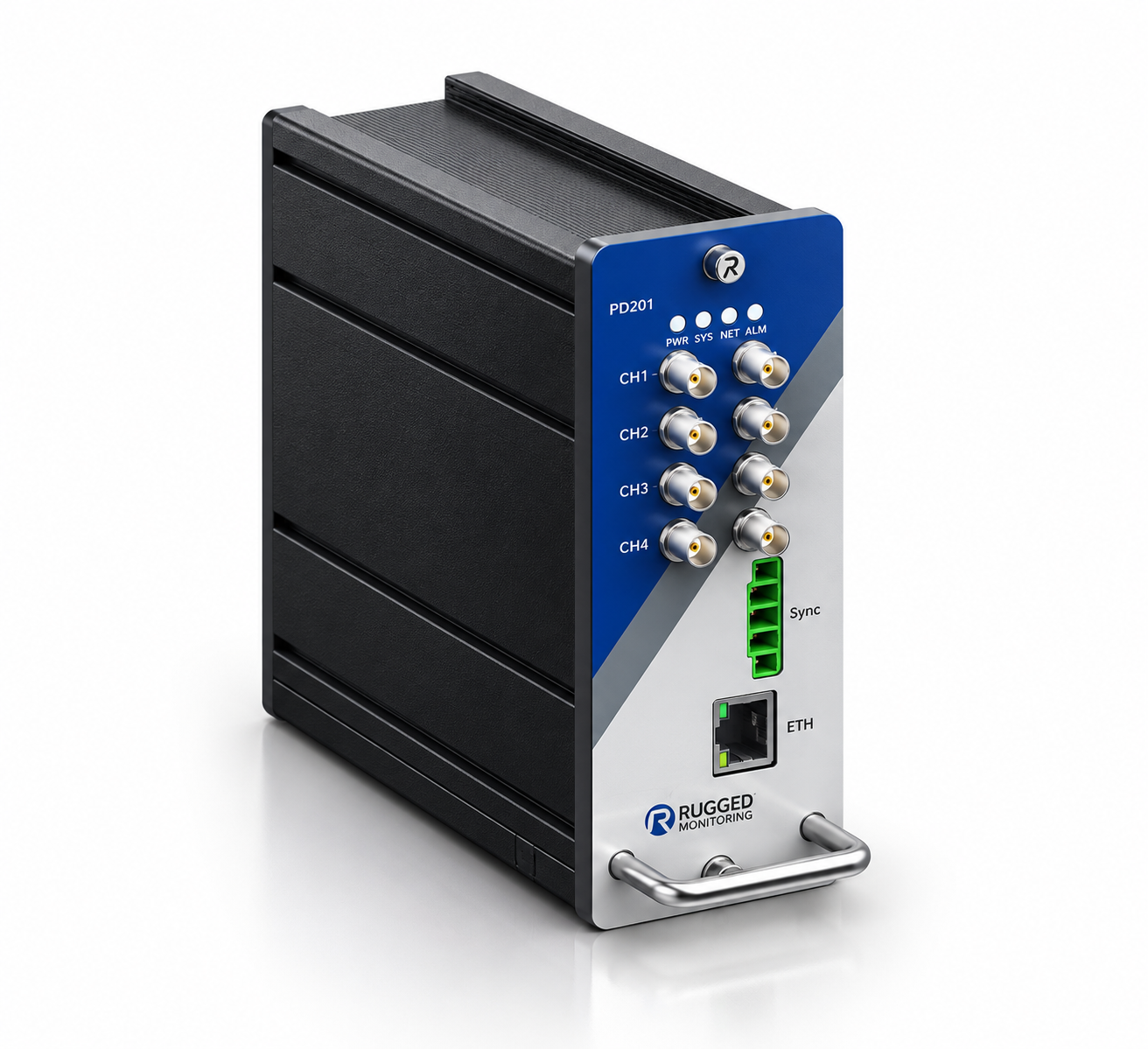
  2. PD201 monitor module
    STEP 02

    PD201 / PD211 monitor

    Captures every discharge pulse continuously

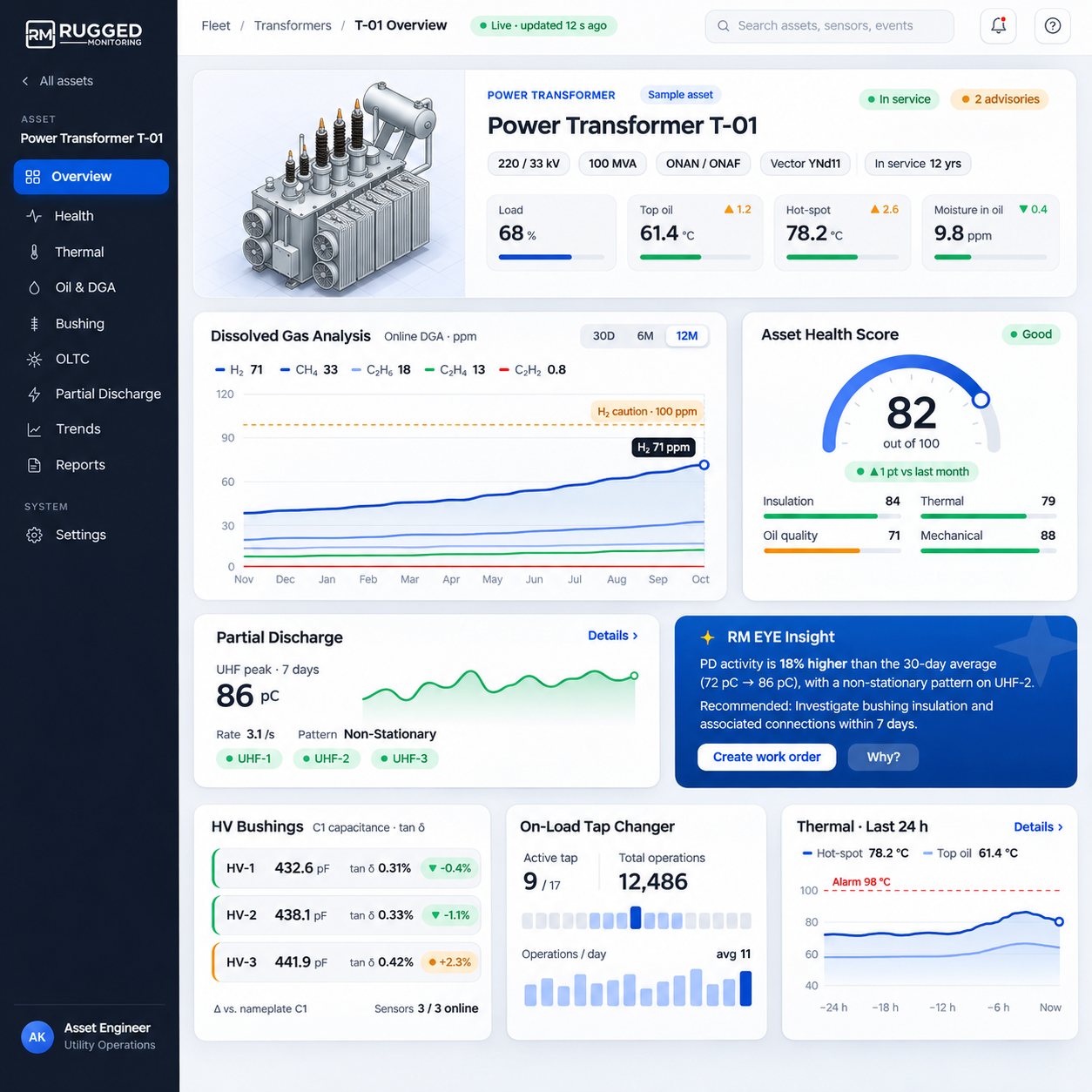
  3. RM EYE dashboard showing a power transformer overview with PD trends
    STEP 03

    RM EYE

    Trend and alert when activity starts to rise

  • Continuous, real-time monitoring
  • Phase-resolved PD (PRPD) and trending
  • Noise rejection with selectable filters
  • Integration with SCADA / asset systems

Our PD monitoring solutions

PD201 (HF) and PD211 (UHF), with RM EYE behind them.

PD201 high-frequency PD monitor module

PD201

High-frequency (HF) PD monitor

  • 0.01 to 50 MHz
  • 4 or 8, simultaneous channels
  • Selectable filters (5 to 50 MHz) and software gating
  • Works with any HF PD sensor, including bushing adaptors, HFCTs, capacitive couplers and acoustic sensors
View PD201
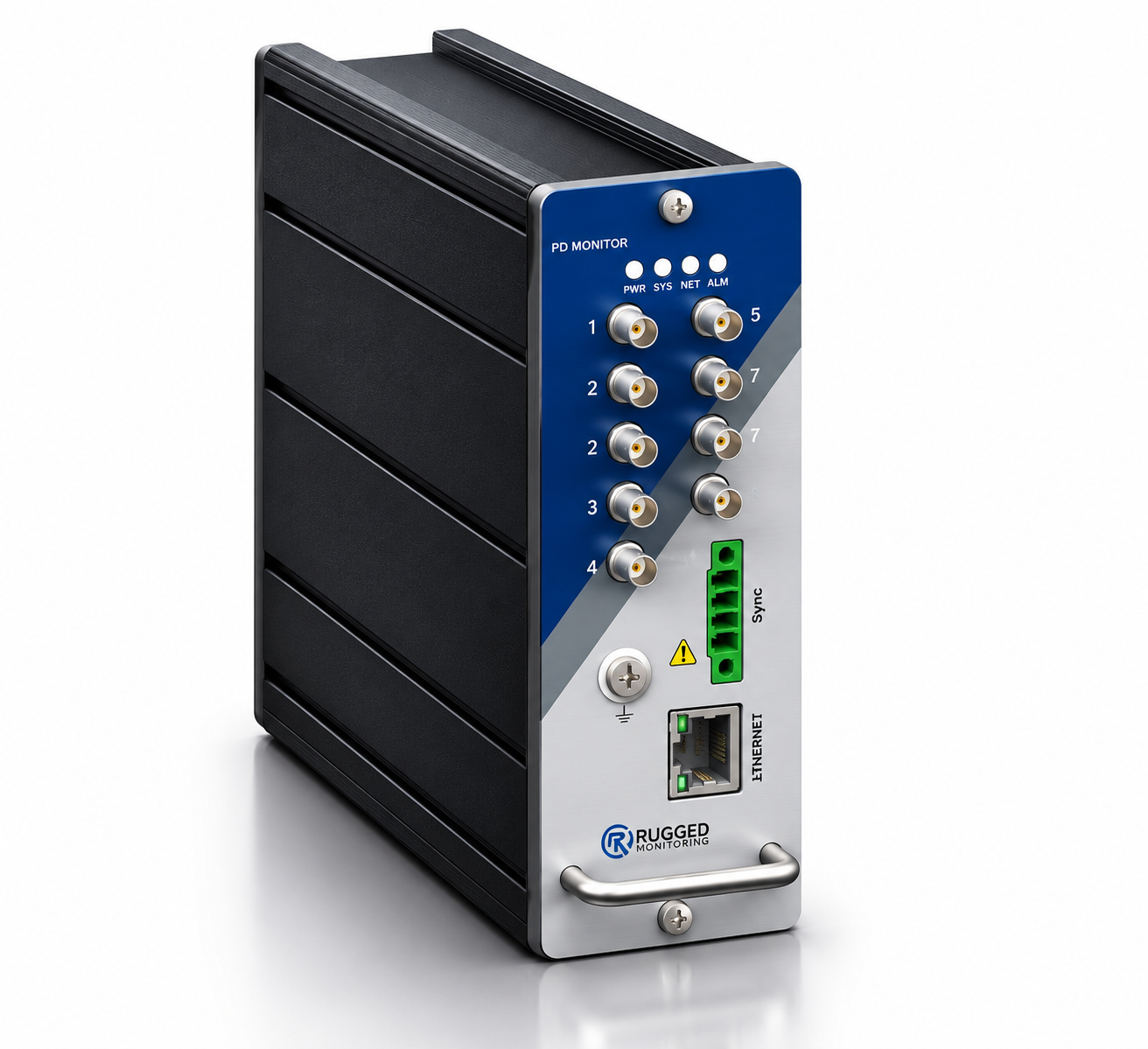
PD211 ultra-high-frequency PD monitor module

PD211

Ultra-high-frequency (UHF) PD monitor

  • 300 to 2000 MHz
  • 4 or 8, simultaneous channels
  • 4 selectable UHF band-pass filters
  • Works with any UHF sensor in the 300 to 2000 MHz band
View PD211

What you can monitor

Five asset types, one PD monitoring approach.

  • Transformers

    Power, dry-type and distribution

  • Switchgear

    GIS, AIS and MV panels

  • Circuit breakers

  • Power cables

  • Rotating machines

See PD monitoring in action

Contact our team and we'll show you how PD201 and PD211 pick up partial discharge, how live trends and alerts appear in RM EYE, and which setup suits your assets.

Choosing a system

What should you look for in an online PD monitoring system?

Use these points when comparing any system, ours included.

  1. Simultaneous channels.

    Multiplexed systems switch between sensors, so they can miss a pulse. Both our monitors, PD201 & PD211, are multi-channel monitors that capture signals across 4 or 8 channels at the same time.

    • 4 CH
    • 8 CH
    • NO MUX
  2. The right frequency range for the asset.

    Different types of PD sensors built for different asset needs. HFCT for cables. HF for transformers and rotating machines. UHF for GIS and transformers. PD201 covers 0.01 to 50 MHz, and PD211 covers 300 to 2000 MHz.

    • 0.01–50 MHz
    • 300–2000 MHz
  3. Noise rejection.

    Substations are electrically noisy. Look for selectable band-pass filters and software noise gating, not just a threshold. PD201 has user-selectable filters from 5 to 50 MHz plus software noise gating. PD211 has four selectable UHF band-pass filters.

  4. Phase synchronisation.

    You need PD pulses mapped against the AC cycle to tell defect types apart. Both monitors have LV and HV sync inputs.

    • LV SYNC
    • HV SYNC
  5. Local data storage.

    If the network drops, you shouldn't lose data. Both units have SSD storage, 64 GB as standard and up to 1 TB.

    • 64 GB
    • 1 TB
  6. Open protocols.

    The data should go into your SCADA or asset system without a gateway project. Both support IEC 61850, Modbus TCP/IP, DNP3 and MQTT, plus RS-485 Modbus RTU.

  7. Sensor freedom.

    Check whether you're locked into one brand of sensor. PD201 works with any HF PD sensor, including bushing adaptors, HFCTs, capacitive couplers and acoustic sensors. PD211 works with any UHF sensor in the 300 to 2000 MHz band.

    • BUSHING
    • HFCT
    • COUPLER
    • ACOUSTIC
    • UHF
  8. Fail-safe alarms.

    Both have a built-in fail-safe relay, so a monitor fault is flagged and doesn't go silent.

    • FAIL-SAFE RELAY
Comparing suppliers

Looking at PD monitoring suppliers? Here's what to compare

Most suppliers will show you a good-looking dashboard. Ask them these questions instead:

  1. Q1

    Do all channels capture at the same time, or do they switch between sensors?

  2. Q2

    Which sensors can I use, and am I locked into yours?

  3. Q3

    What happens to my data if the network goes down?

  4. Q4

    Which protocols come as standard, and which cost extra?

  5. Q5

    Can the same platform also handle transformer, bushing, and temperature monitoring, or is PD a separate system?

RM EYE

With us, PD feeds into RM EYE alongside transformer, bushing, DGA, and temperature data, so your team works in one platform and not five.

Contact our team
  • PD
  • Transformer
  • Bushing
  • DGA
  • Temperature
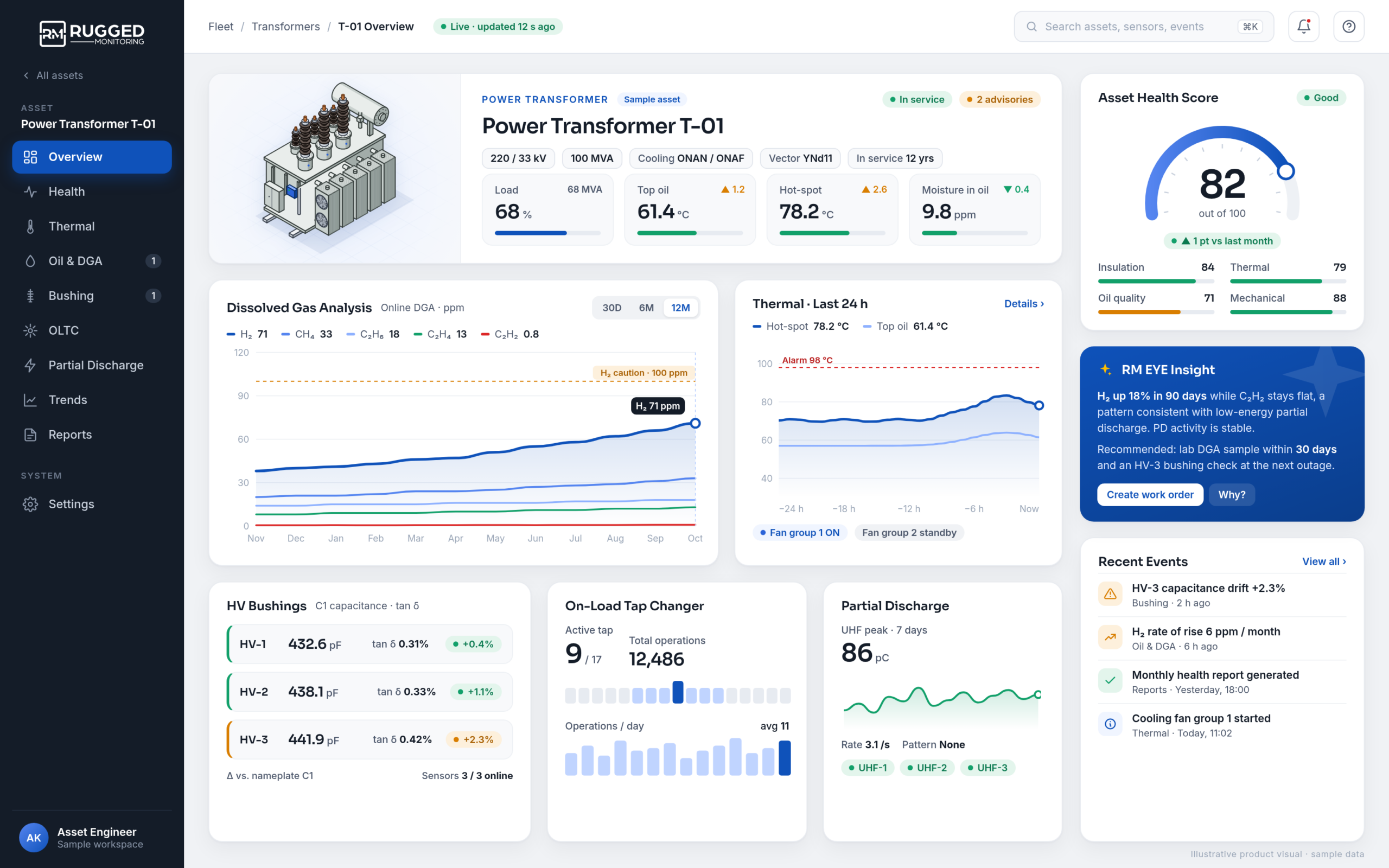
RM EYE dashboard with transformer overview, dissolved gas analysis, thermal and partial discharge panels (sample data)
FAQ

Questions buyers ask us

They do different jobs. Periodic testing gives a detailed snapshot. Online monitoring catches defects that start between tests and shows you the trend, so you know whether a problem is getting worse.

Book a demo

Book a PD monitoring demo

Tell us about your assets and we'll set up a guided demo of PD201, PD211 and RM EYE, shaped around them. A PD engineer runs it, not a call centre.

  • PD201 and PD211 walkthrough
  • Live PD trends in RM EYE
  • The right setup for your assets

Request your demo

All fields required unless marked


    captcha

    Thanks, your demo request is in.

    A PD engineer will be in touch to arrange a demo shaped around your assets.