Turn asset condition into an investment strategy that engineering can defend, finance can understand, and leadership can act on.
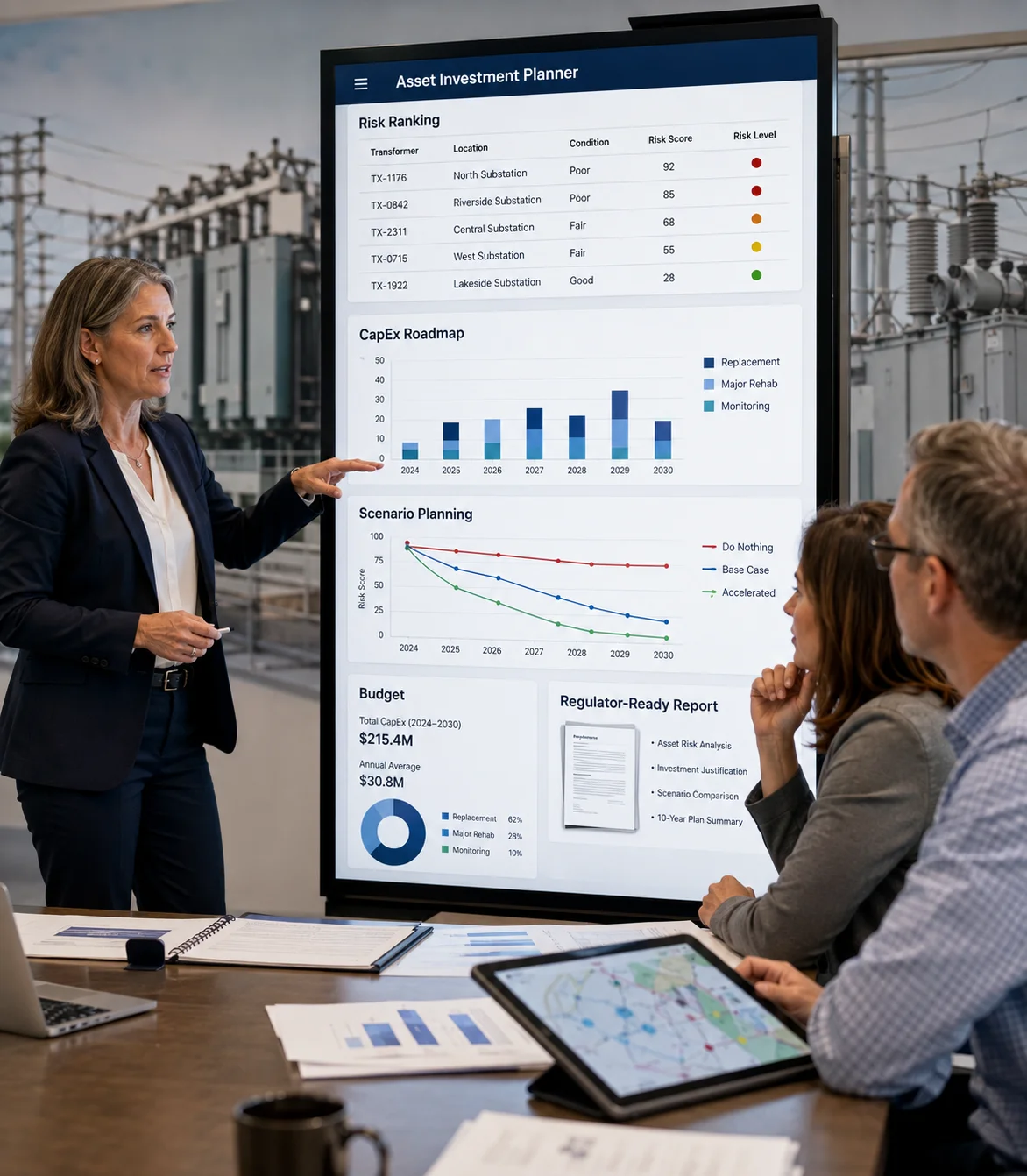
AIP is AI-powered decision analytics that turn asset condition and risk data into a prioritized, explainable, multi-year investment plan, powered directly by RM EYE’s Digital Twin’s Health Index, RUL, and failure-probability outputs.
Which assets should we fund, when, and why?” Every asset owner faces it, usually armed with a spreadsheet, a gut feeling, and a room full of people who disagree.
Every recommendation is grounded in the actual condition and monetized risk of the fleet, not age assumptions, departmental requests, or manual prioritization.
AIP connects fleet condition, health index, probability of failure, consequence of failure, intervention cost, and practical delivery constraints to build a prioritized, multi-year investment strategy.
See the true investment need.
Bring proposed interventions across assets, sites, and regions into one costed portfolio.
Put financial language around asset risk.
Monetize probability and consequence so you can evaluate fundamentally different assets and interventions on a comparable basis.
Optimize the portfolio, not isolated projects.
Find the combination of investments that creates the greatest risk reduction within available capital.
Build real-world constraints into the plan.
Account for budgets, resources, delivery capacity, lead times, and project dependencies before the plan reaches execution.
Change the budget. Rebuild the answer.
Compare funding scenarios and understand how more, or less, capital changes portfolio risk and outcomes.
See the price of waiting.
Quantify the additional risk, cost, and exposure created when an intervention moves into a later year.
Keep unfunded risk visible.
Know what the organization has chosen not to fund, and the risk it continues to carry.
Close the investment loop.
Compare actual cost and risk reduction against the assumptions used when the project was approved.