Rugged Monitoring's
The process of continuously measuring and analyzing the temperature behavior of any critical asset to detect emerging thermal failures is known as thermal monitoring. Traditionally, sensors such as thermocouples, resistance temperature detectors (RTDs), or thermistors were utilized to monitor thermal behavior. But these sensors relied heavily on manual interventions, which limited asset operators’ visibility of real-time fluctuations.
Thus, a modern approach to electrical asset thermal monitoring is to use infrared (IR) Cameras, which are quickly being adopted across utilities, OEMs, and other mission-critical industries.
In industrial and utility environments, thermal anomalies are among the leading causes of electrical asset failures. They are also often reliable indicators of cascading issues, such as partial discharge, loose connections, or other stressors.
Bushings are engineered to handle high voltages and currents while preventing dielectric breakdown between the conductor and the transformer casing. They create a secure and insulated pathway for electrical connections, protecting the transformer from electrical stress and insulation failure.Â
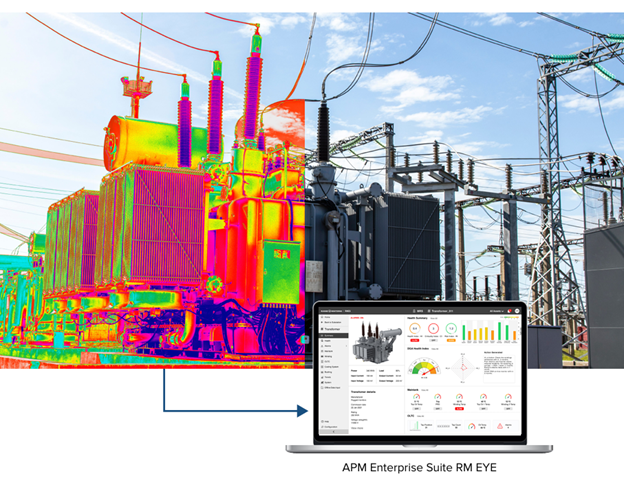
Traditional monitoring methods only identify issues after failure. But electrical asset thermal monitoring with IR Cameras detects heat emitted by energized components and converts it into visual thermographic images. When integrated with asset performance management (APM) systems, thermal monitoring systems using IR Cameras empower operators with:
Â
Parameter | Fiber-Optic Temperature Sensing | IR Camera Monitoring |
Measurement Type | Direct contact point / distributed measurement | Non-contact thermal imaging |
Accuracy | Very high (immune to EMI) | Moderate to high, depending on optics. |
Use Case | Internal components, transformers, cables, windings | Surface-level monitoring of exposed equipment. |
Environmental Sensitivity | Not affected by dust, humidity, or line-of-sight | Performance depends on visibility and camera positioning. |
Scalability | Ideal for multiple distributed hotspots | Suitable for large, exposed areas like an electrical grid. |
Predictive Analytics | Highly effective for critical assets | Useful for continuous visualization and trending. |
Maintenance Effort | Minimal | Minimal |
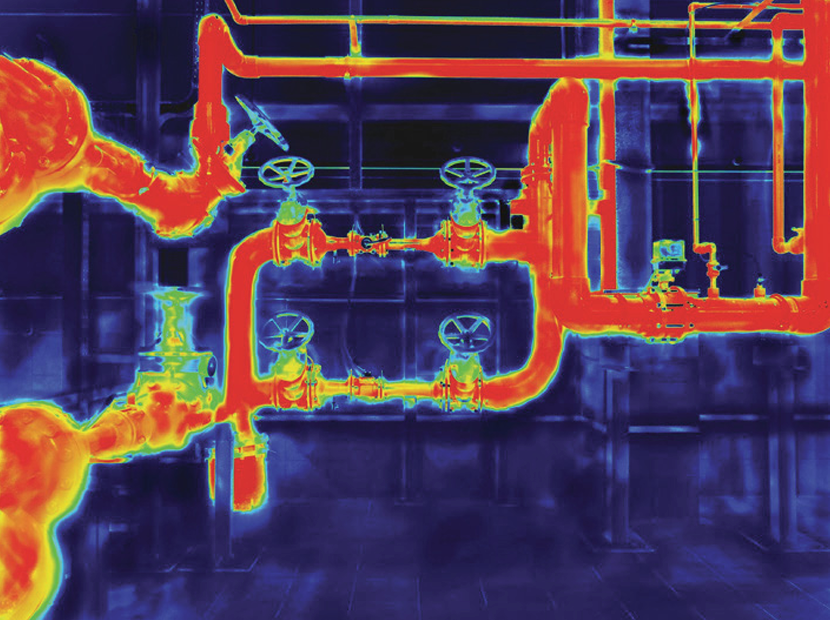
A thermal monitoring ecosystem often uses both fiber optic sensing technology and IR cameras for complete thermal digitalization.
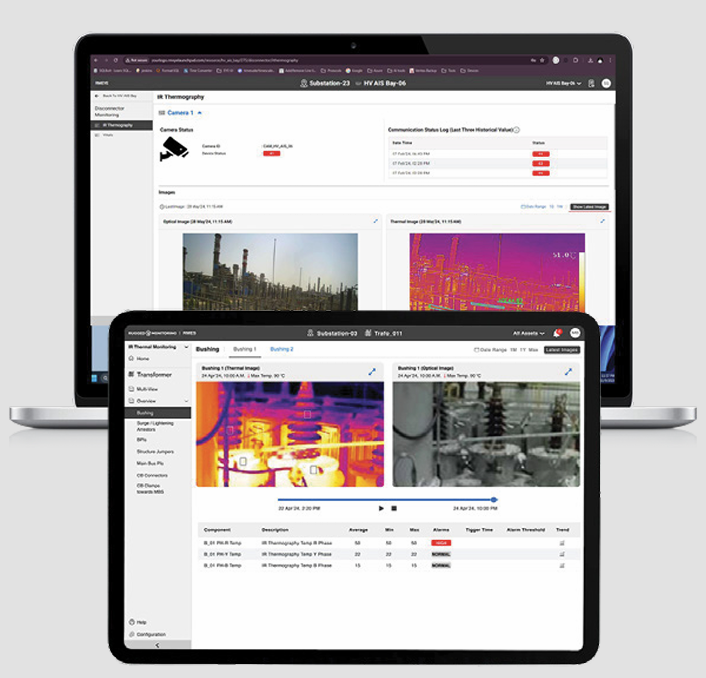
Rugged Monitoring’s Thermal Monitoring Solution enables operators to detect temperature-driven degradation with precision and continuity, replacing periodic thermographic inspections with an automated, real-time monitoring framework.
Using IR thermal imaging integrated into RM EYE, our system captures surface temperature patterns across critical transformer components, including bushings, terminations, tank surfaces, radiators, and connection points.
With continuous thermal monitoring, utilities and industries can reduce dependence on manual inspections, enhance situational awareness, and transition from time-based activity to condition-driven intervention, improving uptime and supporting long-term transformer reliability strategies.
Yes, IR cameras, when used with APM systems, provide thermal analytics based on AI/ML algorithms.
IR cameras update data in milliseconds, ensuring quick and precise data-driven insights.
By identifying thermal hotspots early on, thermal monitoring can predict and prevent issues before they occur.
Using APM, operators can identify trends and patterns in thermal behavior that predict failure probability, enabling the transition from proactive to predictive maintenance.
Have questions or need more information? Reach out to us for reliable Rugged Monitoring solutions.