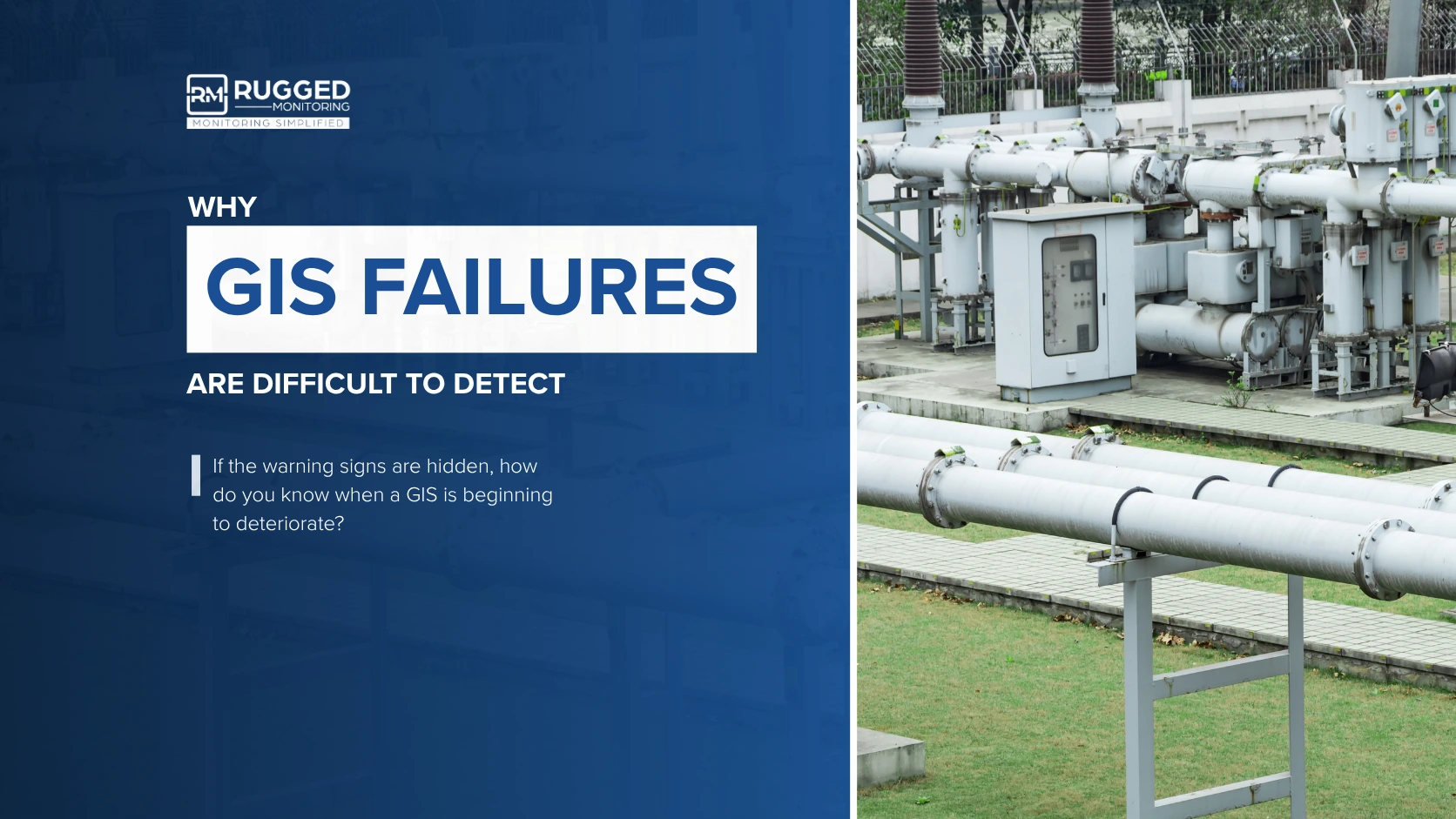
Gas insulated switchgear (GIS) is a critical part of modern power systems. In substations with limited space, engineers and utilities often prefer GIS because of its compact and enclosed design.
But even highly reliable equipment can develop problems over time. Insulation defects, partial discharge, gas leakage, moisture ingress, overheating, and mechanical deterioration can occur while the GIS continues to operate normally. Because these changes happen within sealed enclosures, detecting them at an early stage is not always straightforward.
As faults can develop inside sealed compartments without visible warning signs, gas insulated switchgear monitoring plays a vital role in helping utilities track asset condition and identify developing issues early.
So how do you know when GIS is beginning to deteriorate if hidden warning signs remain undetected?
What Can Cause Failures in Gas Insulated Switchgear?
Gas Insulated Switchgear (GIS) is highly reliable due to its compact, enclosed design. However, like any high-voltage electrical asset, GIS is exposed to electrical, thermal, mechanical, and environmental stresses over time. These stresses can contribute to insulation degradation, gas-related issues, and mechanical deterioration. The challenge is that many of these changes begin gradually and may be difficult to detect at an early stage.
Some common challenges that one can observe over time are as follows:
- Insulation defects and partial discharge: Voids, contamination, free-moving particles, or protrusions can create electrical stress and initiate partial discharge (PD). Persistent PD activity can gradually deteriorate insulation and increase the risk of dielectric breakdown.
- SF₆ gas leakage: In conventional SF₆-insulated GIS, the insulating gas plays an important role in maintaining dielectric performance. SF₆ leakage can reduce gas density, and if density falls below design limits, dielectric performance may be compromised.
- Moisture ingress: Moisture can enter GIS compartments through leaks, ageing seals, or during installation and maintenance activities. Excess moisture can reduce the strength of the insulating environment. The electrical asset is subjected to additional electrical stress, which can contribute to partial discharge activity over time and increase the risk of insulation deterioration and failure.
- Loose electrical connections can increase the resistance to many factors. It can aid in heating, placing additional thermal stress on contacts and insulation.
- Mechanical deterioration: Electrical assets like switchgears are prone to wear and tear, misalignment and operating mechanism problems. It can contribute to affecting the performance of circuit breakers and disconnectors.
The above conditions do not necessarily result in immediate equipment failure. GIS continues to function normally; however, the faults deteriorate the asset internally. And this is where the electrical asset starts to decline in health.
Why Are GIS Failures Difficult to Detect?
The causes of GIS failures may vary, but early detection often makes the difference between a developing fault and a major failure. Several components are enclosed and protected from the external conditions. This means that the teams have limited access to know what is happening inside.
A developing fault may not immediately produce an alarm or interrupt operation. Partial discharge can begin at relatively low levels, a connection can gradually heat up, and gas or moisture conditions can change over time. From the outside, the equipment may still appear to be operating normally.
There is also another complication: not every abnormality develops at the same rate. Some conditions may remain stable for a long period, while others can deteriorate more quickly under electrical, thermal, or mechanical stress.
Individual measurements can also require context. An increase in temperature, for example, could be related to loading or a deteriorating connection. Changes in gas pressure need to be considered alongside temperature and operating conditions.
The real challenge, therefore, is not simply finding a fault after it has developed. It is recognizing the small changes that indicate where the equipment condition may be heading.
How traditional maintenance techniques are not enough?
Traditional Maintenance has always been central to GIS reliability. Scheduled inspections, SF₆ gas checks, functional tests, mechanical inspections, and offline diagnostic testing help maintenance teams assess equipment condition and identify abnormalities.
But the difficulty is knowing when that right time is.
Traditional preventive maintenance is generally performed according to predetermined intervals. A GIS may be inspected and found to be operating normally, but its condition can change before the next scheduled maintenance activity.
More detailed diagnostic tests may provide additional information, but depending on the test and installation, they can require planned outages, specialized personnel, and additional maintenance resources.
This does not make traditional maintenance ineffective. Rather, it highlights an important limitation: periodic maintenance tells you what the condition of an asset is when you inspect it, but not necessarily how that condition is changing between inspections.
To identify deterioration earlier, maintenance teams need greater visibility into the condition of GIS while it is operating.
How Does Predictive Maintenance Support Better Maintenance Decisions?
To identify developing faults earlier, maintenance teams need visibility into asset condition while the GIS is operating. Predictive maintenance supports this visibility by tracking condition indicators associated with insulation degradation, gas leakage, moisture ingress, overheating, and mechanical deterioration.
The key is to look for the effects of deterioration rather than waiting for the eventual failure.
For example, insulation deterioration can produce changes in partial discharge activity. A developing SF₆ leak can be reflected in gas density or pressure trends. Deteriorating electrical connections can result in abnormal temperature patterns, while mechanical wear can lead to changes in operating characteristics.
This creates a direct relationship between the developing condition and what maintenance teams can observe:
- Insulation deterioration → Partial discharge activity
- Gas leakage → Changes in SF₆ gas conditions
- Moisture ingress → Changes in moisture levels
- Deteriorating connections → Abnormal temperature patterns
- Mechanical deterioration → Changes in operating characteristics
Monitoring these conditions gives timely insight. But detecting an abnormal condition is merely the first step. The greater value lies in understanding how those conditions change over time.
How Does Predictive Maintenance Improve GIS Monitoring?
By turning monitoring data into actionable insights, it helps maintenance teams identify developing issues earlier and make more informed maintenance decisions.
Some of the key advantages include:
- Earlier fault detection: Identify developing issues before they become critical.
- Reduced risk of unplanned outages: Enable proactive intervention before failures occur.
- More effective maintenance planning: Schedule maintenance based on asset condition rather than fixed intervals.
- Better use of maintenance resources: Prioritize attention where it is needed most.
- Lower maintenance and repair costs: Address issues before they escalate into major failures.
- Longer asset life: Support the long-term health of critical GIS assets.
- Improved reliability and availability: Maintain more consistent and dependable system performance.
In other words, predictive maintenance helps answer an important question: not just what the condition of the GIS is today, but where that condition may be heading.
How Does Rugged Monitoring Support Predictive GIS Maintenance?
Understanding how equipment condition changes over time requires more than periodic inspections. Maintenance teams need continuous visibility into the indicators that reveal developing faults.
This is where Rugged Monitoring helps. By monitoring key GIS condition parameters, Rugged Monitoring enables utilities to identify emerging issues earlier, make more informed maintenance decisions, and take a more proactive approach to asset reliability.
To know more about Rugged Monitoring book a demo or contact us.
FAQs:
-
Why are GIS failures harder to detect than failures in air-insulated switchgear?
Gas Insulated Switchgear (GIS) failures are difficult to detect. Live components are enclosed within grounded metal compartments filled with insulating gas.Unlike air-insulated switchgear (AIS), where defects cause visible flashes, audible buzzing, or open-air degradation. GIS hides internal insulation breakdowns, micro-leaks, and partial discharge until a major fault occurs.
-
What makes partial discharge difficult to identify inside GIS equipment?
Partial discharge (PD) inside Gas Insulated Switchgear (GIS) is difficult to identify because it develops within sealed, metal-enclosed compartments filled with Sulfur hexafluoride (SF₆) gas or alternative insulating gases. The enclosed design of GIS limits the ability to visually identify internal defects during routine inspections. The GIS components are inaccessible without de–energizing and opening the equipment. Moreover, early-stage PD produces weak electrical, electromagnetic, acoustic, or ultrasonic signals that are not visible to the naked eye, making manual inspection ineffective. As a result, specialized condition monitoring technologies are often required to detect PD before it develops into a more serious insulation failure.
-
Can GIS faults be detected without taking the equipment offline?
Yes, faults in Gas-Insulated Switchgear can be detected without taking the equipment offline. Utilities achieve this by employing continuous online condition monitoring systems, which use sensors for partial discharge detection, acoustic emission monitoring, and real-time SF₆ gas density measurement. These monitoring technologies allow for assessment of the internal condition of GIS assets while they remain fully energized.
-
What are the earliest warning signs of a developing GIS failure?
The earliest warning signs of a developing Gas Insulated Switchgear failure are the partial discharge (PD) activity inside the sealed metal enclosure. Other early indicators include SF₆ gas leaks or moisture ingress, and abnormal mechanical or thermal signatures.
-
How does continuous monitoring improve early fault detection in GIS?
Continuous monitoring in Gas-Insulated Switchgear (GIS) helps track real-time parameters like partial discharge, gas density, and temperature conditions. This visibility exposes hidden internal defects before any catastrophic failures, transforming reactive repairs into scheduled, condition-based maintenance.