Generators rarely fail without warning. Small changes in vibration, temperature, or operating behavior often appear first. But these early signs can be hard to spot in large volumes of data.
Generator condition monitoring uses operating and condition data to assess generator health and identify developing abnormalities. Artificial Intelligence (AI) and Machine Learning (ML) can analyze measurements such as vibration, temperature, and operating trends. This supports fault detection, predictive maintenance, and making more informed maintenance decisions.
This article explores how AI and ML contribute to generator monitoring through predictive analytics, real-time data interpretation, and performance assessment.
Why Generator Monitoring Needs More Than Thresholds
Traditional monitoring often relies on fixed alarm limits. The temperature crosses a set value, and an alarm is raised. This approach is simple and useful. But it has its limitations.
A fixed threshold does not account for how a generator is operating. A winding temperature that is normal at full load may be unusual at partial load. A slow rise in bearing vibration may stay below the alarm limit for months while the underlying problem develops.
Generators also produce a lot of data. Stator winding temperatures, bearing temperatures, vibration, partial discharge (PD) activity, load, and ambient conditions can all be recorded continuously. Reviewing every trend manually is difficult, especially across several machines and sites.
This is where AI and ML can help. They do not replace engineering judgement. Instead, they help teams find meaningful changes in the data sooner and focus attention where it is needed.
What Parameters Are Monitored in Generators?
AI and ML are only as useful as the data they analyze. Common generator monitoring inputs include:
- Stator winding temperature: Helps identify overheating linked to loading, cooling problems, or insulation stress.
- Bearing temperature and vibration: Helps reveal misalignment, imbalance, looseness, or bearing wear.
- Partial discharge: Provides information about the condition of stator winding insulation.
- Electrical parameters: Current, voltage, and load help explain how operating conditions affect other measurements.
- Cooling and ambient conditions: Cooling performance and ambient temperature add context to thermal readings.
The exact set depends on the generator type, its criticality, and the monitoring strategy. Combining several parameters usually gives a more complete picture than any single measurement.
Leveraging AI for Predictive Analysis
Predictive analysis uses historical and real-time data to identify patterns that may indicate a developing problem. AI algorithms learn what normal behavior looks like for a specific generator under different operating conditions. They can then flag deviations from that baseline.
For example, an AI model may learn the expected relationship between load, cooling conditions, and winding temperature. If the temperature rises more than expected for the current load, the model can highlight it, even if no fixed alarm limit has been reached.
This approach helps teams:
- Identify developing faults earlier than threshold alarms alone
- Separate normal operating changes from abnormal behavior
- Prioritize which machines or components need investigation
- Plan maintenance before a problem leads to an unplanned outage
Predictive analysis does not give a guaranteed failure date. It provides early indicators and likelihoods that support maintenance planning. Findings should still be confirmed through inspection, testing, or further diagnostics where needed.
AI can also help teams understand how one condition affects others. For example, a cooling problem may raise winding temperatures, which can accelerate insulation ageing. Looking at related parameters together gives a clearer view of the underlying cause.
ML Algorithms for Fine-Tuned Performance
Machine learning is a subset of AI. ML algorithms learn from data patterns and make predictions without being explicitly programmed for each scenario.
In generator monitoring, ML can analyze large volumes of sensor data and identify patterns that may be difficult to detect manually. Several approaches are commonly used:
- Anomaly detection: Identifies measurements that differ from the generator’s normal behavior.
- Classification: Groups patterns that may be associated with known fault types, such as bearing defects or insulation deterioration.
- Trend and regression models: Estimate how a parameter is likely to change over time.
- Pattern recognition: Helps interpret complex signals such as partial discharge or vibration data.
ML models can improve as they receive more data. As a model sees more operating cycles, seasonal changes, and maintenance events, it can produce more reliable baselines and fewer false alarms.
This is particularly useful for predictive maintenance. By tracking parameters such as vibration, temperature, and partial discharge over time, it can help estimate when a component may need attention. Teams can then schedule work during planned outages instead of reacting to failures.
Machine Learning can also support performance assessment. By comparing actual behavior with expected behavior, it can show whether a generator is running hotter, vibrating more, or behaving differently than similar machines under similar conditions. These insights support operating and maintenance decisions. They do not directly control the generator.
Real-Time Data Analysis and Reporting
Predictive analysis looks ahead. Real-time analysis focuses on the generator’s current condition.
Online monitoring systems continuously collect data from sensors installed on the generator. AI and ML can process this data as it arrives, helping teams identify sudden changes, unusual trends, or abnormal combinations of measurements.
Real-time analysis helps teams:
- Detect fluctuations quickly: Sudden changes in temperature, vibration, or PD activity can be flagged as they occur.
- Reduce alarm noise: Context-aware analysis can help separate significant events from normal operating variation.
- Pinpoint where attention is needed: Teams can see which component or parameter is changing, rather than reviewing every data stream.
Reporting has also changed. Instead of relying only on periodic reports, teams can view continuously updated dashboards and trends. Reports can show how condition has changed over time, which alarms have occurred, and which assets may need investigation.
This makes it easier to share information between operations, maintenance, and asset management teams. It also creates a record of condition history that supports future maintenance decisions.
Turning Insights into Maintenance Decisions
AI and ML outputs are most useful when they lead to clear actions. A detected anomaly should prompt a structured response, not just another alarm.
A practical workflow may include:
- Detect: The system identifies an abnormal trend or deviation.
- Assess: Engineers review the data alongside operating history, loading, and other parameters.
- Prioritize: The condition is ranked based on severity, rate of change, and the generator’s criticality.
- Act: Teams decide whether to keep monitoring, inspect, test, repair, or plan replacement.
AI supports each step by organizing data and highlighting what matters. Engineering expertise remains essential for interpreting results and deciding on the right response.
Data Security and Compliance
Generator monitoring systems collect operational data, so that data needs to be protected. Role-based access controls, secure communication, and appropriate network design help keep monitoring data available only to authorized users.
Trended condition data and maintenance records can also support internal reporting and regulatory documentation. These are supporting considerations, but they should be part of any monitoring system design.
Cost Efficiency and Sustainability
Earlier fault detection supports planned maintenance instead of emergency intervention. This can help reduce unplanned downtime, emergency repair costs, and secondary damage to connected equipment.
Condition-based maintenance can also help teams use resources more effectively. Instead of servicing every machine at fixed intervals, teams can focus attention on generators that show signs of deterioration.
Keeping generators in good condition can also support efficient operation and longer asset life. Over time, this contributes to more sustainable asset management by reducing avoidable failures and unnecessary component replacement.
Challenges to Consider
AI and ML bring clear benefits, but successful use depends on a few practical factors:
- Data quality: Models need accurate, consistent sensor data. Poor sensor placement or gaps in data reduce reliability.
- Baseline period: Models need time to learn normal behavior across different operating conditions.
- Context: Maintenance history, operating changes, and known events help models avoid misleading results.
- Expert review: AI outputs should support, not replace, engineering judgement.
Addressing these factors early helps teams build confidence in AI-driven insights.
Where Rugged Monitoring Fits
Rugged Monitoring provides condition monitoring for rotating machines, including generators. Its solutions track parameters such as temperature, vibration, and electrical stress to support predictive maintenance.
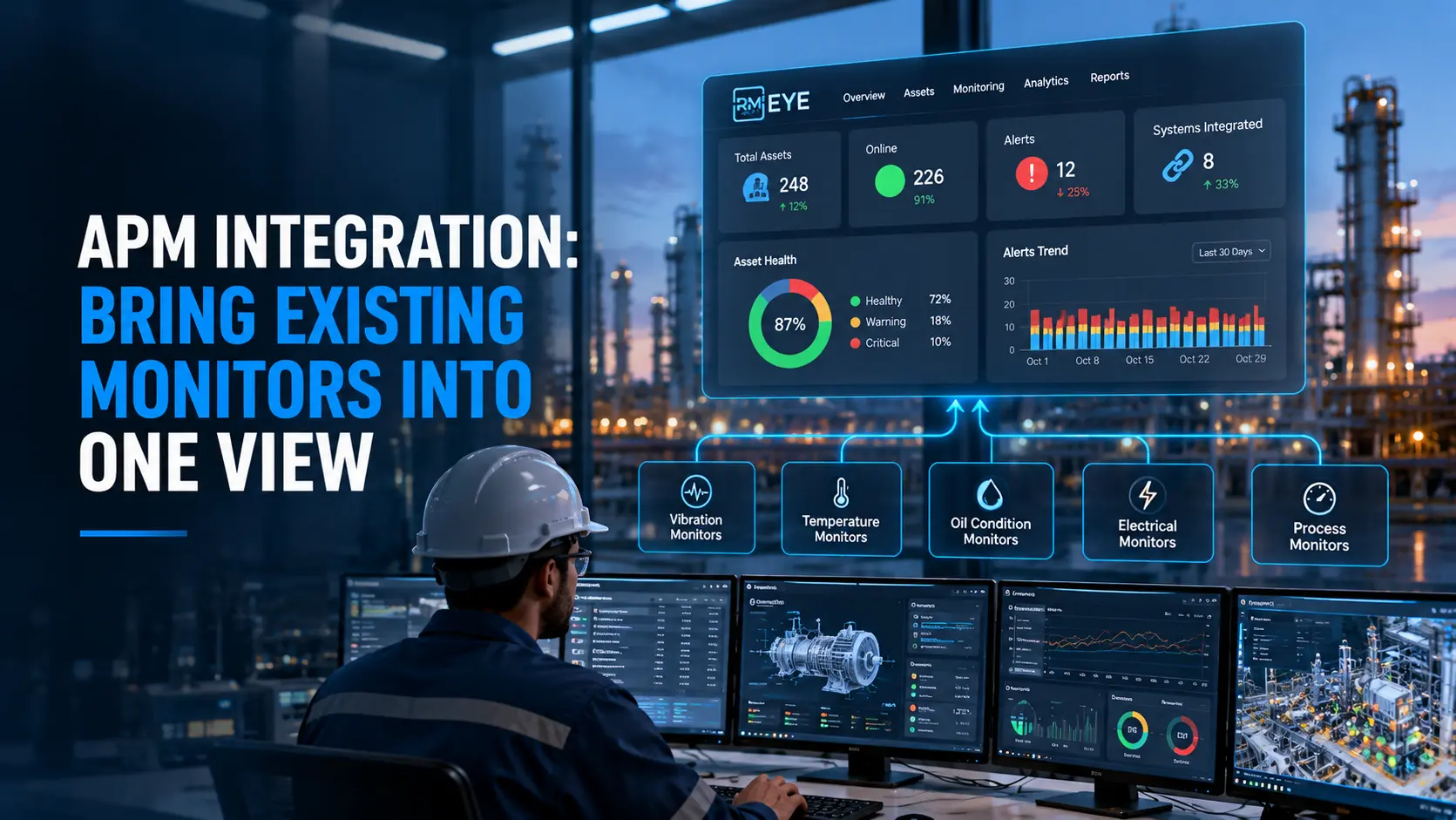
Data from IIoT sensors and edge devices can be brought into RM EYE, Rugged Monitoring’s asset performance management platform. RM EYE uses AI-ML algorithms to interpret real-time data, monitor asset behavior, and help teams identify anomalies, assess risk, and prioritize actions.
Conclusion
AI and ML help turn generator monitoring data into earlier, clearer insights. They can identify abnormal behavior, track trends, and support predictive maintenance decisions.
Used alongside sound monitoring practices and engineering expertise, they help teams move from reacting to failures toward planned, condition-based maintenance.
Ready to bring AI-driven insights into your generator monitoring? Talk to our team.
Frequently Asked Questions
How does AI help with generator condition monitoring?
AI analyzes operating and condition data to learn normal generator behavior. It can then make flag deviations, such as unusual temperature rises or changing vibration patterns, that may indicate a developing fault. This helps teams investigate earlier and plan maintenance more effectively.
What is the difference between AI and ML in generator monitoring?
AI is the broader field of systems that perform tasks such as pattern recognition and decision support. ML is a subset of AI that learns from data. In generator monitoring, ML models learn from historical and real-time measurements to detect anomalies, recognize patterns, and estimate trends.
Which generator parameters can AI and ML analyze?
Common inputs include stator winding temperature, bearing temperature, vibration, partial discharge activity, electrical parameters such as current and load, and cooling or ambient conditions. The exact parameters depend on the generator and the monitoring strategy.
Can AI predict exactly when a generator will fail?
No. AI cannot give a guaranteed failure date. It provides early indicators, trends, and likelihoods that help teams decide when an asset needs attention. Findings should be confirmed through inspection, testing, or further diagnostics.
Does AI replace engineers in generator maintenance?
No. AI helps organize data and highlight meaningful changes. Engineers still interpret the results, consider operating context, and decide on the right maintenance action.
How does AI-based monitoring support predictive maintenance?
By tracking condition trends over time, AI and ML help identify deterioration before it leads to failure. This allows maintenance to be scheduled during planned outages rather than after an unexpected breakdown