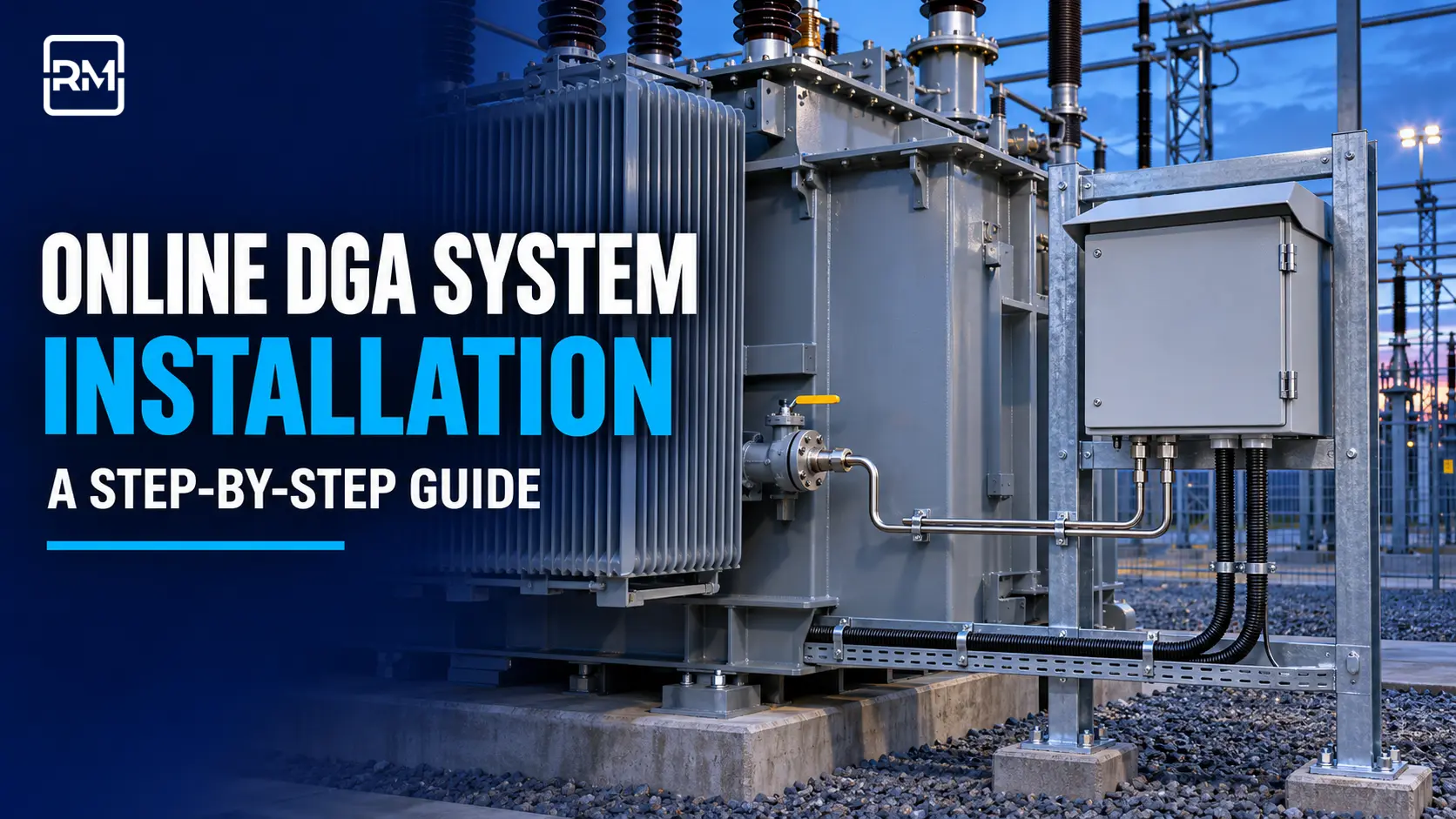
An online DGA system measures gases dissolved in transformer oil while the transformer remains in service. Installing one involves selecting a representative oil connection, mounting the analyser, connecting power and communications, and commissioning it against reference DGA data.
Each step matters because the installation determines whether the measurements provide a reliable picture of changing transformer condition.
What does an online DGA system installation involve?
An online DGA installation creates a measurement path between the transformer oil and the monitoring system.
The analyser is connected to a suitable oil point so that dissolved-gas measurements can be taken while the transformer remains in service. Power and communication connections then allow those measurements and system information to reach the required monitoring or control system.
Once the physical installation is complete, the analyser is commissioned and its initial readings are checked against available reference information. Those first verified measurements become the starting point for future trend analysis.
So, before selecting fittings or running cables, the first task is to understand what the installation requires.
What should you check before installing an online DGA system?
A pre-installation survey brings the transformer, analyser, and site requirements together before work begins.
| Particulars | What to check |
| Oil connection | Suitable transformer oil connection and compatible installation arrangement |
| Insulating fluid | Type of transformer insulating liquid |
| Operating conditions | Expected oil and ambient temperature conditions |
| Power supply | Required power available at the installation location |
| Communications | Required data, alarm, and communication interfaces |
| Cable route | Suitable routing, cable entries and sealing |
| Site requirements | Required permits, access, isolation, or outage arrangements |
| Laboratory DGA | Recent oil analysis results available for commissioning |
| Mounting | Suitable space, mechanical support, and maintenance access |
The checks answer two different questions: can the analyser be installed here, and can it provide useful data once it is installed?
The second question becomes particularly important when deciding where the analyzer should connect to the transformer oil.
Why does the transformer oil connection matter?
The analyser needs oil that represents conditions within the transformer main tank. This makes the selection of the oil connection an important part of installation.
If the analyser is connected to a section where oil remains relatively stagnant, the measured oil may not represent changing conditions in the main tank. Such arrangements are commonly referred to as dead legs.
A convenient transformer oil valve is therefore not automatically a suitable measurement point. Engineers also need to consider the oil path, available space, mechanical support, and maintenance access which influence the final mounting arrangement. CIGRE Technical Brochure 783 provides broader guidance on the application of DGA monitoring systems.
Once the oil point and other site requirements are confirmed, the physical installation can proceed.
How is an online DGA system installed step by step?
Once the mounting point and installation requirements are confirmed, the work can proceed in a controlled sequence.
- Prepare the site. Confirm permits, access, safety requirements, and any required isolation.
- Inspect the oil connection. Check that the selected point is suitable and in appropriate condition.
- Mount the analyser. Install the unit securely with suitable mechanical support and access.
- Establish the oil connection. Connect the analyser using the approved installation arrangement.
- Prepare the oil path. Ensure the connection is correctly filled and remove trapped air where required.
- Connect power and communications. Complete the required electrical, alarm, and data connections.
- Inspect the installation. Check the oil path, mounting, cable entries, and electrical connections.
- Start the analyser. Confirm that the system powers up and communicates with the required monitoring system.
These are general installation stages rather than universal mechanical instructions. Valve arrangements, fittings, wiring, and startup procedures vary between transformers and analysers and should follow the applicable manufacturer and site documentation.
What happens during DGA commissioning?
DGA commissioning connects the physical installation to the condition data that engineers will eventually use.
Where practical, initial online readings should be compared with laboratory analysis from an oil sample collected close to commissioning. IEC 60567:2023 provides guidance for sampling and analysing gases in insulating liquids.
Once the initial readings have been checked, they can establish the DGA baseline readings against which later measurements are compared.
The measurement process then becomes:
Measurement → Baseline → Trend → Interpretation → Decision
As measurements build over time, DGA interpretation helps engineers assess gas patterns and trends in the context of the transformer’s operating history and condition.
Alarm settings form part of this process. They should reflect the transformer, previous DGA results, operating history, and applicable guidance rather than simply being left at generic defaults.
For mineral-oil-filled transformers, IEC 60599:2022 and IEEE C57.104-2019 provide relevant interpretation guidance.
What installation mistakes can affect DGA measurements?
The installation sequence also explains why seemingly small mistakes can affect later measurements.
| Installation issue | Why it matters |
| Unsuitable oil connection | Oil may not represent main-tank conditions |
| Trapped air | Can affect the intended measurement arrangement |
| No recent laboratory reference | Makes initial readings harder to verify |
| Unreviewed alarm settings | Alarms may not reflect transformer condition |
| Poor sealing | Can affect equipment reliability in the site environment |
This is why installation, commissioning, and interpretation should not be treated as separate activities. The quality of the trend starts with the quality of the installation.
Where does an online DGA system fit into transformer condition monitoring?
Once commissioned, an online DGA system provides gas-trend information between periodic laboratory samples.
Online and laboratory DGA complement each other. Laboratory analysis provides reference and diagnostic information from collected oil samples, while online systems show how selected gas measurements change between samples. This difference between online and offline DGA becomes important when deciding how each source of data contributes to transformer condition assessment.
Rugged Monitoring provides DGA monitoring solutions for new and retrofit transformer applications.
The monitor itself, however, is only one part of the measurement chain. Representative oil, suitable installation, reliable commissioning data, and an established baseline are what turn individual measurements into useful trend information.
A successful online DGA system installation therefore starts before the analyser is mounted and continues beyond startup. Planning determines whether the system can be installed correctly; commissioning determines whether its measurements have the context needed for future interpretation.
Connect with Rugged Monitoring to discuss the installation requirements for your transformer application.
Frequently Asked Questions
How long does online DGA system installation take?
Installation time depends on the transformer connection, mounting arrangement, site access, wiring, communications, and commissioning requirements. The expected installation window should be confirmed during planning.
Can an online DGA monitor be installed on an energized transformer?
It depends on the transformer design, available oil connection, selected analyser, and site safety requirements. Any isolation or outage requirements should be confirmed before installation.
Which transformer valve is used for an online DGA system?
The transformer oil valve should provide representative oil from the main tank and be compatible with the analyser’s connection arrangement. The exact valve and fitting depend on the transformer and analyser.
Can an online DGA system be retrofitted on older transformers?
Yes, where the transformer has a suitable oil connection, mounting location, power supply, and required communication interfaces. The installation arrangement should be assessed before selecting a retrofit DGA monitor.
Does an online DGA system replace laboratory oil sampling?
No. Online DGA provides ongoing trend information between samples, while laboratory analysis remains useful for reference measurements, confirmation, and further diagnostic assessment.