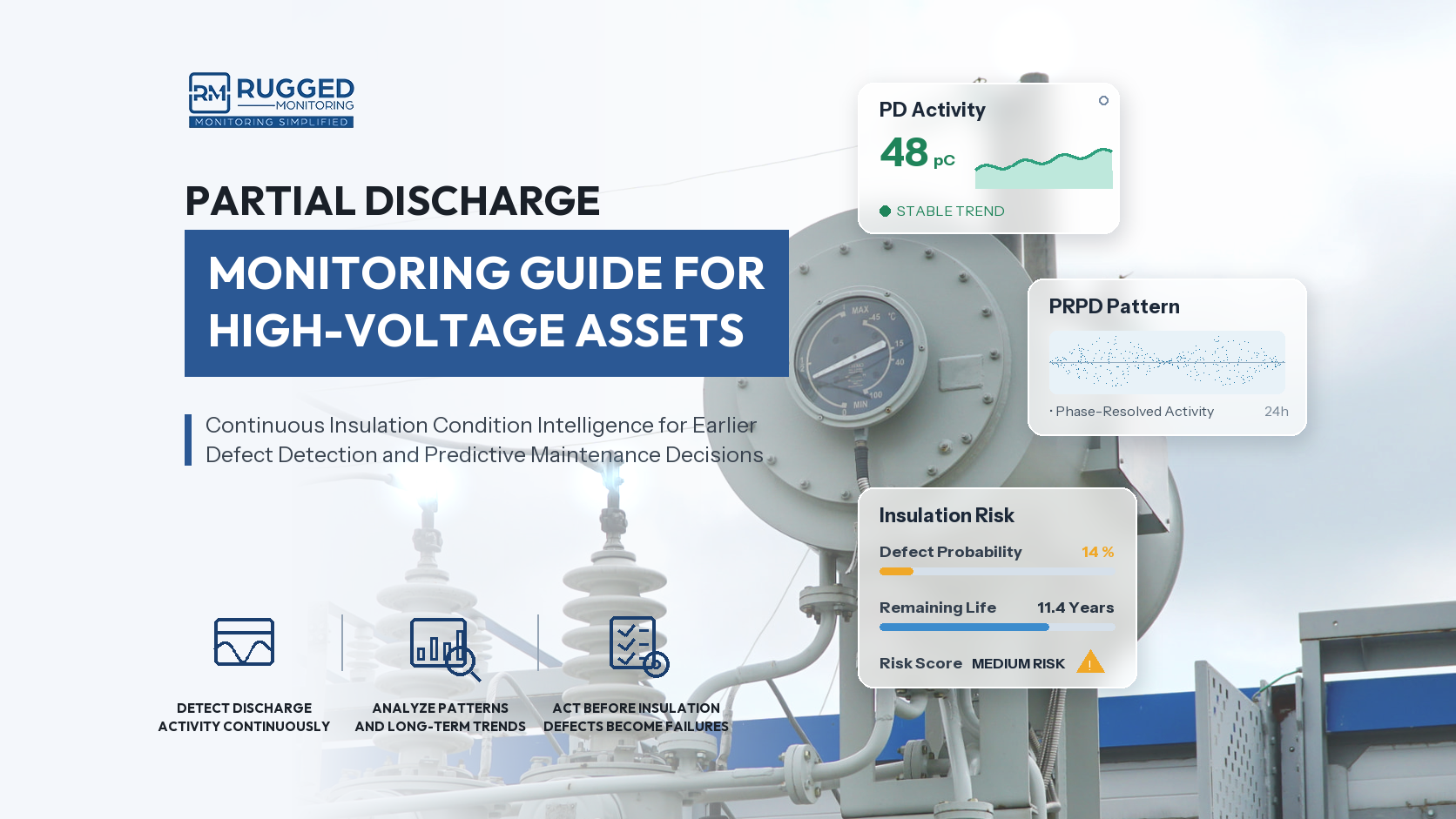
High-voltage assets can continue operating normally even when their insulation condition begins to deteriorate. Routine inspections may show no abnormalities, and operating parameters may remain stable, while defects such as voids, cracks, contamination, or weakened insulation interfaces develop within the equipment.
These defects can concentrate the electric field in localized areas of the insulation system. When the electrical stress exceeds the dielectric strength of that area, partial discharge (PD) can occur. The equipment may continue to operate, but repeated discharge activity can indicate an insulation problem that requires closer attention.
This is where partial discharge monitoring becomes valuable. Instead of relying on a single measurement, continuous monitoring allows engineers to detect discharge activity, analyse its characteristics, and track how it changes over time. This condition information helps maintenance teams identify developing insulation problems and supports a more predictive approach to high-voltage asset maintenance.
Partial Discharge: How It Develops in High-Voltage Insulation
Partial discharge is a localized electrical discharge that only partially bridges the insulation between conductors. Unlike complete dielectric breakdown, it does not create a full conductive path across the insulation system. Equipment can therefore remain operational while discharge activity occurs within or around the insulation.
Consider a gas-filled void within solid insulation. The gas and surrounding dielectric material have different electrical properties, which can cause the electric field across the void to become higher than in the surrounding insulation. When the local field exceeds the dielectric strength of the gas, ionization occurs and produces a discharge.
Repeated discharge activity can gradually degrade the surrounding insulation through electrical, thermal, and chemical processes. As this deterioration continues, the local electric-field distribution can also change, creating conditions that support further discharge activity.
The characteristics of partial discharge vary with the nature and location of the insulation defect, resulting in distinct discharge types.
Types of Partial Discharge
Internal discharge develops within insulation, commonly in voids, cavities, cracks, or dielectric interfaces. Repeated activity can gradually erode and degrade the surrounding material.
Surface discharge occurs along an insulation surface. Moisture, contamination, surface deterioration, and electric-field distribution can contribute to this activity. If it persists, it can lead to tracking and surface erosion.
Corona discharge develops in a gaseous medium around an energized conductor when the electric field becomes highly concentrated, often near sharp edges or protrusions. Its significance depends on the location and equipment involved, but it can indicate elevated localized electrical stress.
Classifying the discharge helps engineers distinguish its characteristics and better understand the underlying insulation condition. However, assessing its significance also requires identifying the defect or condition responsible for the localized electrical stress.
What Causes Partial Discharge?
Partial discharge develops when localized electrical stress exceeds the dielectric strength of a region within or around an insulation system. The underlying cause varies according to equipment design, insulation technology, installation quality, operating conditions, and environmental exposure.
Common causes and contributing conditions include:
- voids or cavities within solid insulation;
- cracks, delamination, or poor dielectric interfaces;
- contamination and moisture;
- sharp conductive protrusions that concentrate the electric field;
- loose or floating metallic components;
- manufacturing imperfections;
- installation or workmanship defects;
- defects in cable joints and terminations;
- thermal and electrical aging; and
- mechanical movement or vibration affecting insulation integrity.
These conditions do not necessarily lead to immediate insulation failure. A defect may remain active while the equipment continues to operate, and its electrical characteristics may change as the defect, load, or surrounding environment changes.
A one-time measurement can confirm that discharge activity exists under specific conditions. Understanding whether that activity remains stable or develops further requires engineers to observe it over time. This is where continuous monitoring becomes important.
Partial Discharge Monitoring: From Detection to Condition Insight
Partial discharge monitoring systematically detects, measures, analyzes, and trends discharge-related signals to provide information about insulation condition.
A typical partial discharge monitoring system for high-voltage equipment follows a connected measurement chain:
Sensor → Data acquisition → Signal processing → Analysis → Trending → Condition assessment
Detection, measurement, and monitoring each serve a different purpose within this process.
Partial discharge detection establishes whether discharge-related activity is present. Partial discharge measurement quantifies characteristics of the detected signals using an appropriate measurement technique. Monitoring builds on both by observing those characteristics over time and identifying significant changes or trends.
This distinction is particularly important when comparing periodic testing with continuous monitoring. A periodic test provides a snapshot of insulation behaviour under the conditions present at that moment. Continuous monitoring builds a historical record as load, voltage, temperature, environmental conditions, and asset condition vary.
The value comes from connecting these measurements over time. To create reliable condition information, however, the system first needs to capture the right signals and distinguish genuine discharge activity from the electrical noise present around high-voltage equipment.
How Partial Discharge Monitoring Detects and Tracks Insulation Defects
A discharge event causes a rapid redistribution of electrical charge. This creates a fast electrical pulse and can also produce electromagnetic, acoustic, optical, and chemical effects.
Monitoring systems can detect these effects using different sensing technologies. The appropriate method depends on the equipment, insulation system, expected defect mechanism, and monitoring environment.
-
Selecting the Appropriate Sensor
High-Frequency Current Transformers (HFCTs) detect high-frequency current pulses and can be used where a suitable grounding or conductor path is available, including many power cable applications.
Ultra-High-Frequency (UHF) sensors detect electromagnetic emissions generated by discharge activity. Engineers commonly use UHF techniques in Gas-Insulated Switchgear (GIS), where the metallic enclosure provides a suitable environment for detecting signals from internal sources.
Transient Earth Voltage (TEV) techniques detect high-frequency transient voltages on metallic switchgear surfaces and are commonly associated with metal-clad switchgear applications.
Acoustic sensors detect pressure waves that propagate through insulating media and equipment structures. Depending on the application, these measurements can also help engineers locate the source.
Conventional electrical measurement detects electrical pulses associated with rapid charge displacement and can provide quantitative information when engineers correctly configure and calibrate the measurement circuit.
No single technology suits every application. Sensor selection depends on equipment construction, insulation design, accessibility, expected signal characteristics, frequency response, and the surrounding electromagnetic environment.
Once the sensor detects electrical activity, the monitoring system needs to capture the signal with sufficient detail for further analysis.
-
Acquiring the Signal
Sensors feed the detected signals into a monitoring or data-acquisition system. Because discharge pulses contain high-frequency components, the system requires appropriate bandwidth, sensitivity, sampling capability, and synchronization.
For AC systems, a phase reference can provide additional diagnostic context by establishing when individual events occur relative to the applied voltage waveform.
High-voltage environments, however, contain many other high-frequency signals. Capturing the signal is therefore only one part of the measurement process; the system must also distinguish relevant activity from interference.
-
Separating Discharge Activity from Noise
Substations and generating facilities can contain switching transients, power-electronic interference, radio-frequency transmissions, communication signals, and other electromagnetic disturbances. Detecting a high-frequency pulse does not automatically confirm an insulation defect.
Effective high-voltage partial discharge monitoring uses techniques such as filtering, pulse discrimination, pattern recognition, and multi-channel comparison to separate potential discharge sources from background interference.
This balance is important. Insufficient discrimination can produce false alarms, while excessive filtering may remove information relevant to the condition assessment.
After separating meaningful activity from interference, engineers can examine the characteristics of the detected signals.
-
Analyzing Measurements and Patterns
Engineers assess discharge activity using characteristics such as magnitude, repetition rate, phase position, polarity, pattern distribution, and changes in behaviour.
In conventional electrical partial discharge measurement, one important parameter is apparent charge, typically expressed in picocoulombs (pC). Apparent charge does not directly represent the charge moving within the physical defect. Instead, it represents an equivalent charge that would produce the same measurable voltage change at the terminals of the test object.
Magnitude alone does not provide a universal measure of severity. Engineers need to interpret the measurement in the context of the equipment, insulation system, measurement technique, defect type and location, operating conditions, background noise, and previous behaviour.
Phase-Resolved Partial Discharge (PRPD) analysis adds further diagnostic information by relating individual pulses to the phase angle of the applied AC voltage. Different discharge mechanisms can produce different phase-dependent distributions, helping engineers characterize potential sources.
These measurements explain what is happening at a particular point in time. Comparing them over longer periods helps determine whether the condition is remaining stable or changing.
-
Tracking Changes Over Time
Trending allows engineers to compare magnitude, repetition rate, PRPD patterns, and other characteristics over days, weeks, or months.
An asset with relatively stable discharge behaviour may require a different engineering response from one showing significant changes in its magnitude, repetition, or pattern. Historical data gives teams the context needed to recognize these differences and determine whether closer investigation is appropriate.
This is where continuous monitoring extends the value of individual measurements. By combining detection, analysis, and trending, the monitoring process turns electrical signals into condition information that engineering and maintenance teams can use.
Why Continuous Monitoring Matters for High-Voltage Asset Reliability
High-voltage insulation can deteriorate while equipment continues to perform its normal function. Continuous insulation condition monitoring helps engineering teams identify changes that periodic inspections or individual measurements may not capture.
Earlier Identification of Insulation Problems
Discharge activity can indicate defects that routine visual inspection may not reveal. Detecting and characterizing abnormal behaviour gives engineers an opportunity to assess the condition and determine whether additional diagnostics or maintenance are required.
Monitoring cannot guarantee the prevention of insulation failure, and not every failure mechanism produces a long or easily detectable discharge precursor. Where measurable activity exists, however, tracking it can provide earlier information about changes within the insulation system.
Condition Information Between Periodic Inspections
Periodic testing remains valuable for commissioning, diagnostics, and scheduled maintenance, but it represents equipment condition at a particular moment.
Load, voltage, temperature, humidity, and other operating conditions can change between tests. Some insulation defects can also produce intermittent electrical activity.
Continuous monitoring captures these variations and establishes a historical trend rather than relying solely on isolated measurements.
Supporting Predictive Maintenance
This historical information becomes particularly useful when organizations apply it within a predictive maintenance strategy.
Periodic maintenance follows predetermined intervals. Preventive maintenance uses planned interventions to reduce the probability of failure. Predictive maintenance uses asset-condition data and trends to identify developing problems and determine when investigation or intervention may be required.
Instead of relying only on the question, “Is this asset due for maintenance?”, engineering teams can consider how the insulation condition is changing and whether that change requires action.
Better Maintenance and Asset Decisions
Earlier information about abnormal insulation behaviour can give teams more time to perform diagnostic testing, plan inspections, arrange specialist support, procure components, or coordinate maintenance with an appropriate outage window.
Organizations can also combine this information with other condition indicators through Asset Performance Management (APM) to assess asset health and prioritize maintenance across a wider asset population.
The value of these measurements also depends on the equipment being monitored. Transformers, switchgear, rotating machines, and power cables use different insulation systems and experience different defect mechanisms, so the monitoring approach needs to reflect the asset.
Partial Discharge Monitoring Across High-Voltage Assets
The same underlying electrical phenomenon can behave differently depending on equipment construction and insulation design. Effective partial discharge monitoring for high-voltage assets therefore requires sensing and analysis methods suited to each application.
Power Transformers
Power transformers contain complex combinations of solid and liquid insulation exposed to electrical, thermal, and mechanical stresses.
Insulation defects, high-field regions, dielectric interfaces, and transformer components can generate discharge activity. Continuous monitoring allows engineers to identify abnormal behaviour and track changes while the transformer remains operational.
Because transformers have complex physical structures and multiple signal-propagation paths, source localization can be challenging. Engineers can therefore combine discharge measurements with other transformer condition indicators to develop a broader assessment of asset health.
Gas-Insulated Switchgear (GIS)
GIS combines compact insulation geometry with high electrical stresses. Conductive protrusions, free metallic particles, spacer defects, poor interfaces, and other abnormalities can create localized field enhancements.
The metallic enclosure makes UHF detection particularly relevant for these systems. Continuous monitoring can track internal electrical activity while the equipment remains in service and highlight changes that may require further assessment.
Air-Insulated Switchgear (AIS)
AIS can experience surface discharge, corona, contamination-related activity, and deterioration of insulation components.
Environmental factors such as humidity, pollution, dust, and temperature can influence this behaviour. Depending on equipment design, engineers can use TEV, acoustic, electromagnetic, or other suitable sensing techniques.
Tracking the measured activity over time helps distinguish persistent or developing behaviour from conditions observed during a single inspection.
Rotating Machines
High-voltage motors and generators rely on stator winding insulation exposed to electrical, thermal, mechanical, and environmental stresses.
Discharge patterns can provide information about deterioration within insulation, at interfaces, or around winding components. Rotating machines can also produce multiple simultaneous sources, making machine-specific interpretation important.
Long-term monitoring establishes baseline behaviour and helps engineers identify meaningful changes during the operating life of the machine.
Power Cables
High-voltage cable reliability depends on the integrity of the cable insulation, joints, and terminations.
Manufacturing imperfections, installation problems, poor jointing, or deterioration during operation can create localized field enhancements and initiate discharge activity.
Cable systems also introduce the challenge of localization. Detecting electrical activity confirms that a potential source exists, but maintenance teams may also need to determine where it originates along the cable. Appropriate sensing and signal-analysis techniques can help locate the source and focus further investigation.
These differences explain why organizations need to evaluate more than the sensor when selecting a monitoring solution. The complete system must suit both the asset, and the condition information engineers need from it.
Key Capabilities of a Partial Discharge Monitoring System
An effective partial discharge monitoring system should connect appropriate sensing with reliable data acquisition, signal processing, analysis, and long-term trending.
Key considerations include:
- sensing technology suited to the asset and insulation system;
- sensor location, sensitivity, and frequency response;
- noise rejection and source separation;
- measurement repeatability;
- phase synchronization and PRPD analysis;
- multi-channel comparison where appropriate;
- long-term trending;
- alarm and notification capabilities;
- remote monitoring;
- scalability across multiple assets;
- integration with high-voltage asset monitoring and APM platforms; and
- the ability to convert measurements into meaningful condition information.
The objective is not simply to collect more electrical data. A monitoring solution should provide a connected path from detecting abnormal activity to understanding whether the condition requires attention:
Detect → Measure → Analyze → Trend → Assess → Predict → Act
When these capabilities work together, engineering and maintenance teams can use insulation condition information as part of a broader predictive maintenance strategy.
End-to-End Partial Discharge Monitoring with Rugged Monitoring
Rugged Monitoring provides an end-to-end partial discharge monitoring system for high-voltage assets, connecting asset-specific sensors, continuous monitoring, data analysis, and Asset Performance Management (APM). This approach captures discharge activity, processes and trends the measurements, and turns the resulting data into condition information for transformers, switchgear, rotating machines, and power cables.
By connecting sensing with asset-level analytics, Rugged Monitoring helps engineering and maintenance teams identify changes in insulation behaviour, prioritize assets that require attention, and make informed predictive maintenance decisions.
Explore Rugged Monitoring’s partial discharge monitoring solutions for high-voltage assets or contact our team to discuss your application.
FAQs: Partial Discharge Monitoring for High-Voltage Assets
What is partial discharge monitoring and why is it important?
Partial discharge monitoring detects, measures, analyzes, and trends electrical discharge activity associated with insulation defects in high-voltage equipment. It helps engineers identify changes in insulation behaviour and provides condition information that can support predictive maintenance decisions.
How does partial discharge monitoring work?
Sensors detect electrical, electromagnetic, or acoustic effects generated by partial discharge. Monitoring equipment acquires and processes these signals, separates relevant activity from interference, analyzes characteristics such as magnitude and phase relationship, and tracks changes over time.
What causes partial discharge in high-voltage equipment?
Voids, cracks, contamination, moisture, poor dielectric interfaces, conductive protrusions, floating components, manufacturing imperfections, installation defects, and insulation deterioration can create localized areas of elevated electrical stress that initiate partial discharge.
Which electrical assets need partial discharge monitoring?
Partial discharge monitoring is particularly relevant to critical high-voltage equipment where insulation condition affects reliability, including power transformers, GIS and AIS switchgear, high-voltage motors and generators, and power cable systems, including joints and terminations.
Can partial discharge monitoring help prevent insulation failure?
Monitoring cannot guarantee that insulation failure will not occur. However, when a developing insulation defect produces detectable discharge activity, continuous monitoring can identify changes in its behaviour and support further diagnostics, maintenance planning, or intervention before the condition progresses.