The ability to use asset data and predict transformer failures even before they occur is where most utilities fall behind.
Transformers rarely fail without warning. In most cases, the asset begins signaling distress weeks or even months in advance through thermal deviations, evolving gas patterns, insulation stress, or mechanical wear. Yet, when a failure does occur, it is still treated as an unexpected event.
Utilities that rely on periodic inspections or traditional monitoring systems often miss cascading events due to limited visibility and insufficient interpretation. This disconnect is the root cause of modern asset management, troubling most plants.
They can identify which transformer is the oldest, which one has crossed an alarm threshold, or which unit is due for maintenance. However, to predict transformer failure based on actual conditions, degradation patterns, and operational stress remains a challenge.
This limitation is not due to a lack of data but to the way data is interpreted and used.
How is this gap now risking businesses?
Transformers are the most capital-intensive assets amongst utilities. Their failure extends beyond just equipment damage. A single transformer outage can result in ~100 hours of downtime, fire hazards, plant safety issues, operational disruption, and millions of dollars in maintenance and recovery costs.
However, transformer failures are statistically rare.
According to CIGRE’s transformer reliability report, major transformer failure rates are below 1% per year.
This creates a dangerous psychological gap.
Because failures are rare, teams become accustomed to normal operation.
Because transformers usually run quietly, they are assumed to be healthy.
Because alarms are infrequent, silence is treated as a sign of safety.
But when failure does happen, its consequences are severe. The most tedious issue for most plant operators is replacement. Industry data shows that large power transformer lead times have extended significantly in recent years. Often exceeding 12–24 months, depending on specifications and supply chain constraints. Costs have also escalated, with large units reaching multi-crore investments.
This increases the stakes for asset experts who are responsible for ensuring transformer safety and health.
Now, the inability of their maintenance strategies is not just a technical issue, but a strategic and financial risk.
Plants cannot solely rely on reactive approaches or post-failure recovery to predict transformer failures. They require an end-to-end system that ensures early fault detection, provides data-driven awareness, and supports proactive interventions.
Why are plants unable to predict transformer failures?
Despite the widespread adoption of IIoT-based sensors and advanced monitoring systems, most utilities still operate in semi-reactive mode.
The reason: siloed systems create fragmented data
Failure does not occur because a single parameter exceeds a threshold. It occurs when multiple parameters evolve together, often pushed beyond their acceptable limits, until a tipping point is reached.
For example, a transformer operating at elevated temperature may not trigger an alarm if it remains within limits. However, if that temperature is consistently higher than its historical baseline for the same load conditions, it may indicate cooling inefficiency or internal degradation. Similarly, a DGA report showing acceptable gas levels may still mask risk if the rate of gas generation increases over time.
In most plants, these signals are not integrated.
SCADA systems only provide operational visibility. They are not designed to predict transformer failures. Their primary function is to monitor and control system parameters in real time, not to analyze long-term degradation patterns.
Similarly, monitoring systems such as edge monitoring, EAM, or CMMS, only collect data, display it, and generate alarms. Their approach is effective for detecting immediate abnormalities, but it does not capture early-stage degradation.
To predict transformer failures, plants must shift from threshold-based monitoring towards data-driven analytics. This requires understanding how parameters evolve over time and how they interact with and affect one another.
How to Predict Transformer Failures?
Asset Performance Management (APM) platforms shift the focus from just data collection to decision support. They integrate data across multiple parameters, assets, and geographical locations, analyze patterns, and provide a unified view of the plant’s operations and maintenance.
It also ingests data from existing systems, such as SCADA systems, online sensors, or offline manuals, to ensure no data is missed during evaluation.
Instead of condition-based maintenance, APM platforms predict transformer failures using risk-based decision-making. They use AI/ML algorithms to transform raw operational data into decision-ready intelligence, helping asset experts understand:
- Assets’ current conditions
- Degradation rate
- Criticality of the asset
- Likely failure modes
- Consequences of failure
Thus, allowing teams to move beyond subjective judgment.
With APM, asset experts now have answers to:
- Which transformer has the highest probability of failures?
- Which failure mechanism is most likely to occur?
- How urgent is the suggested intervention?
Capabilities of Asset Performance Management (APM)
Early-stage degradation patterns
APM platforms are designed to identify early-stage patterns before they escalate to critical issues. This includes:
- Detect subtle changes in DGA trends, temperature behavior, or insulation levels
- Identify any abnormal performance under similar operating conditions
- Correlate multiple signals for useful degradation patterns
- Flag accelerating trends rather than just threshold breaches
Actionable Insights
Data alone cannot prevent failures. Asset experts require data-driven decisions. With APM, they gain clear, actionable recommendations that include:
- The link between detected issues and probable failure modes
- Specific actions for specific events (inspection, load reduction, or maintenance)
- Priority of interventions based on risk and urgency
- Reduce reliance on manual interpretation or expert dependency
Historical Data Integration
Past behavior is a strong predictor of future failure. APM platforms incorporate historical data to improve accuracy and context.
- Integrates maintenance history, test reports, and inspection records
- Identifies recurring issues and long-term degradation patterns
- Tracks asset performance against its own historical baseline
- Ensures critical insights are not lost in disconnected systems
Fleet-Wide Visibility
Managing one transformer is manageable. Managing dozens or hundreds requires a different approach. APM provides centralized visibility across the entire asset fleet.
- Compares health and performance across multiple transformers
- Identifies high-risk assets and outliers instantly
- Enables better allocation of maintenance resources
- Provides a unified dashboard for enterprise-level decision-making
Predictive Maintenance
APM enables a shift from time-based or reactive maintenance to predictive strategies based on actual asset condition.
- Predicts failure probability based on real-time and historical data
- Schedules maintenance only when required, reducing unnecessary interventions
- Minimizes unplanned outages and extends asset life
- Optimizes maintenance costs while improving reliability
APM is Now a Strategic Business Imperative to Predict Transformer Failures
Without APM, most plants operate in one of two modes:
Reactive: responding to alarms or failures
Preventive: performing scheduled maintenance regardless of condition
Both approaches have limitations. Reactive maintenance leads to unexpected failures. Preventive maintenance may result in unnecessary interventions or missed risks.
APM enables a third approach: predictive maintenance.
In this model, maintenance decisions are based on the asset’s actual condition and its failure probability. This allows teams to intervene at the right time, neither too early nor too late.
The result is improved reliability, optimized maintenance effort, reduced operational risk, and maximized asset ROI.
Moving Toward Predictive Asset Management
The future of transformer management lies in continuous condition evaluation rather than periodic inspection. As asset fleets age and operational demands increase, the limitations of traditional approaches become more evident.
Most plants already have access to transformer data. The challenge lies in connecting, interpreting, and acting on them in time.
The question is no longer whether data is available.
The question is whether that data is being used to answer the most critical concern:
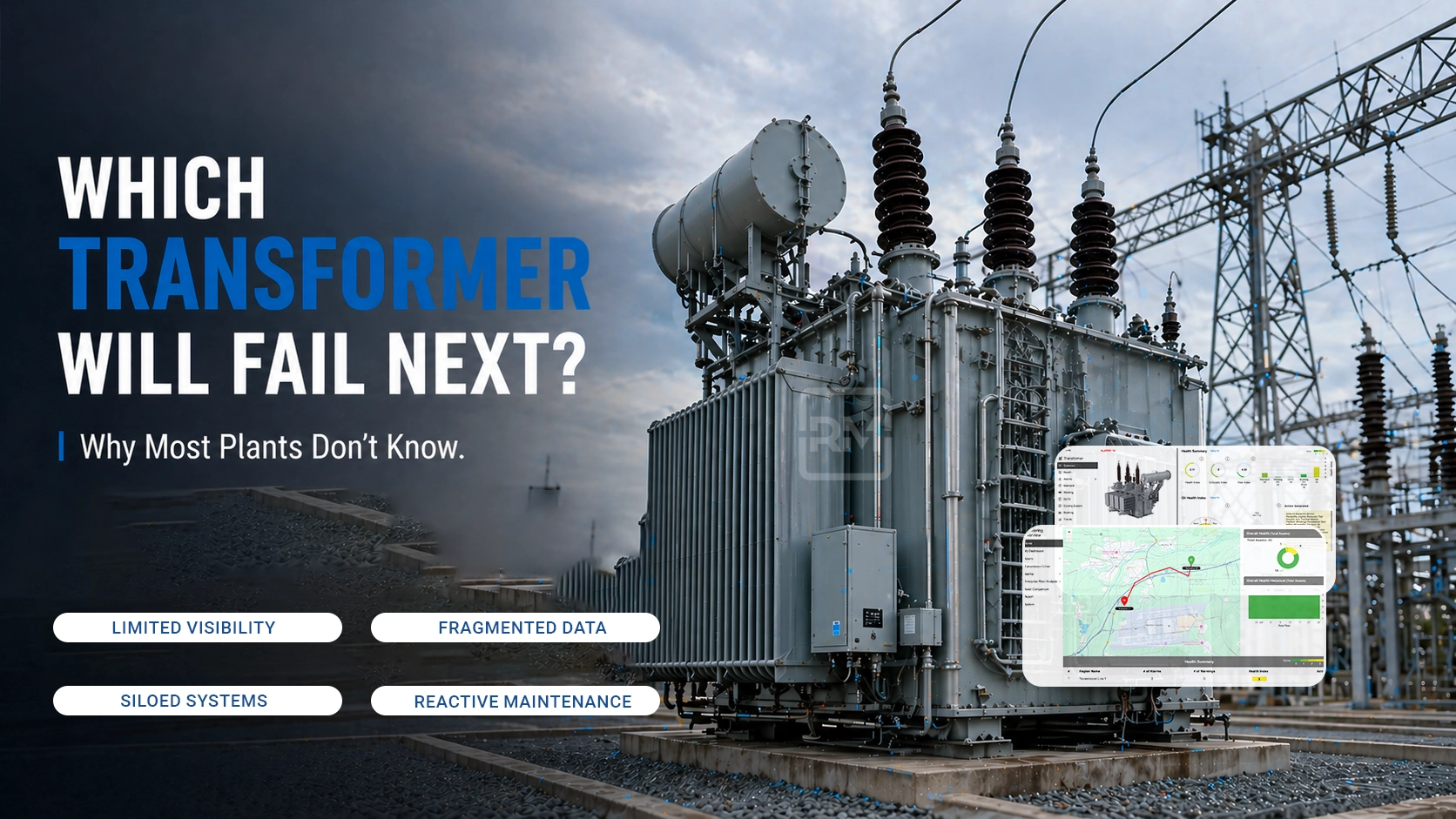
Which transformer will fail next?
Because in modern asset management, the ability to predict transformer failures defines the difference between reactive operations and predictive performance.
Understand more about Asset Performance Management from our Industry Experts.
Book a Demo Today!