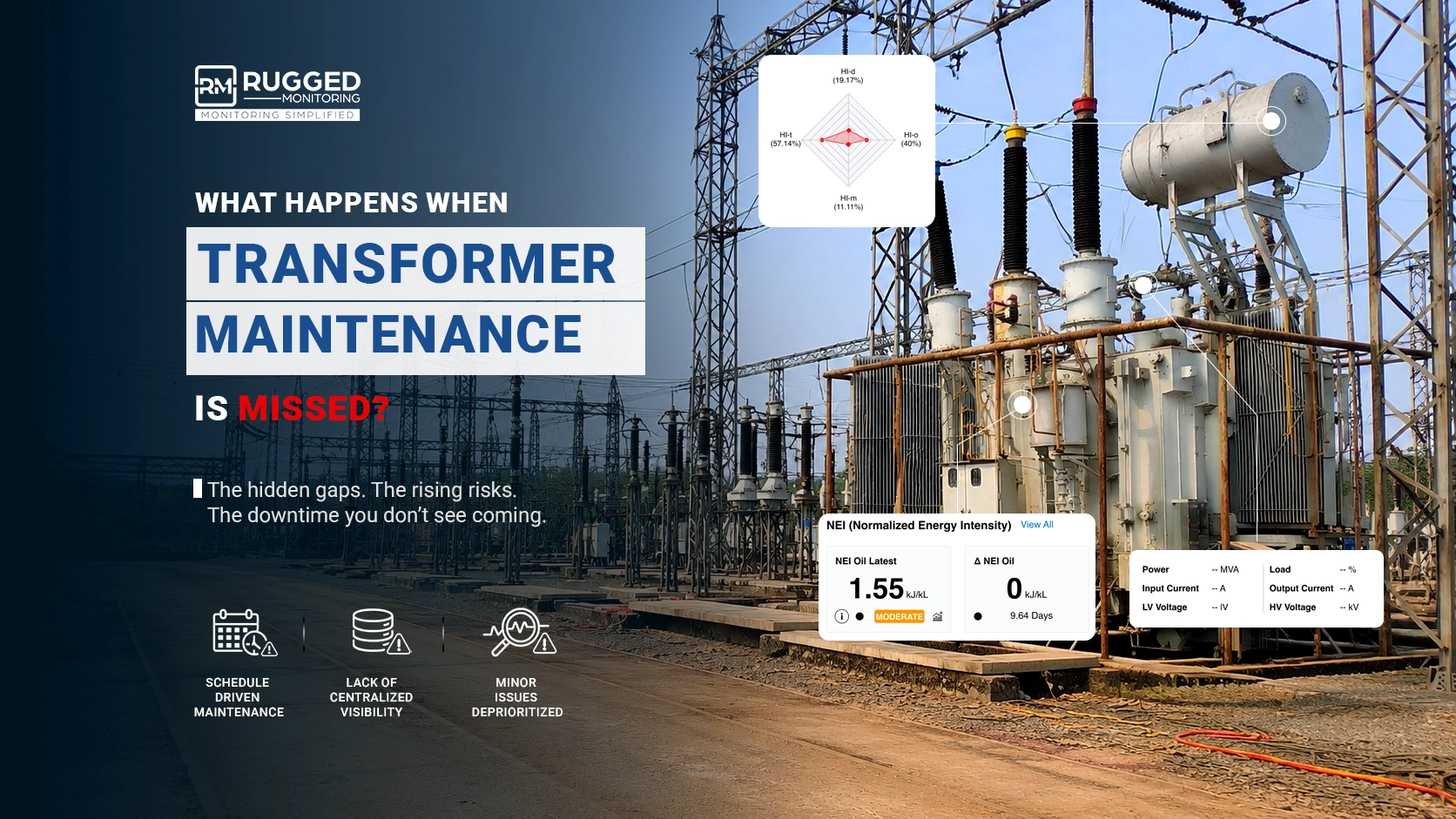
Findings from various asset failure investigations highlight a consistent issue: delayed, deprioritized, or neglected transformer maintenance.
A cooling fan was not serviced on time.
An oil test was postponed due to operational constraints.
A minor increase in moisture was recorded but not acted upon.
A DGA report that showed a change, but not enough to trigger urgency.
Individually, these do not justify immediate shutdown. Collectively, they define the early stages of failure.
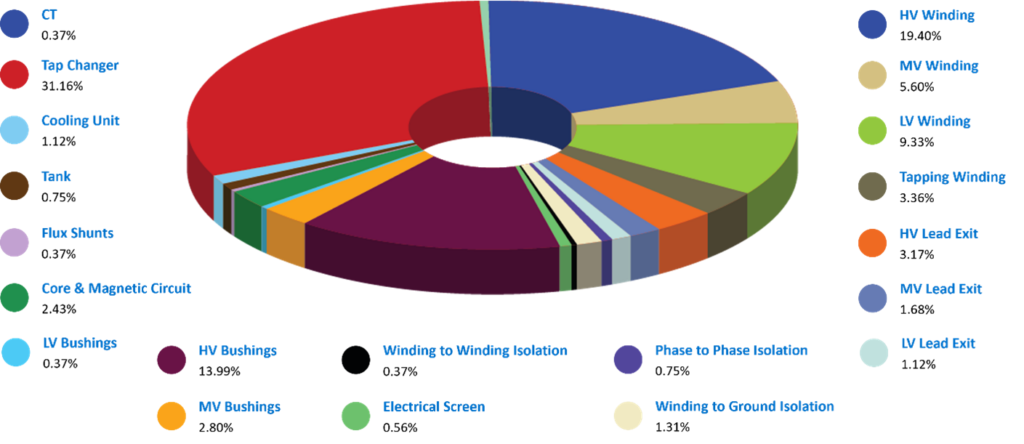
Notably, even the CIGRE transformer reliability report supports the hypothesis that multi-parameter events are the leading cause of transformer failures. Thus, underscoring the complexity and consequences of missed transformer maintenance.
So, the question utilities should be asking is: can their current transformer maintenance translate these gaps into actionable decisions?
Why do transformer maintenance gaps persist despite defined procedures?
Most utilities and industrial plants operate with structured transformer maintenance programs aligned with IEC, IEEE, or other industry standards. These strategies have clearly defined maintenance schedules, testing intervals, and inspection protocols.
So why does maintenance still get missed?
The problem is with the operational environment, which introduces variability in transformer health and performance. Such variability, combined with stringent scheduling, cannot predict the onset of failures.
- Maintenance competes with operations
Transformers are rarely taken offline unless absolutely necessary. And so, planned maintenance often gets deferred due to:
-
- Load demand constraints
- Production targets
- Grid stability requirements
Over time, “temporary” delays become extended gaps.
- Maintenance is schedule-driven, not condition-driven
Most maintenance programs follow fixed intervals. While this ensures routine coverage, it does not account for how the transformer is actually operating.
A heavily loaded transformer may require more frequent attention. Whereas a lightly loaded one may not. But when maintenance is purely schedule-based, these differences are not captured.
- Lack of centralized visibility
In many plants, maintenance data is fragmented:
-
- Inspection records in one system
- Test reports in another
- SCADA data separately
Without integration, it becomes difficult to track what has been missed, delayed, or partially completed.
- Minor issues are often deprioritized
Small deviations in transformer behavior, like slight temperature increases, minor oil leaks, or early gas formations, are often not treated as urgent issues.
However, they are often the first indicator of transformer failures.
But since transformer maintenance is fragmented, periodic, and slow, these issues are not addressed early and evolve into failures.
The Consequences of Missed Transformer Maintenance
Understanding what happens if transformer maintenance is missed requires utilities to look beyond the immediate effects of failures. The impact is usually gradual, cumulative, and often underestimated.
Thermal Stress
Every small increase in temperature significantly accelerates insulation aging. According to multiple industry studies, for every 6-8 °C increase, the insulation life nearly reduces by 50%.
When transformer maintenance is missed:
- The asset’s cooling efficiency drops
- Heat dissipation becomes uneven
- Winding temperatures increase
These factors do not have immediate effects on failures. They slowly reduce the transformer’s remaining life, which often goes unnoticed without real-time monitoring.
Insulation Degradation
Insulation is the most critical parameter for ensuring transformer reliability. Unlike other components, insulation is directly affected by changes in temperature, moisture, and oil quality. Thus, it is also the most difficult parameter to monitor, especially through silos.
When transformer maintenance activities such as oil testing, filtration, or moisture checks are missed, insulation degradation also goes unchecked.
And once insulation weakens beyond a point, failures become extremely difficult to prevent.
Dissolved Gas & Internal Faults
Dissolved gas analysis (DGA) not only addresses gas formation in oil, but also identifies issues related to:
- Partial Discharge
- Thermal Overheating
- Arcing
When DGA testing is delayed, or data trends are not monitored properly:
- Developing faults go unnoticed
- Transformer performance & behavior patterns are not tracked
- Early warning signs are missed
All this missed transformer maintenance results in abnormal gas levels and catastrophic failures.
Mechanical and Auxiliary Systems
Critical transformer components, such as bushings, OLTCs, and cooling systems, require frequent inspections to ensure continuous asset performance.
According to CIGRE, bushing failures, although less frequent, often result in the most severe consequences. They are also the most expensive and tedious component to replace.
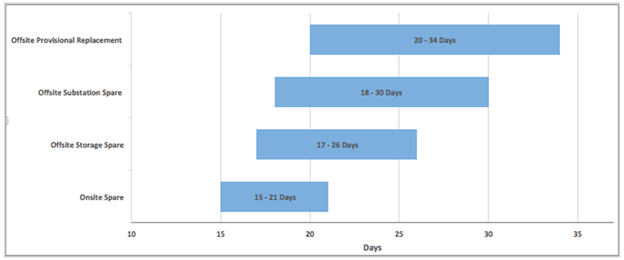
Figure: Nominal time required to replace an LPT or expedite it on an emergency basis [Source: U.S. Energy Report 2024]
Thus, without continuous visibility and integrated transformer maintenance, utilities face increased maintenance costs and asset downtime.
THE OVERALL RISK OF UNPLANNED DOWNTIME
Ultimately, all these issues converge into one catastrophic outcome-
decreased transformer reliability & increased unplanned downtime.
A report by the U.S. Department of Energy highlights how aging fleets and missed transformer maintenance significantly contribute to overall plant efficiency and ROI.
Traditional Transformer Maintenance is Not Enough
Conventional monitoring systems alone cannot compensate for missed transformer maintenance. While they provide visibility into parameters, they do not address gaps in O&M execution and strategies.
Traditional systems also rely a lot on manual interventions and human-based calculations, which cannot:
- Identify performance patterns
- Correlate data between parameters or components
- Analyze small gaps that compound to large failures.
As a result, utilities face a disconnect between what is being monitored and what is being maintained.
For preventing failures, transformer maintenance must move beyond isolated tasks or scheduled practices to a more integrated approach.
The role of Asset Performance Management (APM) in preventing maintenance-driven failures
Asset Performance Management (APM) addresses the limitations of traditional transformer maintenance practices by connecting maintenance activities with condition data.
It enables:
- Identification of missed transformer maintenance activities
- Continuous tracking of asset health between maintenance cycles
- Correlation between maintenance gaps and performance degradation
- Risk-based prioritization of interventions
Instead of relying solely on schedules, asset teams gain visibility into how maintenance impacts actual asset condition.
Visibility into missed and delayed transformer maintenance
One of the most immediate advantages of APM is the ability to track maintenance execution across the fleet. Instead of relying on manual logs or periodic reviews, APM provides a centralized view of the complete transformer.
This allows asset teams to identify patterns that are often early indicators of increasing risk. Without this visibility, transformer maintenance gaps remain hidden until they manifest as performance issues.
Linking maintenance gaps to degradation patterns
APM does not stop at tracking maintenance compliance. It correlates missed activities with changes in transformer condition.
By establishing these relationships, APM helps teams understand not just what was missed, but what impact that miss is having on the asset. This shifts maintenance from procedural exercise to a risk-aware function.
Continuous condition tracking between maintenance cycles
A key limitation of traditional maintenance is that it provides only periodic visibility. APM fills the gaps between maintenance intervals by continuously analyzing:
- Temperature trends relative to load
- DGA evolution patterns
- Moisture and oil condition changes
- Performance of auxiliary systems
This ensures that even if a maintenance activity is delayed, the system can detect early signs of degradation and flag them for attention. It effectively reduces dependence on fixed schedules by introducing real-time condition awareness.
Risk-based prioritization of maintenance actions
In large transformer fleets, not all assets require immediate attention. APM enables prioritization based on actual risk rather than schedule adherence.
Thus, providing utilities with answers for the most relevant questions such as:
- Which missed maintenance activity is most critical?
- Which transformer is most at risk due to maintenance gaps?
- Where should resources be allocated first?
This prevents situations where low-risk tasks consume time while high-risk assets are overlooked.
Enabling a shift from reactive to preventive action
Ultimately, the role of APM is to move maintenance from a reactive model to a preventive and predictive one. Instead of responding to failures or alarms, asset teams can act on early signals linked to maintenance gaps.
This includes:
- Triggering inspections when degradation patterns emerge
- Adjusting maintenance schedules based on asset condition
- Preventing escalation of minor issues into major faults
By closing the loop between transformer maintenance, monitoring, and decision-making, APM ensures that missed activities do not translate into missed failures.
APM is now a Strategic Business Investment for Utilities
Transformer maintenance is not simply about completing scheduled tasks.
It is about ensuring that no early signal of degradation is missed.
Understanding what happens if transformer maintenance is missed requires recognizing this cumulative effect.
With APM, utilities can transform their maintenance from a compliance-driven function into a reliability-driven strategy. Thus, ensuring every action is visible, every impact is measurable, and every decision is informed. Significantly, reducing downtime and maximizing transformer reliability, longevity, and ROI.
Explore the impact of Rugged Monitoring, Enterprise APM Suite, RM EYE: