Medium-voltage (MV) panel switchgear often receives insufficient attention during grid modernization efforts. Typically, these assets are scrutinized only after incidents such as breaker trips, insulation failures, or protection malfunctions. Thus, compromising operational continuity.
However, MV switchgear remains the most pivotal asset for ensuring plant reliability and stability. It manages the distribution of electrical power to critical components, including transformers, motors, feeders, and ancillary equipment.
Utilities that rely on conventional maintenance strategies tend to address maintenance needs only superficially. This approach can pose challenges in coordinating shutdowns, managing space constraints, complying with safety and permitting processes, adhering to production schedules, and maintaining a comprehensive understanding of asset risk. Such limitations can undermine the overall effectiveness and resilience of the grid.
In this blog, we will explore why maintenance readiness is difficult for MV Panels, why traditional preventive programs often fall short, and how asset performance management systems improve decision-making.
Why MV Panels Are Critical to Plant Reliability?
An MV Panel is often a small part of the physical plant footprint, but it controls a large share of operational continuity. It feeds major electrical loads and protects downstream assets from faults. When a panel fails, the impact can extend beyond a single electrical room because multiple feeders, transformers, motors, or process lines may depend on the same switchgear lineup.
Medium voltage switchgear performs three core functions. It distributes power, interrupts fault current, and enables safe isolation for maintenance. A weakness in any of these functions can create risks to reliability, safety, and production. A breaker that does not operate correctly may fail to isolate a fault. Insulation deterioration can lead to internal arcing. Loose connections can create localized heating that damages busbars, cable terminations, or adjacent components.
The reliability challenge is that many failure mechanisms are progressive. Contamination, humidity, thermal cycling, vibration, contact wear, and insulation aging can develop slowly before producing a visible symptom. This makes MV Panel maintenance a reliability issue, not just a compliance activity.
The Problem with Traditional Maintenance
Traditional maintenance strategies often rely on fixed schedules, outdated information, fragmented systems, and manual interventions. Yes, this approach is better than neglect, but it does not entirely prevent catastrophic events.
Standards such as IEC 62271-200 provide requirements for metal-enclosed MV switchgear and control gear, while broader maintenance and safety guidance, such as IEEE Std 902, can inform industrial maintenance practices. However, standards and scheduled maintenance alone do not provide continuous visibility into developing equipment conditions.
For example, it provides the know-how of what a plant should do during a scheduled inspection for a feeder during an annual breakdown. But it does not provide information on how to identify it early on. Still, many utilities rely on traditional systems and standards to prepare for their next maintenance.
The calendar may show when the next shutdown is due, but it may not indicate whether the panel has rising partial-discharge activity, breaker-mechanism wear, thermal stress, or deteriorating insulation. Those details determine the scope of work and the level of urgency.
Periodic inspections also result in the following challenges:
Blind Spots Caused by Limited Visibility
Offline tests can only confirm conditions at one point in time. They miss defects that develop between inspection intervals. Critical issues such as partial discharge, contact heating, or moisture-related insulation stress can take weeks, if not months, to show signs of fault. Thus, a test passed by MV Panel switchgear six months ago does not always mean the asset is healthy today.
Fragmented Data Results in Poor Decisions
MV Panel maintenance readiness because the information needed for good planning is often scattered. Test reports may sit in folders. Breaker service history may be stored in maintenance software. Thermography records may be separate from relay test data. Operator observations may remain in shift logs. This fragmentation makes it difficult to understand the true condition of each panel before planning work.
Unplanned Downtime Leads to Unreliability
MV Panel maintenance usually requires isolation, safety approvals, and coordination with production. If the plant cannot afford frequent shutdowns, maintenance teams must decide which panels deserve attention during limited windows. Without reliable data, those decisions often depend on age, past failures, or judgment rather than measurable risk. Thus, resulting in maximized uncertainty and minimized reliability.
What Is Maintenance Readiness for MV Panel?
Maintenance readiness for any asset is the ability to execute the right maintenance action at the right time without avoidable delays, safety gaps, or production disruptions. It is not just the availability of technicians or scheduled inspections.
Two MV Panels of the same age can have very different risk profiles. One may operate in a clean, climate-controlled electrical room with moderate loading. Another may operate in a hot, humid, dusty environment with frequent switching and high process criticality. A fixed schedule may treat both assets equally, even though their maintenance needs differ.
Thus, a good maintenance strategy includes asset history, test records, condition indicators, safety procedures, and real-time asset performance. Platforms such as asset performance management (APM) integrate all this data into one centralized system. Empowering utilities with a one-stop view and advanced analytics for data-driven maintenance strategies.
How APM Ensures Continuous MV Panel Maintenance Readiness?
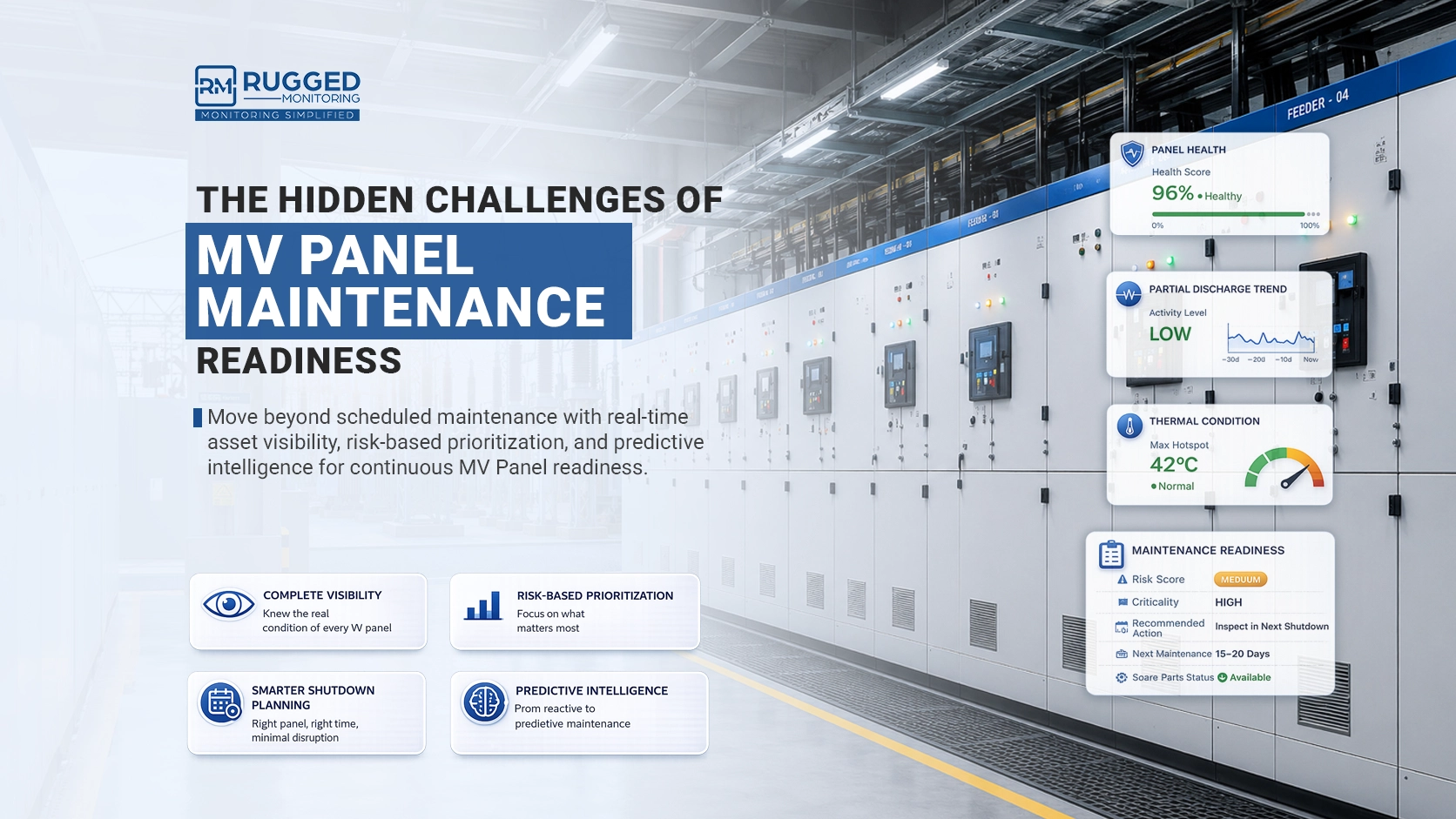
Asset performance management (APM) systems operate on the framework of condition-based monitoring. While condition monitoring analyzes real-time asset conditions to improve readiness through early fault detection, APM transforms that analysis into data-driven decisions. By connecting condition data with asset hierarchy, criticality, failure modes, maintenance history, inspection results, and operational consequences, APM for MV Panel ensures real-time maintenance readiness.
Instead of just providing continuous visibility into MV Panel health and performance, APM helps utilities answer critical questions such as:
- Which MV Panels are at highest risk?
- Which assets should be included in the next shutdown?
- Which spares should be staged?
- Which defects can be monitored, and which require immediate action?
Thus, transforming maintenance from just technical visibility to an ROI-driven strategy.
APM platforms also improve consistency across teams. Without a central platform, one engineer may interpret a partial discharge trend as urgent while another may continue monitoring. APM standardizes risk scoring, escalation logic, and maintenance recommendations. Thus, it aids maintenance managers in defending decisions with evidence rather than assumptions.
In addition, APM enables predictive maintenance, empowering maintenance teams to foresee and prepare even before a failure occurs. This reduces the need for corrective work, unplanned downtime, emergency fund use, and improper resource allocation, ensuring continuous MV Panel maintenance readiness.
From Maintenance Reliability to Predictive Intelligence
MV Panel maintenance readiness is no longer only about completing inspections on schedule. It is about knowing which assets are healthy, which are deteriorating, and which failures could affect safety or production before the next shutdown arrives. Traditional maintenance improves reliability by creating structure, but predictive intelligence goes much further. It integrates condition data, asset criticality, historical performance, and risk into a single decision framework.
For maintenance managers and reliability teams, this shift changes how MV switchgear is managed. Instead of reacting to test results or planning work based only on fixed intervals, teams can use continuous monitoring and APM insights to identify early warning signs, prioritize interventions, and prepare the right spares and resources in advance. Thus, transforming MV Panel maintenance from a periodic activity into an ongoing reliability strategy.
The plants that achieve the highest maintenance readiness will be those that move beyond isolated inspections and build a connected view of asset health.
With the right monitoring ecosystem, MV Panels can be managed with greater confidence, reliability, and clearer maintenance priorities.
Strengthen your MV switchgear maintenance strategy.
Explore Rugged Monitoring’s end-to-end MV Panel monitoring ecosystem, or book a demo of our Enterprise APM Suite, RM EYE.
FAQs
What is an MV Panel?
An MV Panel is used to control and distribute medium voltage power in industrial and utility settings. It includes components such as circuit breakers, busbars, protection relays, and cable terminations, serving applications at power levels above those of low-voltage distribution.
Why is MV Panel maintenance important?
MV Panel maintenance is crucial to prevent outages, protect downstream assets, and ensure safety. Regular inspections and assessments help identify issues like insulation deterioration, breaker wear, and loose connections. This proactive approach supports compliance and enhances long-term reliability.
What are the biggest challenges in MV Panel maintenance?
The biggest challenges include limited outage windows, scattered asset data, hidden internal defects, spare part availability, and inconsistent risk prioritization. Many MV switchgear problems develop gradually and are not visible during routine walkdowns. This makes condition data essential for planning the right maintenance action before failure occurs.
How can condition monitoring improve MV Panel reliability?
Condition monitoring enhances MV Panel reliability by tracking early warning signs such as partial discharge, abnormal temperatures, humidity, breaker operating patterns, and environmental stress. This enables maintenance teams to identify faults early, leading to better planning, fewer emergencies, and more efficient shutdowns.
How does APM improve maintenance readiness?
APM enhances maintenance readiness by consolidating monitoring data, asset criticality, maintenance history, inspection results, and risk models on a single platform. It helps teams identify which MV Panels need attention, plan necessary work, and determine required spares or skills, turning asset data into actionable maintenance decisions.