Partial discharge helps identify insulation defects before they lead to dielectric failure. However, detection is only part of the challenge. Engineers must also determine how to evaluate the electrical asset. This is where the online vs. offline partial discharge decision matters: it affects which conditions you can observe, whether an outage is required, how the test voltage is applied, and how you interpret the results.
Neither method is inherently superior. Online testing observes partial discharge while equipment experiences its actual operating stresses, whereas offline testing creates controlled conditions for a more focused diagnostic assessment. The challenge for engineers is determining which approach provides the information needed to support the next maintenance decision.
Understanding these differences is essential when testing high-voltage electrical assets. This article compares both approaches and explains how to select the right method based on asset criticality, operating constraints, and the questions the maintenance team needs the test to answer.
What do Online and Offline Partial Pischarge Testing mean?
Online partial discharge testing measures partial discharge while the electrical asset remains energized. This method is valuable for detecting and tracking insulation problems under actual operating conditions without requiring a shutdown.
Offline partial discharge testing, by contrast, isolates the asset and uses an external voltage source. This gives engineers greater control over test conditions and enables a more detailed diagnostic assessment. The right choice depends on the asset, testing objective, outage availability, and applicable test standard. Because each method provides a different perspective on insulation condition, many maintenance programs use them as complementary tools rather than alternatives.
Testing vs. Diagnostic Assessment: What Is the Difference?
While online and offline partial discharge testing differ in how measurements are obtained, diagnostic assessment focuses on a broader objective. Engineers are not only concerned with whether partial discharge is present, but also what the observed activity reveals about insulation condition, asset health, and potential risk. Understanding this distinction is important because the value of a partial discharge measurement lies not just in detecting a problem, but in supporting informed maintenance and reliability decisions.
Testing
- Identifies whether partial discharge activity is present.
- Generates measurement data from the insulation system.
- Helps detect potential insulation defects or deterioration.
Diagnostic Assessment
- Interprets what the measured partial discharge activity means.
- Evaluates insulation condition, defect severity, and associated risk.
- Supports maintenance planning, repair decisions, and asset management strategies.
In simple terms, testing answers the question, “Is partial discharge occurring?” Diagnostic assessment answers the question, “What does that partial discharge mean for the asset?” While testing provides the measurement, diagnostic assessment provides the context needed to understand its significance and determine the most appropriate course of action.
However, partial discharge behaviour is influenced by various factors, including voltage, load, temperature, environmental conditions, and defect characteristics. As a result, the conditions under which measurements are collected can significantly influence what is observed and how the results are interpreted. Online and offline testing therefore provide different diagnostic perspectives on the same asset condition.
How is Offline Partial Discharge Testing different?
Offline partial discharge testing answers a distinct set of questions. The equipment is isolated from the power system and energized using a suitable external source, allowing engineers to control the electrical stress applied during the assessment.
This controlled environment enables measurements that may be difficult to obtain during normal operation. Depending on the asset and applicable procedure, engineers can evaluate how partial discharge activity changes as test voltage is increased or reduced and perform more detailed diagnostic or localization work.
Offline testing is therefore particularly valuable during commissioning, planned outages, post-repair verification, or when another condition assessment has identified a problem requiring deeper investigation.
Consider a cable circuit where online measurements repeatedly indicate suspicious partial discharge activity. During a planned outage, an offline diagnostic test can be used to investigate the insulation system under controlled voltage conditions and support defect localization before deciding whether repair or replacement is necessary.
The trade-off, however, is operational. Offline partial discharge testing during shutdown requires isolation, safety preparation, outage coordination, suitable test equipment, and qualified personnel. The test conditions also differ from the asset’s normal operating environment.
This is why offline testing should not automatically be viewed as the “better” version of online testing. It provides different diagnostic information.
What Online Partial Discharge Testing Reveals?
The major advantage of online partial discharge testing is that the equipment remains in service during the assessment. Sensors detect PD signals while the asset experiences the electrical and environmental stresses present during normal operation.
Depending on the equipment, detection may involve technologies such as high-frequency current transformers (HFCTs), transient earth voltage (TEV) sensors, UHF sensors, or acoustic methods. The most appropriate technique depends on factors such as asset construction, the type of insulation system, and the location of the discharge under investigation.
Because the system remains energized, online testing can reveal partial discharge activity associated with actual operating voltage, loading conditions, switching events, temperature, humidity, and other service-related factors. This provides engineers with insight into how the insulation system behaves under real-world operating conditions.
Online testing is particularly valuable because it:
- Evaluates insulation performance while the asset remains in service.
- Eliminates the need for a dedicated shutdown.
- Captures PD activity under actual operating and environmental conditions.
- Supports routine condition assessment of critical assets.
- Helps identify developing insulation defects before they result in failure.
For example, an industrial facility may monitor an MV switchgear lineup that cannot easily be isolated without interrupting production. Online testing can identify abnormal PD activity while the switchgear remains operational, allowing engineers to assess asset condition without disrupting normal operations.
However, online testing also operates in an electrically noisy environment. External interference must be distinguished from genuine partial discharge activity, and accurate interpretation requires appropriate sensors, measurement practices, and engineering expertise.
These characteristics highlight both the strengths and limitations of online testing. To understand where online testing fits within an asset assessment strategy, it is useful to compare it with offline testing and examine how the two approaches differ.
Comparing Online and Offline Partial Discharge Testing
The fundamental difference of testing is the electrical state of the asset and the level of control engineers have over the test.
| Consideration | Online PD Testing | Offline PD Testing |
| Asset condition | Energized and operating | Isolated from the power system |
| Shutdown required | No dedicated test outage | Yes |
| Electrical stress | Actual system operating conditions | Applied by an external test source |
| Load conditions | Actual operating load can influence measurements | Normal operating load is absent |
| Test voltage control | Generally limited by system conditions | Controlled according to the test procedure |
| Environment | Real operating environment | More controlled diagnostic conditions |
| Best suited to | Screening, trending, and continuous monitoring | Focused diagnosis, commissioning, and planned outage testing |
| Noise environment | Potentially higher | Can often be controlled |
| Trending | Particularly valuable for repeated/continuous monitoring | Typically performed at defined diagnostic intervals |
For that reason, interpreting online vs offline PD testing for electrical assets requires context. Asset design, sensor location, measurement bandwidth, applied voltage, operating condition, background noise, previous results, and the applicable standard can all affect what the measurement means.
Understanding these differences is important, but the practical question is when each approach should be used. The answer depends on the maintenance objective, operating constraints, and the information required to support the next decision.
From Partial Discharge Detection to Asset Reliability Decisions
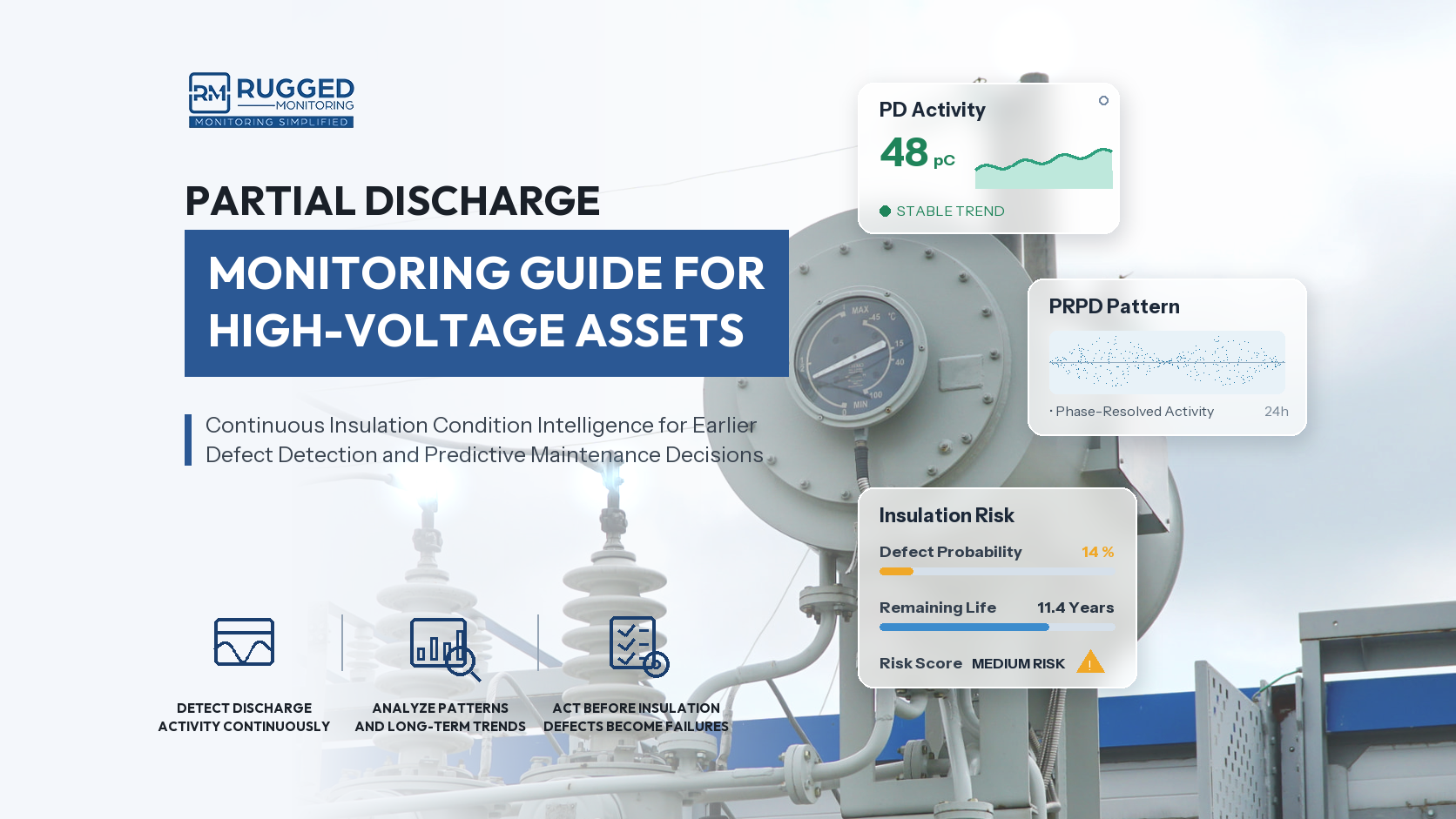
Partial discharge measurements provide valuable insight into insulation condition, but their greatest value often emerges over time. A single measurement may indicate that insulation degradation exists. Repeated measurements and continuous monitoring can reveal whether that condition is stable, progressing, or accelerating.
This is where partial discharge monitoring moves beyond detection and becomes a tool for predictive maintenance. By tracking changes in PD activity and correlating them with asset operating conditions, maintenance teams can identify developing risks before they lead to insulation failure or unplanned outages.
Predictive intelligence is built on more than a single test result. It combines:
- Historical partial discharge trends
- Real-time condition data
- Asset criticality
- Operating and environmental conditions
- Previous maintenance and inspection records
When these inputs are evaluated together, engineers gain a clearer understanding of asset health and can prioritize maintenance activities based on risk rather than calendar schedules.
For example, two assets may exhibit similar levels of partial discharge activity. However, the asset showing a rapidly increasing trend may require immediate investigation, while the asset with stable activity may simply require closer observation. The difference lies not in the measurement itself, but in the insight gained from its progression over time.
This shift from isolated measurements to continuous condition intelligence enables organizations to move beyond periodic testing and toward condition-based and predictive maintenance strategies, where decisions are guided by evidence of developing asset deterioration rather than fixed inspection intervals.
Rugged Monitoring enables this approach through a complete monitoring ecosystem that combines sensors, monitoring devices, and the RM EYE software platform. By providing continuous visibility into asset condition and correlating critical operational data, the platform helps maintenance teams identify emerging insulation issues earlier, prioritize resources more effectively, and make more informed reliability decisions across critical electrical assets.
To learn more about Rugged Monitoring’s predictive maintenance solutions for electrical assets, contact our team.
FAQs
What is the difference between online and offline partial discharge testing?
Online partial discharge testing is performed while equipment remains energized by the power system, so PD is measured under actual operating conditions. Offline testing isolates the equipment and uses an external voltage source, giving engineers greater control over the test conditions. Each approach answers different diagnostic questions.
Can partial discharge testing be performed while equipment is energized?
Yes. Online partial discharge testing is specifically designed to assess energized equipment without taking it out of normal service. The appropriate sensors and measurement techniques depend on the equipment type, construction, voltage class, and applicable testing procedure.
Does offline partial discharge testing require a shutdown?
Yes. Equipment must generally be isolated and de-energized from the normal power system before applying an external test voltage. This requires outage planning, appropriate safety procedures, specialist test equipment, and qualified personnel.
Is online partial discharge testing as accurate as offline testing?
Accuracy is not the most useful way to compare the two methods because they measure PD under different conditions. Online testing captures behavior under actual service conditions but must contend with background noise, while offline testing provides greater control over applied voltage and the test environment. The appropriate method depends on the diagnostic objective.
When should you use online PD testing instead of offline PD testing?
Online PD testing is particularly valuable when shutdowns are difficult, when equipment needs to be assessed under real operating conditions, or when deterioration needs to be trended over time. It is also well suited to continuous monitoring of critical assets where early detection is important.
Can online and offline PD testing be used together?
Yes. Online testing can identify and trend suspicious activity without interrupting service, while offline testing can provide a more controlled diagnostic investigation during a planned outage. Using the methods together can provide a more complete understanding of insulation condition.
Which electrical assets can be assessed using online PD monitoring?
Online PD techniques can be applied to assets including switchgear, power cables, GIS, transformers, motors, and generators, although the appropriate sensing technology differs by equipment type. Always select testing methods based on asset design and relevant standards.