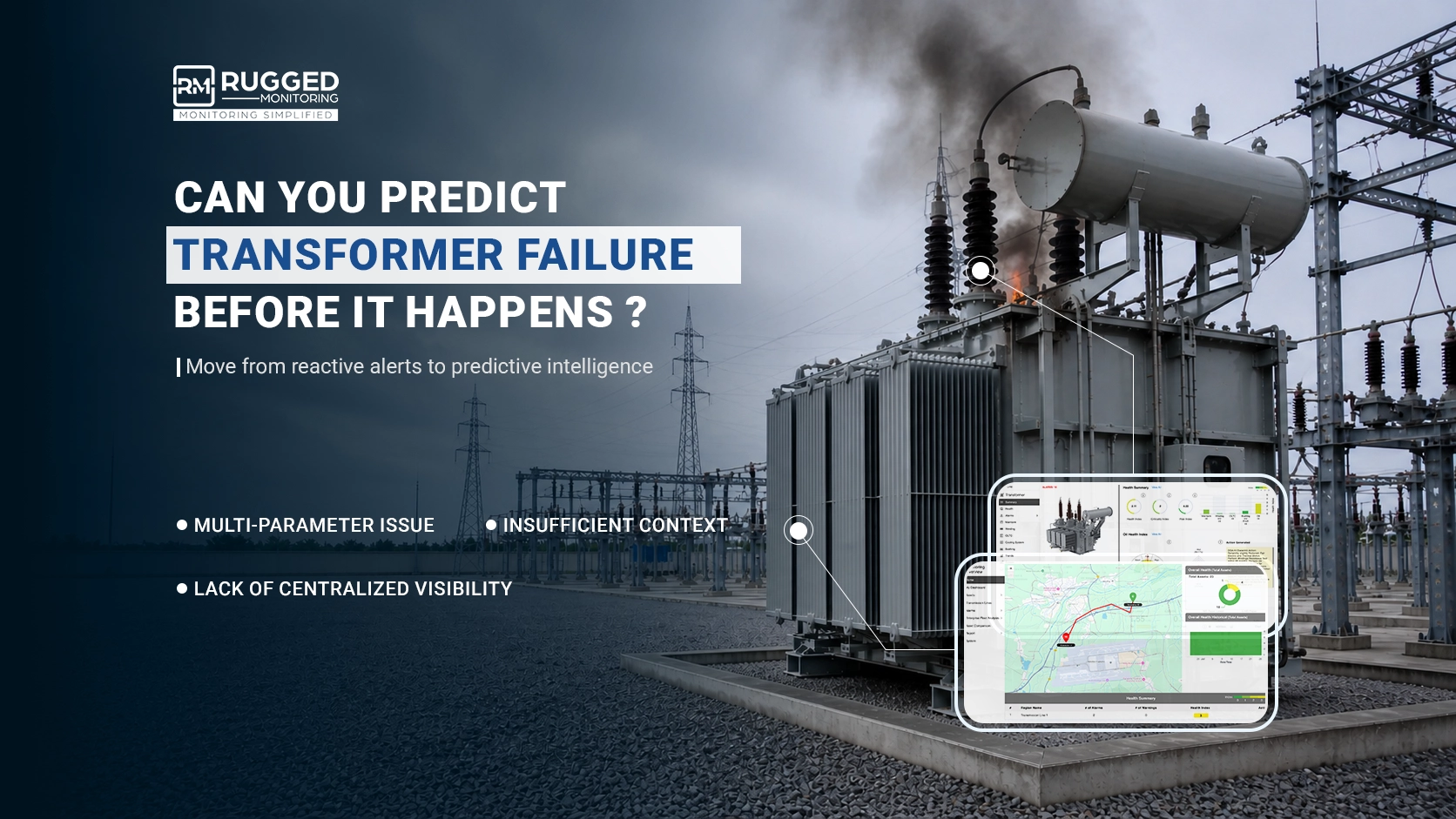
Transformer failures can often be anticipated by identifying early signs of deterioration through condition monitoring. Indicators derived from dissolved gas analysis (DGA), partial discharge monitoring, winding hotspot temperature, and bushing diagnostics can reveal developing faults or deterioration. Analyzing these indicators alongside historical trends and operating conditions helps asset managers assess emerging risks and plan timely maintenance.
Early transformer failure detection is where most utilities are struggling.
A transformer failure rarely originates at the moment of trip or outage. In most cases, failure is an end result of a gradual degradation process that develops over time across insulation, oil, thermal performance, and mechanical components.
It takes weeks or even months for a transformer to typically exhibit measurable changes. But when maintenance is done periodically, manually, or in a fragmented manner, these indicators appear to remain within acceptable limits. Therefore, unable to trigger warnings or predict transformer failures for immediate interventions.
As a result, a majority of utilities fail in early transformer failure detection, assuming normalcy.
However, the signals were present throughout. They just weren’t collected and interpreted in a way that enabled timely action.
Now, the critical question for asset teams is:
“Is it actually possible to predict transformer failure before it happens, or are your current systems fundamentally limited?”
Why Conventional Monitoring Systems Cannot Guarantee Transformer Failure Detection?
Most industries have already invested in what they assume are “advanced monitoring systems”. These typically include industrial IoT sensors, monitoring units, SCADA, EAM, temperature indicators, and online condition-monitoring tools.
While they provide visibility into operating parameters and a level of operational control, they are not designed to predict transformer failures. Their primary function is transformer failure detection based solely on predefined thresholds, i.e., notify operators when a set limit is crossed.
This limits the architecture of what monitoring can do.
Transformers do not always fail only because a threshold has been crossed. Parameters that interact with each other evolve over time within their normal range, leading to failure.
For example, insulation degradation can result in higher temperatures under similar load conditions. However, since only systems are set up for temperature, it would trigger an alarm for that parameter only. It would be unable to pinpoint insulation degradation using conventional transformer failure detection methods.
Another example, a transformer may operate consistently at higher temperatures under similar loading conditions compared to its historical baseline. Similarly, gas concentrations in DGA may remain within limits while showing an accelerating trend.
In both cases, conventional transformer failure detection strategies are unable to accurately predict failures.
The gap isn’t the lack of data.
The gap is the inability to interpret data in context across time, operating conditions, and failure mechanisms.
Understanding Transformer Failures as a Multi-Parameter Issue
Most substations are operating on fragmented monitoring systems.
IoT sensors that collect data.
Edge-monitoring units.
SCADA that aggregates all data and sets alerts.
But all these transformer failure detection systems are just that: detect events.
What most SCADA, EAM, or CMMS systems fail to understand is that each transformer parameter behaves differently and produces different indicators under different conditions.
- Dissolved Gas Analysis (DGA) reflects internal faults such as overheating, partial discharge, or arcing
- Thermal measurements indicate loading stress and cooling efficiency
- Moisture content affects insulation integrity and aging rate
- Partial discharge (PD) signals dielectric weakness
- Maintenance and inspection records provide context on recurring issues
Such a multi-parameter data context is missing, leaving asset experts unable to predict transformer failures.
How Can Asset Performance Management Help with Early Transformer Failure Detection?
Asset Performance Management (APM) systems address the core limitations of conventional transformer failure detection by integrating data, applying analytics, and enabling decision-making on a single platform.
An APM can aggregate inputs from SCADA systems, condition-monitoring systems, DGA reports, maintenance records, and offline inspection data into a unified framework. Instead of visualizing these data streams separately, asset experts can evaluate them collectively against known failure mechanisms.
So how does it predict failures before they happen?
First, APM platforms detect early-stage degradation patterns by continuously analyzing trends and identifying deviations that may not trigger alarms but indicate emerging issues.
Second, they perform multi-parameter correlation, linking thermal behavior, gas formation, moisture levels, and operational stress to specific failure modes such as insulation degradation, overheating, or partial discharge.
Third, APM introduces risk-based prioritization by assigning health indices and risk scores. This allows asset teams to identify which transformers require immediate attention and which can be monitored further.
Fourth, it provides actionable insights. Instead of presenting raw data, the system highlights the likely cause of degradation and suggests appropriate actions, such as inspection, load adjustment, or targeted maintenance.
This reduces reliance on manual interpretation and improves consistency in decision-making across the organization.
How to Prevent Transformer Failures using APM?
To prevent transformer failures, asset experts can utilize a structured approach that includes several key capabilities of APM:
Trends Analysis
APM platforms continuously analyze trends across critical parameters to identify early deviations.
- Tracks DGA gas generation rates, not just absolute values
- Monitors temperature rise patterns relative to historical behavior
- Identifies accelerating degradation trends before thresholds are crossed
- Detects abnormal variations in moisture, load, and cooling response
Context-Aware Behavior
APM evaluates asset behavior relative to operating conditions, not in isolation.
- Compares temperature against load and ambient conditions
- Interprets DGA trends alongside thermal and operational events
- Identifies abnormal performance under similar operating scenarios
- Detects deviations from the transformer’s own historical baseline
Actionable Insights
APM platforms convert complex condition data into clear recommendations.
- Links detected anomalies to probable failure modes (thermal, electrical, insulation)
- Suggests targeted actions such as inspection, load adjustment, or maintenance
- Prioritizes issues based on severity and urgency
- Reduces dependency on manual interpretation and delayed decision-making
Data-Driven Decisions
APM enables decisions based on actual asset condition and risk.
- Replaces time-based maintenance with condition-based intervention
- Quantifies asset health and failure probability
- Supports risk-based prioritization of maintenance activities
- Enables consistent decision-making across teams and locations
Fleet-Level Visibility
APM provides a centralized view across the entire asset fleet.
- Compares health and performance across multiple transformers
- Identifies high-risk assets and underperforming units instantly
- Enables optimized allocation of maintenance resources
- Supports enterprise-level planning and reliability strategy
From Transformer Failure Detection to Prevention: A Necessary Shift
Conventional transformer failure detection methods rely on fragmented systems and reactive responses to alarms. While effective to an extent, they are not sufficient for modern power grids, which are characterized by aging infrastructure, renewable integration, and increasing operational demands.
Asset performance management enables a shift toward predictive maintenance, where decisions are based on actual asset condition rather than fixed intervals.
This approach reduces unnecessary maintenance, optimizes resource allocation, and minimizes the risk of unplanned outages.
More importantly, it provides the visibility required to predict transformer failure before it becomes unavoidable.
FAQs
- Why are traditional monitoring systems not sufficient?
Traditional monitoring systems focus on threshold-based alerts and real-time visibility. They do not analyze long-term trends, parameter correlations, or deviations from historical behavior, which are essential for predicting failure.
- How can you predict transformer failure accurately?
To predict transformer failure, it is necessary to analyze multiple indicators over time, identify deviations from normal behavior, and correlate these changes with known failure mechanisms.
- How does APM improve decision-making?
APM platforms integrate data from multiple sources, analyze it in context, and provide risk-based insights. This enables asset teams to prioritize actions based on actual condition and failure probability rather than assumptions.
FINAL CTA
Ready to transform your maintenance from reactive to predictive?
Book a demo with our experts to understand the capabilities of APM