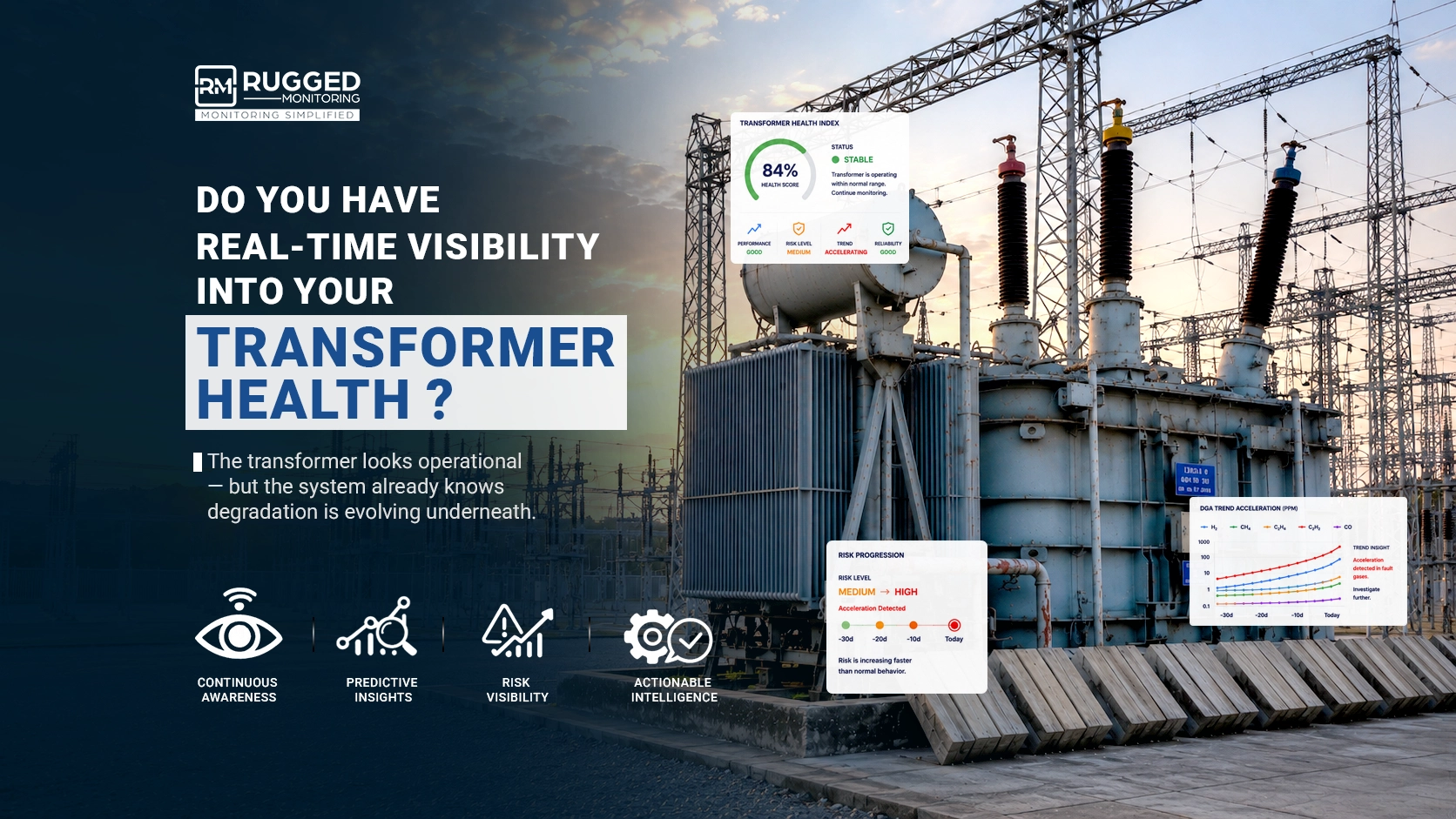
Almost all utilities and industries operate today with some form of a transformer monitoring system. They can access temperature readings, load data, relay events, and, in some cases, periodic diagnostic reports.
Operationally, such a system already creates the impression of visibility.
But when a transformer trips, overheats, or develops a fault, it is never “something suddenly went wrong”. All transformer failures precede weeks or months of health & operational changes. A transformer operating normally might be experiencing insulation degradation faster than systems can detect. Or cooling efficiency might be declining slowly under similar conditions. Or dissolved gas generation may be increasing steadily without triggering any alarms.
None of these issues immediately halts operations or causes massive failures. But, over time, collectively, they change the transformer’s risk profile.
And this is why transformer monitoring systems are rapidly shifting their focus towards continuous, real-time asset visibility and awareness.
Why are transformer monitoring systems adopting real-time visibility?
With the global rise in electricity consumption, demand is at an all-time high. Utilities are struggling to keep up with this amid growing concerns about reliability and sustainability, including regulatory requirements and renewable integration.
Another major concern is the transformer fleets. According to the U.S. Department of Energy, a significant portion of the installed large power transformer base has already exceeded or is approaching its intended design life, increasing reliability concerns across utilities and industrial infrastructure.
Given these conditions, traditional transformer monitoring systems become less effective.
Yes, they do collect data, and yes, they do provide the illusion of visibility.
But the biggest challenge for utilities is continuous real-time visibility into transformer health and performance.
The objective is not simply to collect more operational data. It is to establish an understanding of transformer behavior to help predict and mitigate upcoming failures.
Traditional transformer monitoring systems use a fragmented approach. Multiple systems for multiple parameters & assets, spread across multiple platforms. This introduces the complexity of handling and understanding the nuances of transformer health and performance.
What utilities need is a centralized monitoring system that integrates data and provides context all in one place.
Why is real-time monitoring important for transformers?
Most traditional monitoring architectures are designed primarily for operational supervision and safety.
A typical transformer monitoring system may provide:
- Temperature readings
- Loading information
- Alarm notifications
- Insulation status
- Relay events
- DGA diagnostics
While these functions are critical, they are only operational. They are unable to provide a detailed analysis of the complete transformer. To achieve this, utilities require real-time visibility into the transformer health and performance, which would help them answer critical questions such as:
- Is the transformer aging abnormally?
- How fast is the degradation accelerating?
- Is thermal stress relative to the transformer’s historical behavior?
- How is the risk evolving without raising any alarms?
Such a detailed analysis can only be achieved when utilities have real-time visibility into the transformer conditions. This also changes the role of monitoring entirely, shifting it towards a more predictive approach.
Instead of waiting for abnormalities to become severe enough to trigger alarms, real-time visibility empowers transformer monitoring systems to identify:
- Early-stage degradation
- Unusual trend acceleration
- Abnormal operating patterns
- Emerging failures
All before they escalate into catastrophic events that cause utilities and industries to incur unaccounted-for downtime and maintenance costs.
This contextual understanding is becoming central to modern transformer monitoring strategies.
The role of real-time visibility in predictive maintenance
One of the most rapid shifts happening across asset monitoring is the adoption of predictive maintenance. Asset monitoring systems are shifting their approach from parameter-based monitoring toward behavior-based analysis.
This evolution is also closely tied to advanced platforms like Asset Performance Management (APM).
Designed on the same architecture as condition-based monitoring, APM systems provide complete real-time visibility and predictive intelligence. They integrate the transformer monitoring system data across parameters, fleets, and geographical locations to provide a centralized view of asset health and performance.
APM-oriented platforms can also integrate:
- SCADA inputs
- Online monitoring data
- Sensor live-feed
- DGA reports
- Maintenance records
- Operational history
- Offline & testing reports
- Environmental conditions
Thus, ensuring asset teams are empowered with a comprehensive, actionable understanding of transformers.
With such a wide context of the asset, transformer monitoring systems can:
- Detect degradation earlier
- Prioritize high-risk assets
- Reduce unnecessary interventions
- Optimize outage planning
Thus, improving the reliability and efficiency of maintenance.
With APM, asset teams no longer need to rely on periodic snapshots, manual intervention, or just alarm-driven response. Instead, they gain real-time predictive intelligence, minimizing downtime and maximizing asset reliability.
Real-Time Transformer Visibility is Now an Operational Necessity
The significance of continuous transformer visibility will grow as power grid operations become more dynamic.
Aging infrastructure, fluctuating load conditions, and longer replacement timelines have created a need for systems like APM that can predict and prevent faults before they occur. Also, its ability to identify real-time fluctuations in transformer health is necessary not only for maintenance teams but also for the overall grid’s operational continuity and reliability.
Thus, modern grids require modern transformer monitoring systems that move beyond alarms and data acquisition.
Utilities that can quickly adapt to this change can achieve complete grid modernization.
Move Towards Transformer Monitoring Systems that Ensure Real-Time Visibility
Electrical asset monitoring is no longer just about visibility into operating parameters.
The larger challenge today is understanding how transformer condition evolves over time and identifying early signs of degradation before they become operational problems.
Traditional transformer monitoring systems provide important operational data but often stop short of delivering continuous health visibility. This is why the industry is increasingly adopting advanced approaches such as APM, which provide centralized visibility and predictive intelligence.
The value of modern transformer health monitoring lies not simply in detecting alarms faster, but in understanding asset behavior early enough to make better maintenance and operational decisions.
Because ultimately, reliability does not depend on how much data is available.
It depends on how early the asset condition can truly be understood.
Get in touch with our industry experts to book a demo for our RM EYE, Enterprise APM Suite.
Contact our team today and empower your transformers with the real-time visibility they deserve.