Traditional monitoring is currently struggling to keep up with the evolving power grid. Driven by renewable energy integration, grid digitalization, distributed energy resources (DERs), electrification, and rising reliability expectations, today’s modern power grid looks fundamentally different from the centralized, predictable systems of the past.
Yet, while grids have evolved, many utilities are still relying on traditional monitoring systems designed decades ago, systems built for static assets, limited data, and reactive operations. This mismatch creates blind spots, operational inefficiencies, and growing reliability risks.
In this blog, we explore why traditional grid monitoring systems are failing, how modern grids are monitored today, and what utilities must do to bridge the gap between legacy infrastructure and future-ready smart grid monitoring.
What Is Traditional Grid Monitoring?
Traditional monitoring systems in power grids were designed around a centralized generation model, where electricity flowed one way, from large power plants through transmission and distribution networks to end users.
Key characteristics of traditional monitoring include:
- SCADA-based visibility at substation or feeder level
- Periodic manual inspections
- Alarm-based monitoring focused on threshold violations
- Limited real-time data granularity
- Asset-specific, siloed monitoring systems
These systems were sufficient when grids were stable, predictable, and lightly stressed. But they were never designed for the dynamic, data-intensive nature of modern grids.
Why Do Traditional Grid Monitoring Systems Fail?
Traditional grid monitoring systems were built for a very different era, one where power flows were predictable, generation was centralized, and operational conditions changed slowly. But in the current modern grid, this system can no longer be upheld.
As modern power grids are dynamic, decentralized, and highly stressed, legacy monitoring architecture becomes static in both design and capability. This fundamental mismatch is why traditional grid monitoring systems are failing to keep up.
-
Unable to Scale with the Dynamic Energy Landscape
Traditional monitoring assumes relatively stable operating conditions and gradual system changes. Modern grids, however, operate under constant variability, such as:
-
- Variable renewable generation (solar and wind)
- Bidirectional power flows from DERs
- Rapid load fluctuations from EVs and electrification
- Microgrids and islanding operations
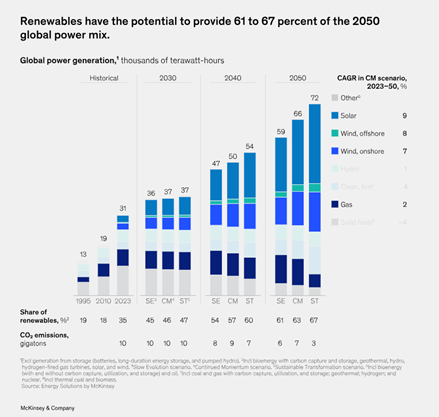
Source: Global Energy Perspective 2025- McKinsey
Legacy monitoring tools struggle to keep up with these rapid changes. Data refresh rates are slow, visibility is limited, and system awareness often lags behind real-world conditions. As a result, operators are frequently reacting to events after they have already escalated, rather than anticipating them.
This delayed awareness is one of the primary reasons traditional monitoring approaches fall short in modern grid environments.
-
Lack of Integrated Real-Time Visibility
Another critical limitation of traditional grid monitoring is the lack of granular, asset-level visibility. Conventional substation monitoring typically relies on aggregated measurements, periodic data snapshots, and limited sensor deployment. While this may provide a high-level operational overview, it fails to reveal what is happening inside individual assets.
Modern grids demand continuous, high-resolution data from transformers, switchgear, cables, breakers, and power electronic components. Without this level of detail, utilities struggle to detect early signs of asset degradation, distinguish between normal operational stress and abnormal behavior, or accurately assess true asset health.
In many cases, the first indication of a problem is not a warning, but an outage. By the time traditional systems register a fault, the opportunity for preventive action has already passed.
-
Reactive Instead of Predictive
Traditional monitoring systems are inherently reactive. They are designed to trigger alarms when predefined thresholds are exceeded, not to identify evolving risk patterns. Whereas modern grids demand:
-
- Predictive maintenance
- Condition-based interventions
- Risk-based asset prioritization
Traditional systems lack the analytics, historical context, and intelligence needed to predict failures before they happen. This leads to higher unplanned downtime and inefficient maintenance practices.
-
Siloed Monitoring and Fragmented Data
One of the most critical limitations of traditional monitoring is data silos.
Typical scenarios include:
-
- Separate systems for transformers, switchgear, protection relays, and cables
- OEM-specific tools that don’t communicate with each other
- No unified view of grid or substation health
In 2019, an oscillation initiated by a fault in the control system of a steam turbine at a combined cycle power plant in the U.S. lasted ~18 minutes before the unit was taken offline. Later, a report published by the North American Electric Reliability Corporation (NERC) highlighted how operators faced significant challenges pinpointing the cause due to fragmented alarm systems and control measurements.
This highlights how, in many cases, the first indication of a problem is not a warning, but the lack of centralized visibility. Fragmentation prevents utilities from correlating events across assets, making it difficult to understand cascading failures or systemic risks.
Thus, siloed traditional monitoring is incompatible with modern grid complexity.
-
Inability to Support Grid Digitalization
Grid digitalization is not just about adding sensors; it’s about turning data into actionable intelligence.
Traditional monitoring systems struggle with:
-
- Data interoperability
- Integration with digital platforms
- Advanced analytics and AI models
- Cloud or edge-based architecture
As a result, it becomes a setback rather than an enabler of digital transformation.
Learn more about the importance of Substation Digitalization
Why must Utilities Shift to Smart Grid Monitoring?
Smart grid monitoring combines advanced IIoT-based sensors deployed across substations, feeders, and critical assets with real-time data acquisition systems that continuously capture operational and condition data. This data is then consolidated through integrated condition-monitoring frameworks that provide asset-level health insights rather than isolated measurements. On top of this foundation, predictive maintenance analytics analyze historical and real-time data to identify early signs of degradation and forecast potential failures before they impact operations. All of these capabilities are brought together within centralized digital platforms that offer a unified, system-wide view of grid performance.
Unlike traditional monitoring, which is largely reactive and asset-siloed, smart grid monitoring is continuous, integrated, and intelligence-driven. It enables utilities to move from simply detecting faults to understanding risk, prioritizing interventions, and actively improving grid reliability in an increasingly complex energy landscape.
The smart grid monitoring approach:
Phase 1: Digitizing critical assets with sensors
This phase focuses on establishing real-time continuous visibility across the entire power grid or substation. IIoT-based sensors are installed at critical asset points to capture parameters like temperature, partial discharge, vibration, load, and operating cycles.
While insights at this stage may be limited, utilities gain something essential for the first time: continuous awareness of asset conditions, rather than relying on periodic inspections or assumptions.
Phase 2: Integrating monitoring data into unified platforms
Once asset-level data is available, the next challenge is fragmentation. Many utilities quickly realize that isolated monitoring systems create as many problems as they solve. To overcome this, they integrate data streams from multiple assets and substations into unified monitoring platforms.
This phase is about breaking down silos. Data from different OEM systems, communication protocols, and asset types is centralized and standardized. Operators move away from multiple dashboards and disconnected alarms toward a single, coherent view of substation or grid health. This integration enables cross-asset visibility and sets the foundation for system-level analysis.
Phase 3: Applying predictive maintenance and analytics
With integrated and continuous data in place, utilities can move beyond basic monitoring to predictive maintenance. Advanced analytics and machine-learning models analyze historical trends, real-time measurements, and operating context to identify early signs of degradation and estimate failure risk.
In this phase, maintenance strategies shift from calendar-based or reactive approaches to condition-based and risk-driven interventions. Instead of asking “What failed?”, utilities begin asking “What is likely to fail next and when?” This reduces unplanned outages, optimizes maintenance resources, and extends asset life.
Phase 4: Linking monitoring with operational decision-making
Predictive insights only deliver value when they influence decisions. In this phase, monitoring and analytics outputs are directly linked to operational workflows and control-room decision-making.
Asset health indicators, risk scores, and predictive alerts are aligned with dispatch planning, load management, outage management systems, and maintenance scheduling. Operators gain contextual intelligence, understanding not only that an asset is at risk but also how that risk affects grid reliability, safety, and service continuity. Monitoring evolves from a diagnostic function into an operational decision-support system.
Phase 5: Scaling across substations and grid segments
Once proven at pilot sites or critical substations, the approach is scaled systematically across the network. Utilities replicate standardized architectures, analytics models, and operational processes across substations, feeders, and grid segments.
This phase transforms isolated digital projects into enterprise-wide grid intelligence. Utilities gain fleet-level visibility, consistent risk assessment, and the ability to prioritize investments and interventions across the entire grid. Scalability ensures that digital monitoring supports not only individual assets but also long-term grid planning and resilience strategies.
By progressing through these phases, utilities fundamentally change how they manage reliability. The focus shifts from responding to outages after they occur to anticipating risk and preventing failures before they impact customers.
This phased transition enables utilities to operate modern grids with greater confidence, resilience, and efficiency, turning monitoring from a reactive necessity into a strategic capability.
What does the future look like?
The evolution of the power grid has outpaced the capabilities of traditional monitoring systems. As grids become more complex, distributed, and data-driven, legacy approaches create operational risk rather than reliability.
To keep pace with modern grids, utilities must move beyond traditional monitoring and towards complete grid modernization. Thus, transforming grids to be safer, more efficient, and more reliable.
Contact Rugged Monitoring’s Team of Experts to Start Your Transition to Smart Grid Monitoring