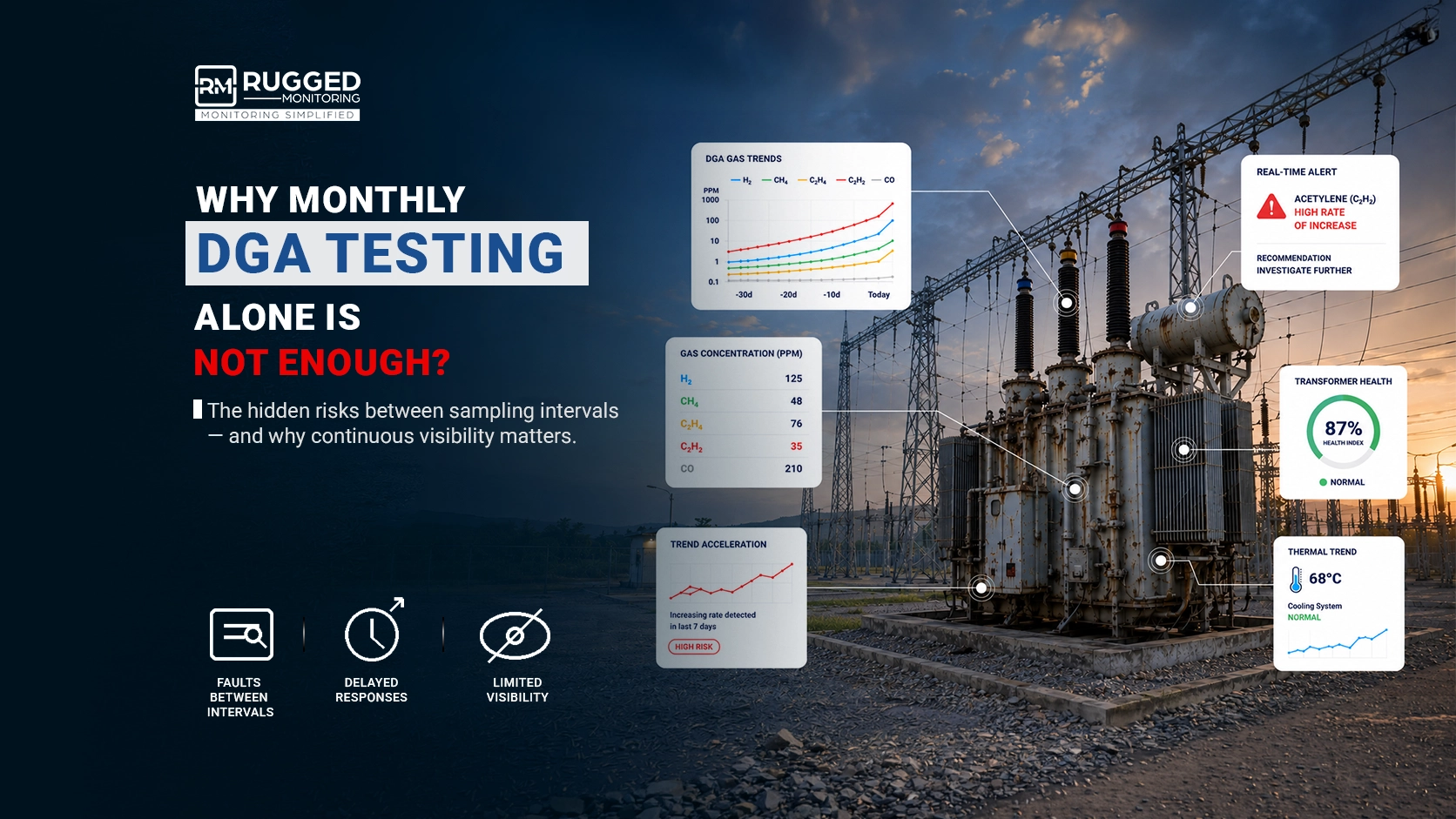
Online DGA monitoring is changing the way utilities and industrial plants approach transformer reliability. Traditional testing or periodic oil checks are increasingly unable to keep pace with the development of transformer faults.
For decades, periodic transformer oil analysis has been considered the standard approach for identifying internal transformer issues. Where utilities collect oil samples monthly or quarterly, send them to laboratories, review dissolved gas levels, and compare the results against acceptable thresholds.
From a compliance perspective, this process appears sufficient.
Operationally, however, the reality is different.
Transformer failures do not follow maintenance calendars. Internal faults such as thermal overheating, partial discharge, and low-energy arcing can accelerate rapidly between sampling intervals. A transformer may appear stable during one monthly report and show critical gas escalation weeks later, without any visibility into what happened in between.
Hence, there is a need for online DGA monitoring.
Fundamentally, the issue is not that DGA is ineffective. In fact, Dissolved Gas Analysis remains one of the most valuable diagnostic techniques available in transformer condition assessment. The limitation lies in how infrequently the data is captured and how often it is disconnected from real operating conditions.
As transformer fleets age and loading conditions become increasingly dynamic, relying solely on periodic sampling creates growing diagnostic blind spots.
The Growing Need for Online DGA Monitoring
The basic principle of DGA monitoring is: internal transformer faults generate gases.
When insulation, oil, or metallic components experience abnormal electrical or thermal stress, decomposition occurs, and gases dissolve into the transformer oil. Different fault mechanisms generate characteristic gas signatures:
- Hydrogen (H₂) often indicates partial discharge.
- Acetylene (C₂H₂) is associated with arcing.
- Ethylene (C₂H₄) suggests thermal overheating.
- Carbon monoxide (CO) reflects cellulose insulation degradation.
By analyzing these gases using online DGA monitoring, utilities can identify developing internal faults before they occur. Thus, making DGA a foundational component of transformer maintenance programs globally.
Standards such as IEC 60599 and IEEE C57.104 provide detailed guidance for interpreting gas levels and fault conditions.
Traditional transformer oil analysis methods were successful when:
- Transformer loading profiles were more stable.
- Grid conditions were less dynamic.
- Continuous digital monitoring was limited.
- Maintenance cycles were largely time-based.
But for today’s operating environment, things have changed significantly.
Transformers are subjected to:
- Higher and fluctuating load demands
- Renewable integration variability
- More aggressive thermal cycling
- Extended operating life beyond original design expectations
Without online DGA monitoring, such dynamic faults go unnoticed and rapidly evolve into catastrophic failures.
But Why is Monthly DGA Testing Not Enough?
The primary challenge with periodic testing is not the quality of the data but the gap between maintenance.
Unlike online DGA monitoring, traditional transformer oil analysis relies only on a laboratory report. This provides a snapshot of transformer conditions at a specific moment, when the sample was collected. What it does not show is how the transformer behaved before the sample was taken or how rapidly conditions may change afterward.
This creates several critical limitations.
Fault acceleration between sampling intervals
A transformer fault rarely develops at a constant rate. Some faults remain stable for months, while others escalate rapidly within days or weeks.
For example:
- A localized thermal fault may suddenly intensify under increased loading.
- Partial discharge activity may accelerate due to insulation weakening.
- Moisture ingress may trigger rapid dielectric deterioration.
Without online DGA monitoring, these transitions may go completely undetected until the next sample.
This is particularly concerning for high-criticality transformers where fault escalation can lead to:
- Forced outages
- Fire risk
- Irreversible insulation damage
- Long-duration downtime
According to CIGRE reliability studies, insulation and dielectric-related failures remain among the most significant contributors to transformer outages globally.
Loss of trend continuity
The value of DGA lies less in individual gas values and more in trend behavior.
A single report may indicate acceptable gas concentrations, but online DGA monitoring provides trend analysis that reveals:
- Accelerating gas generation
- Sudden directional changes
- Unusual gas ratio evolution
When sampling intervals are too large and manual, this continuity is lost.
What remains unknown is:
- When the increase began
- Whether it accelerated gradually or suddenly
- Whether operational events triggered the change
Without continuous visibility, diagnosis becomes reactive rather than predictive.
Delayed response to developing faults
Traditional transformer oil analysis workflows are inherently delayed:
- Sample collection
- Transportation to the laboratory
- Testing and analysis
- Report generation
- Engineering review
In some cases, actionable interpretation may take days or weeks.
For slowly developing faults, this may be acceptable. But for rapidly evolving conditions, it is not.
Hence, online DGA monitoring. It resolves the problem with real-time analytics and data-driven decisions.
Inability to correlate gas behavior with operational conditions
Periodic DGA reports are often reviewed independently of:
- Transformer loading
- Ambient temperature
- Cooling system performance
- Switching events
This disconnect limits diagnostic accuracy.
Gas generation is strongly influenced by operational stress. Without correlating DGA trends with operating conditions, engineers may struggle to determine:
- Whether gas formation is load-related
- Whether thermal stress is increasing
- Whether a fault is transient or persistent
This is one of the most significant practical limitations of DGA testing in transformers today.
How Online DGA Monitoring Is Changing Transformer Maintenance?
Online DGA monitoring addresses the limitations of traditional transformer oil analysis by providing real-time visibility and continuous condition assessment. This fundamentally changes how faults are detected and managed.
Continuous fault visibility
With online DGA monitoring, gas trends can be observed continuously rather than retrospectively.
This enables:
- Detection of rapid gas escalation
- Identification of abnormal trend acceleration
- Immediate visibility into changing fault conditions
Instead of discovering a fault weeks later, asset teams can identify it as it develops.
Improved diagnostic confidence
Continuous gas monitoring provides significantly richer trend data.
Engineers can evaluate:
- Gas generation rate
- Trend stability
- Correlation with load cycles
- Impact of operational events
This improves diagnostic accuracy and reduces uncertainty around fault interpretation.
Faster operational response
One of the most important advantages of online DGA monitoring is response speed.
Continuous monitoring enables:
- Early alerts for abnormal gas growth
- Faster engineering review
- Timely inspection and intervention
This reduces the likelihood that faults will progress unnoticed between maintenance intervals.
Better integration with advanced monitoring systems
Modern transformer reliability strategies depend on integrating multiple data sources:
- DGA trends
- Temperature behavior
- Load patterns
- Moisture levels
- Cooling performance
Online DGA monitoring systems make this integration possible by providing continuous data streams rather than isolated reports.
This supports more advanced condition assessment and predictive maintenance strategies.
The Shift Toward Continuous Asset Visibility
The industry is gradually shifting from periodic diagnostics toward intelligent predictive systems.
This does not eliminate traditional transformer oil analysis. Instead, it enhances it by adding:
- Real-time visibility
- Faster fault recognition
- Better trend continuity
- Improved operational response
This evolution is closely tied to broader Asset Performance Management (APM) strategies, in which transformer condition is continuously evaluated rather than only during scheduled testing intervals.
The objective is no longer simply identifying faults.
It is identifying them early enough to prevent escalation.
The Goal is to Achieve Predictive Maintenance through Online DGA Monitoring
Dissolved Gas Analysis remains one of the most important diagnostic tools in transformer maintenance. However, the operational environment surrounding transformers has changed significantly, while many testing practices have remained largely unchanged.
The key challenge today is not the absence of diagnostics, but the absence of continuous visibility.
The major limitations of DGA testing in transformers arise when periodic reports are required to detect rapidly evolving faults under increasingly dynamic operating conditions.
This is why online DGA monitoring is becoming essential, not as a replacement for transformer oil analysis, but as the next step in making it more responsive, connected, and actionable.
Because in transformer reliability, the difference between a manageable fault and a major failure often comes down to one factor:
How early was the change detected?
Move on from monthly reports. Shift to predictive intelligence.
Learn more about Rugged Monitoring’s DGA monitoring system and how it transforms your monitoring data into actionable intelligence.