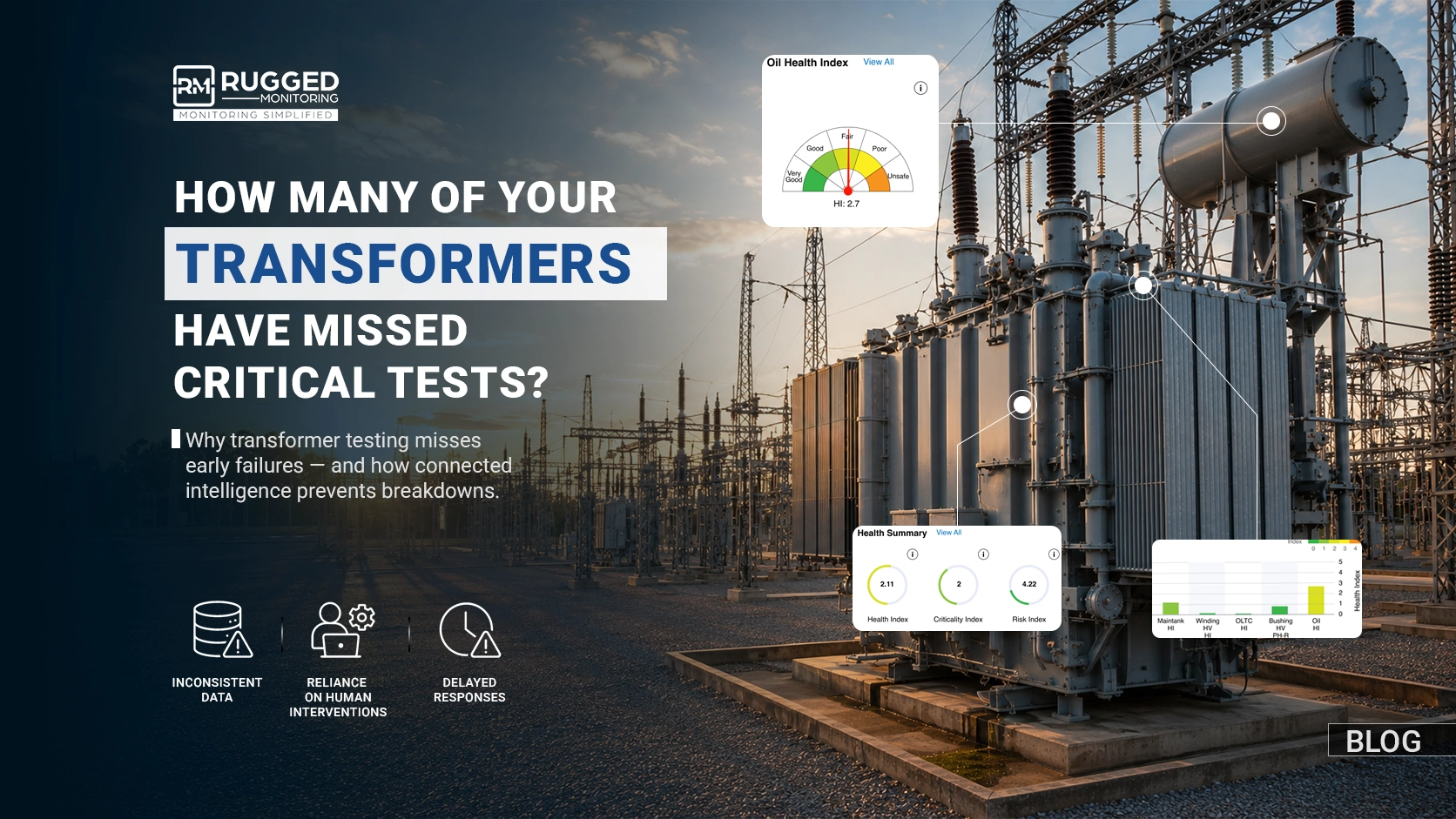
Threshold-based transformer testing and maintenance procedures represent the biggest gap in monitoring. They focus on evaluating the evidence behind failure, post-event. Whereas, in most cases, that evidence has existed in the form of incomplete data, delayed visibility, or improperly executed transformer maintenance schedules.
Consider this, a situation that is frequently encountered by substations and industrial plants:
- A transformer develops an internal fault
- Monitoring systems in place, wait for it to cross a set threshold
- An alert is triggered when the event occurs
- Post-failure analysis is conducted, revealing the issue as DGA that was scheduled too late. Moisture content was not measured after a known oil leak.
- A tan delta test conducted earlier flagged some abnormal values, but it wasn’t followed up on.
- Scheduled cooling system checks were postponed due to operational constraints
On paper, every system was doing its job. But when the issue is observed across the board, a different pattern emerges.
The issue is not a lack of alerts; the issue is isolation.
According to industry assessments, a significant proportion of failures are caused by insulation degradation, aging, thermal hotspots, and oil contamination. All these conditions trigger alerts, but still cause failures due to transformer testing silos.
The Current State of Transformer Testing in Utilities & Industrial Plants
Transformer testing practices across utilities and industrial plants are, in principle, well-defined and standardized. Frameworks established by IEC, IEEE, and utility-specific guidelines clearly outline routine, diagnostic, and specialized testing requirements across the asset lifecycle. From a compliance standpoint, most organizations are aligned.
Typical transformer testing procedures include a combination of electrical, chemical, and thermal diagnostics:
- Dissolved Gas Analysis (DGA) for internal fault detection
- Insulation Resistance (IR) and Polarization Index (PI) for dielectric condition
- Tan delta (power factor) testing for insulation losses
- Winding resistance and ratio tests for electrical integrity
- Oil quality analysis (BDV, moisture, acidity) for insulation medium health
- Partial discharge (PD) measurements for early insulation defects
- Thermographic inspections for thermal anomalies
Collectively, these transformer testing methods form a robust diagnostic framework. However, in practice, they are often executed as discrete activities, either scheduled, completed, or archived, rather than as interconnected inputs to a continuous condition assessment process.
This is where the limitation begins.
A transformer does not fail due to a single parameter drifting out of range. Failures typically arise from the interaction of multiple low-severity issues that evolve simultaneously and affect one another over time.
When testing remains fragmented, these interactions are rarely identified early.
The challenge, therefore, is not the absence of testing but the absence of integration and contextual interpretation.
This concern is also reflected at an industry level. A report by the U.S. Department of Energy highlights that limited visibility into condition data, particularly when testing results are not effectively integrated or analyzed, can directly impact reliability and lead to higher maintenance costs over time.
In its current state, transformer testing in many organizations remains compliance-driven rather than insight-driven. Bridging this gap is essential if testing is to move from a periodic obligation to a meaningful tool for failure prevention.
How does relying only on transformer testing miss critical failures?
Insulation degradation goes unnoticed
Insulation-related failures are a leading concern for transformers. Periodic IR, PI, or tan-delta transformer testing cannot detect minor deviations and early-stage degradation patterns. Additionally, factors such as moisture ingress, thermal stress, and oxidation all contribute to weaker insulation. When these issues are tested in isolation, changes remain invisible until a major dielectric event occurs.
DGA trends are lost between intervals
DGA is the most advanced diagnostic tool for identifying internal faults. However, its effectiveness is highly dependent on trend continuity. Transformer testing should be followed by analyzing gas formation patterns, early fault signatures, and fault progression rates, all of which require advanced analytics.
Cooling system issues remain hidden
Cooling systems are only checked during routine transformer maintenance. They are not continuously evaluated like the rest of the transformer. Thus, resulting in missed faults due to irregular transformer testing. Stress accumulated over time reduces cooling efficiency, increases operating temperatures, and accelerates insulation aging.
Bushing deterioration is not identified early
Bushing failures are among the most severe causes of transformer failure, often leading to catastrophic damage. Just transformer testing fails to recognize early fault indicators such as increased capacitance, higher tan delta values, or localized heating.
Oil degradation acceleration goes undetected
The quality of transformer oil directly affects the insulation performance and its ability to dissipate heat. Transformer testing is generally done in fixed time intervals, missing any changes that occur in between that require immediate action. Thus, resulting in reduced dielectric strength, increased acidity, and sludge formation that compromise both electrical and thermal performance.
Is transformer testing enough?
Most utilities today only execute traditional maintenance strategies, such as scheduled transformer testing and other reactive interventions. While this approach is effective for a threshold-based framework, it has several limitations:
- Limited visibility into complete asset health and performance
- Fixed schedules unable to detect faults early on
- Testing frequency does not align with degradation patterns
- Data is spread across systems, limiting decision-making
- Maintenance strategies depend heavily on manual interventions
And even when testing is performed at accurate intervals, errors in execution or data interpretation reduce its effectiveness. Other issues with traditional transformer testing include:
- Lack of testing consistency
Tests may be missed, ignored, or delayed due to personnel unavailability or budget and operational constraints, increasing the risk of transformer failures. Inconsistency also disrupts trend analysis data and reduces diagnostic accuracy.
- Over-reliance on single test results
Decisions based on individual reports and fragmented data lead to an incomplete diagnosis. Without correlating multiple transformer testing data, operators fail to identify cascading issues, which will maximize asset downtime and maintenance costs.
- Ignoring minor deviations
Minute changes and deviations in critical parameters, such as insulation, are often ignored because of the established thresholds. However, such minor changes are often the earliest indicators of transformer failures.
- Poor data integration
In traditional maintenance strategies, transformer testing data is stored in silos, making it difficult to analyze long-term trends or forming patterns. This limits asset experts’ ability to make context-aware decisions that affect the transformer’s performance, reliability, and aging.
- Delayed response to abnormal results
Even when transformer testing identifies issues, corrective action is often delayed due to unclear prioritization. This is due to a lack of centralized visibility across the asset or its entire fleet.
These gaps highlight the need for a centralized monitoring platform that supports the existing industry-established transformer testing practices.
How does Asset Performance Management (APM) strengthen transformer testing and maintenance?
Asset performance management (APM) systems do not replace transformer testing. They work towards enhancing its effectiveness. They integrate testing data across multiple systems, assets, and timelines to deliver real-time, data-driven intelligence. With APM, transformer testing is not just performed, it is:
- Tracked
- Analyzed
- Correlated
- Acted Upon
Visibility into testing compliance
APM provides a centralized view of all testing activities across the transformer fleet.
- Identifies missed or delayed tests
- Tracks adherence to testing schedules
- Highlights gaps in maintenance execution
Continuous condition assessment
Instead of relying solely on periodic tests, APM continuously evaluates asset condition.
- Tracks trends between test intervals
- Identifies emerging risks early
- Reduces dependency on discrete testing events
Improved decision-making
APM converts test data into actionable insights.
- Prioritizes assets based on risk
- Recommends targeted interventions
- Reduces delay between detection and action
Fleet-level testing intelligence
APM enables comparison across multiple transformers.
- Identifies assets with recurring testing gaps
- Detects systemic issues across the fleet
- Optimizes maintenance planning
From missed tests to missed failures
A transformer does not fail because testing procedures are undefined. It fails because those procedures are executed in isolation from one another.
For the modern grid that demands continuous performance and higher reliability even during operational overloads, monitoring requires more than adding tests.
It requires an asset performance management system that ensures that every test contributes to a continuous understanding of asset conditions.
When transformer testing becomes part of a connected, predictive intelligence framework, it shifts from a compliance activity to a reliability driver.
Stop relying on incomplete testing cycles to understand your transformers.
Get full visibility into your transformer’s health and performance with RM EYE APM.