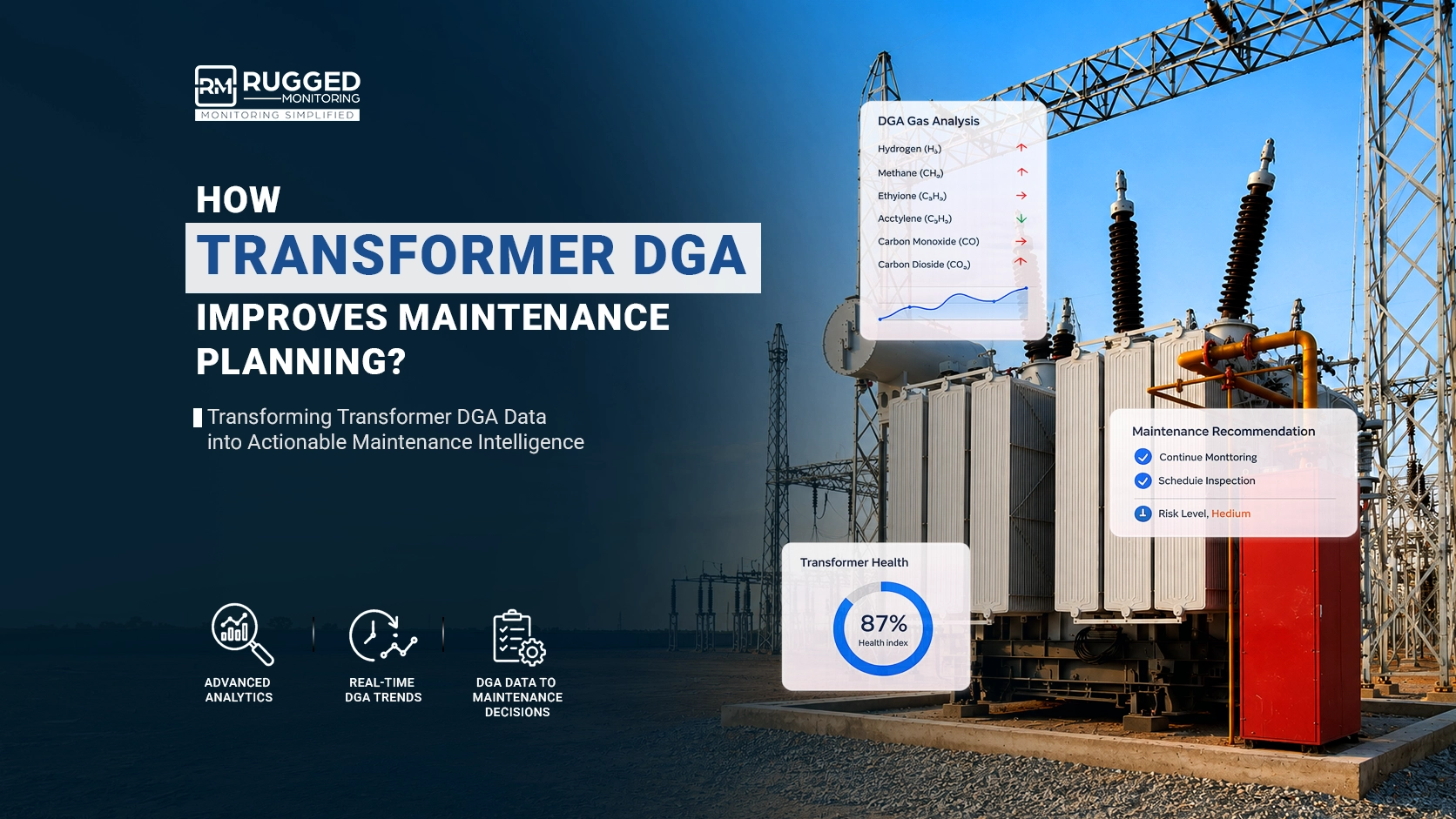
Transformer DGA (dissolved gas analysis) is the most widely used diagnostic technique for detecting faults in oil-filled transformers. By analyzing the presence of gases dissolved in transformer oil, asset experts can prioritize inspections, schedule maintenance, and even allocate operational budgets. This improves operational foresight into the asset’s actual condition and minimizes the risk of unexpected failures.
While DGA testing remains a cornerstone of transformer condition assessment, the method remains highly reactive. Results need to be manually evaluated, test records are fragmented, and data is underutilized for insight-driven actions.
Thus, utility and industrial operators are continuously shifting their maintenance strategies towards a more predictive, risk-based approach, converting transformer DGA data into actionable maintenance decisions.
What Is Transformer DGA and Why Does It Matter?
Transformer DGA is an advanced diagnostic method that measures gases generated within oil-filled transformers. By analyzing the gases generated during the breakdown of insulation materials or transformer oil under electrical or thermal stress, operators can detect faults early.
Common gases monitored during DGA testing include hydrogen, methane, ethane, ethylene, acetylene, carbon monoxide, and carbon dioxide. Each of these gases provides clues to different failure mechanisms occurring inside the transformer.
Since many transformer faults begin internally and remain invisible during routine inspections, transformer DGA provides one of the earliest indicators of deteriorating asset health.
Traditionally, protection devices such as Buchholz relays have been used to detect substantial or catastrophic faults in oil-filled transformers. They respond to significant gas accumulation or oil surge once a serious internal event is already underway. They do not capture the subtle dissolved-gas patterns that show a fault is still developing. That early visibility comes from transformer DGA. APM platforms then help teams turn those results into prioritized maintenance decisions.
The Mechanism Behind Dissolved Gas Analysis
As transformers operate, electrical and thermal stress can break down oil and insulation. That produces dissolved gases. Each gas is a clue, not a verdict.
Common associations include:
Hydrogen — often linked with partial discharge; can also appear with other low-energy electrical or thermal stress
Methane — often linked with low-temperature overheating of oil, and sometimes with discharge activity
Ethylene — often linked with higher-temperature hotspots or localized overheating of oil
Acetylene — often linked with high-energy arcing
Carbon monoxide — often linked with thermal stress on cellulose (paper) insulation
Carbon dioxide — often linked with overheating of paper; usually read with carbon monoxide and other oil gases
Oxygen — often linked with residual air or air ingress, not a fault gas by itself
*The IEC 60599 provides a reliable framework for interpreting gas levels, helping operators pinpoint issues such as partial discharges, overheating, or even electrical arcing inside the unit.
The Limitations of Isolated DGA Reports
Many organizations still manage transformer DGA reports as standalone laboratory documents. While valuable, isolated reports create challenges for long-term decision-making.
Engineers often need to manually compare historical reports, evaluate trends, and correlate findings with operating conditions. This process becomes increasingly difficult as transformer fleets scale.
The result is delayed decision-making, inconsistent risk assessments, and missed opportunities for early intervention.
Centralized monitoring platforms, such as asset performance management (APM), solve this challenge by continuously aggregating transformer DGA results alongside operational and maintenance data. Instead of reviewing individual reports, maintenance teams receive asset health insights and prioritized recommendations.
This shift transforms DGA from a diagnostic test into a strategic maintenance planning tool.
How does APM help DGA with Transformer Maintenance Planning?
Traditional maintenance programs often rely on time-based intervals. Transformers may be inspected annually regardless of their condition. While simple to manage, this approach can result in unnecessary maintenance on healthy assets and insufficient attention to deteriorating equipment.
APM introduces condition-based decision-making for transformer DGA. Instead of asking when maintenance is due, organizations can evaluate whether maintenance is necessary at all.
Gas generation trends help maintenance teams assess fault progression rates. Slowly increasing gas concentrations may require continued monitoring, while rapidly escalating values could justify immediate inspection or outage planning.
This enables maintenance resources to be directed toward the assets presenting the highest operational risk.
For example, two transformers of the same age may receive identical maintenance schedules under a time-based program. APM analytics could reveal that one transformer remains healthy while the other is experiencing active insulation degradation, requiring prioritized intervention.
Why APM for Transformer DGA?
While a single DGA test provides only a snapshot of a transformer’s condition, APM offers comprehensive insights into its health and performance.
Gas concentration changes over time often reveal more valuable information than absolute values alone. A transformer with moderately elevated gas levels that remain stable may pose a lower risk than one showing rapidly accelerating gas generation.
APM also helps maintenance teams answer critical questions such as:
- Is the fault active or dormant?
- Is deterioration accelerating?
- How quickly is risk increasing?
- When should intervention be planned?
These insights support more accurate maintenance scheduling and reduce uncertainty during asset management decisions.
How to use APM with DGA data for reliable transformer health monitoring?
Transformer DGA is one of the most valuable diagnostics, becoming significantly more powerful when combined with asset performance management (APM) platforms.
APM systems evaluate multiple data sources simultaneously, including loading history, temperature profiles, moisture levels, oil quality metrics, insulation condition, and maintenance records.
DGA is a critical input within this broader asset health framework.
APM aggregates transformer DGA data alongside online monitoring information, asset criticality, operational history, maintenance records, loading profiles, and risk assessments. Advanced analytics then evaluate asset conditions and prioritize maintenance actions based on business impact.
Instead of reviewing hundreds of individual DGA reports, maintenance teams receive a consolidated view of transformer health, risk levels, and recommended interventions.
This enables organizations to optimize maintenance budgets while improving reliability outcomes.
From DGA Testing to Predictive Maintenance
The ultimate value of transformer DGA lies not only in fault detection but also in its ability to support predictive maintenance strategies.
Predictive maintenance uses condition data and analytics to forecast future asset behavior and identify optimal intervention windows before failures occur.
By combining diagnostic intelligence with risk modeling and asset health analytics, APM supports strategic decisions related to maintenance prioritization, capital planning, refurbishment, and replacement.
Rather than treating DGA as a standalone test, organizations can incorporate it into a comprehensive asset management framework that aligns maintenance activities with reliability objectives.
This evolution represents the next stage of transformer health management for utilities, industrial facilities, and power-intensive operations.
Take the next step towards intelligent asset management.
Book a Demo of our Enterprise APM, RM EYE.
FAQ Section
How often should DGA testing be performed on transformers?
Testing frequency depends on transformer criticality, age, operating conditions, and utility standards. Critical transformers may require quarterly or monthly testing, while lower-risk assets may follow annual testing schedules. Continuous monitoring may be appropriate for highly critical assets.
What faults can DGA analysis detect?
DGA analysis can identify thermal faults, partial discharge activity, high-energy arcing, insulation degradation, and oil decomposition. Different fault mechanisms generate characteristic gas signatures that help engineers determine the underlying issue.
What is the difference between laboratory DGA and online DGA?
Laboratory DGA relies on periodic oil sampling and laboratory analysis, while online DGA continuously monitors fault gases using permanently installed sensors. Online systems enable faster detection of changes in transformer conditions.
How does DGA support predictive maintenance?
DGA provides condition data that helps maintenance teams assess fault progression and asset health. When combined with operational and historical data, it enables maintenance scheduling based on predicted asset condition rather than fixed intervals.
How does APM use DGA data?
APM platforms integrate DGA information with operational, maintenance, and risk data to generate asset health scores, maintenance recommendations, and failure risk assessments. This helps organizations prioritize resources and optimize maintenance planning.