Most organizations have monitoring systems, but very few have true asset health monitoring.
That distinction is becoming increasingly important as transformer fleets age, operating conditions become more dynamic, and maintenance teams are expected to manage larger asset populations with limited resources.
Walk into any utility substation or industrial plant control room, and the volume of available information appears overwhelming. Operators have access to SCADA screens, alarm logs, inspection reports, maintenance schedules, oil analysis records, and equipment histories.
On paper, visibility may seem adequate.
Yet when a transformer develops a fault, overheats unexpectedly, or experiences accelerated insulation degradation, maintenance teams are often forced to make reactive decisions. The issue is not that information was unavailable. The issue is that the information never existed in a form that accurately reflected the asset’s actual condition in real time.
This is one of the most overlooked operational challenges in modern utilities and industrial infrastructure:
The growing lack of visibility in asset health monitoring.
What is Asset Health Monitoring?
Electrical asset health monitoring empowers maintenance teams with continuous, real-time evaluation of an asset’s operational and physical conditions throughout its lifecycle.
Conventional systems like SCADA, EAM, or CMMS focus only on fixed alarms and inspection data, failing to provide information on how equipment behaves under real operating conditions.
For critical assets such as transformers, asset health monitoring can provide continuous insights into:
- Thermal performance under varying loads
- Dissolved gas generation trends
- Cooling system efficiency
- Moisture levels and insulation conditions
- Operational stress and historical degradation patterns
The objective is not simply to identify faults after they occur, but to understand whether the asset’s health is improving, stable, or deteriorating over time.
This is especially important for maintenance teams, as asset health directly correlates to its performance, reliability, and efficiency.
And without continuous visibility into asset health monitoring, their decisions remain delayed, static, and reactive.
Why Is the Lack of Visibility into Asset Health Monitoring an Operational Threat?
Most assets continue to perform despite poor internal health. And either due to limited or no visibility, this is not considered a potential operational risk. Thus, pushing maintenance teams to:
- Think the asset is healthy because no alarms exist
- Continue operating equipment under increasing stress
- Miss early-stage degradation patterns
- Delay maintenance because visible symptoms have not appeared yet
But over time, inadequate asset health monitoring leads to accelerated aging, increased probability of failures, and eventually higher maintenance and replacement costs.
According to a report published by the International Energy Agency, aging infrastructure combined with reactive maintenance and limited asset visibility is a growing reliability concern for power grids globally.
One of the biggest reasons maintenance teams struggle with real-time visibility for asset health is fragmented systems.
Multiple asset data is spread across multiple systems. Some offline & some online.
Currently, a typical asset maintenance environment may include:
- SCADA for operational parameters
- DGA reports
- CMMS platforms for maintenance records
- Periodic inspection reports
- Relay event logs and fault history
All these work independently and rarely communicate with each other, creating data silos, information loss, and manual errors. Without a centralized system that provides complete visibility into asset health monitoring and predictive maintenance, teams still base their decision on isolated data points.
Thus, affecting not only maintenance strategies but also operational decisions.
The Role of Asset Performance Management in Asset Health Monitoring
Unlike EAM or CMMS platforms, Asset Performance Management (APM) provides a centralized approach to evaluating asset conditions, performance, and health through integrated data and analytics.
Its primary focus is on understanding how assets behave over time and how that behavior impacts reliability. A typical APM framework includes:
- IIoT sensor data
- Historical maintenance records
- Condition monitoring trends
- Asset health patterns
- Operational history & offline data
- Asset Behavioral analysis
- Predictive Insights
- Data-Driven Actions
Thus, expanding the purpose of APM beyond just collecting data.
Instead of asking, “Was this maintenance completed?”, APM helps utilities and industries answer, “Is this asset becoming healthier or riskier over time?”
That fundamental difference is enough for teams to understand asset health monitoring and beyond.
How Does APM Ensure Real-Time Visibility into Asset Health Monitoring?
The biggest advantage of APM is its ability to ensure continuous, integrated visibility across assets, fleets, and locations.
Instead of treating monitoring, maintenance, and diagnostics as separate activities, APM integrates them into a unified operational view.
Through continuous conditional awareness, O&M teams gain real-time visibility into asset health monitoring.
Data Centralization:
APM eliminates the need for fragmented systems and ensures a centralized understanding of asset health and conditions.
Predictive Maintenance Capabilities:
Instead of relying on fixed schedules, maintenance teams can prioritize actions based on:
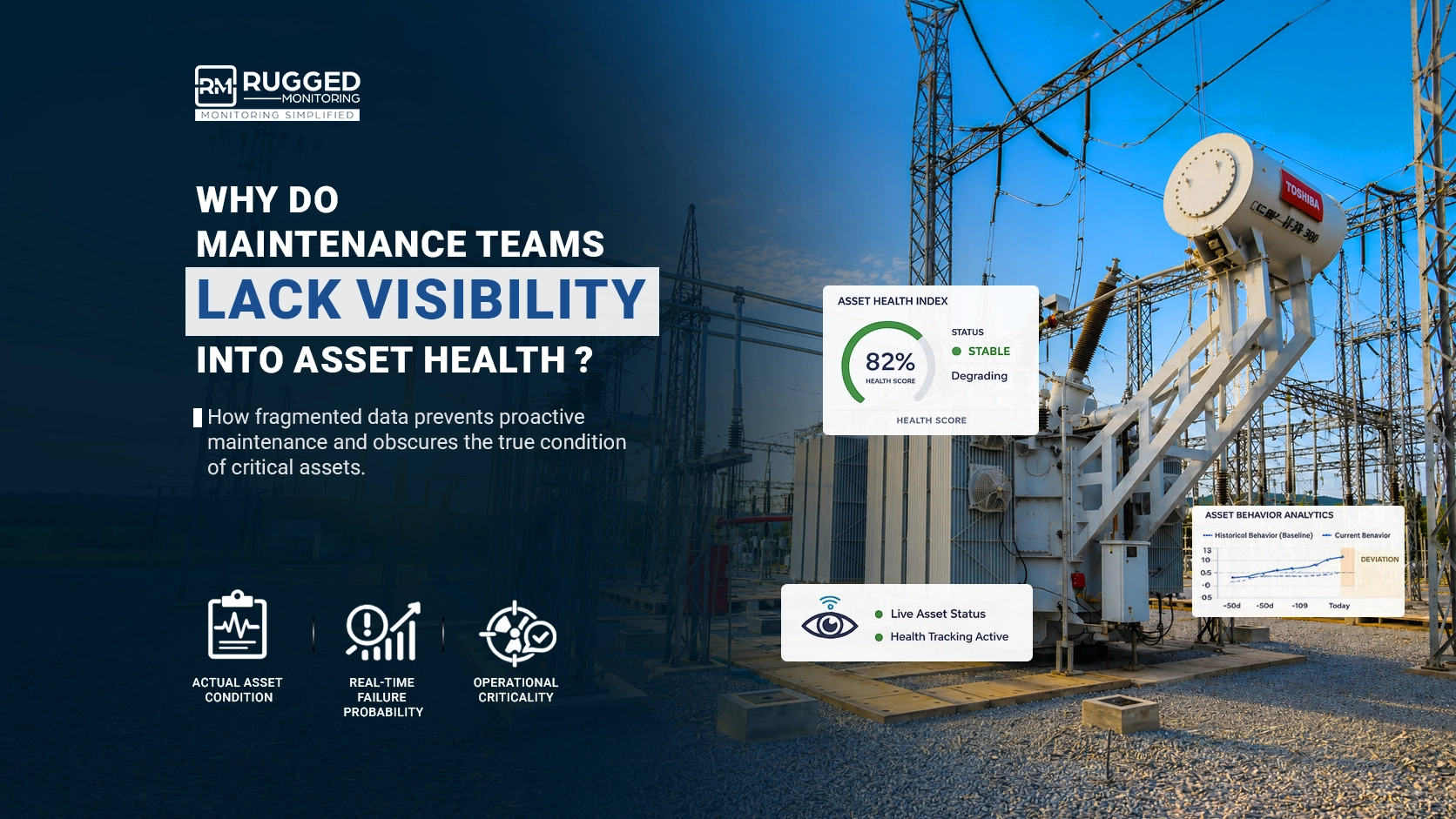
- Actual asset condition
- Degradation rate
- Failure probability
- Operational criticality
This improves maintenance efficiency while reducing unexpected failures.
Fleet-level visibility
APM also enables organizations to evaluate transformer condition across the entire fleet rather than on a per-asset basis.
Maintenance teams can:
- Compare transformer health across substations
- Identify high-risk assets early
- Allocate maintenance resources more effectively
- Track degradation trends across locations
This level of visibility is difficult to achieve with isolated monitoring systems alone.
For Visibility Beyond Asset Conditions
The challenge facing maintenance teams today is not a lack of monitoring systems or maintenance procedures. The challenge is the inability to convert fragmented operational data into continuous visibility into true asset health.
Traditional approaches provide isolated snapshots of transformer behavior, but modern operating environments require something more dynamic: continuous asset health monitoring that can identify degradation before it leads to operational failure.
This is why the industry is increasingly moving toward Asset Performance Management.
Because ultimately, reliability is not determined by how much data exists.
It is determined by how effectively that data provides visibility into the asset’s condition before failures occur.