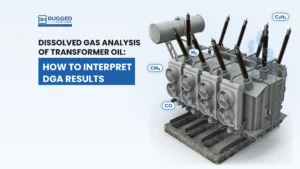
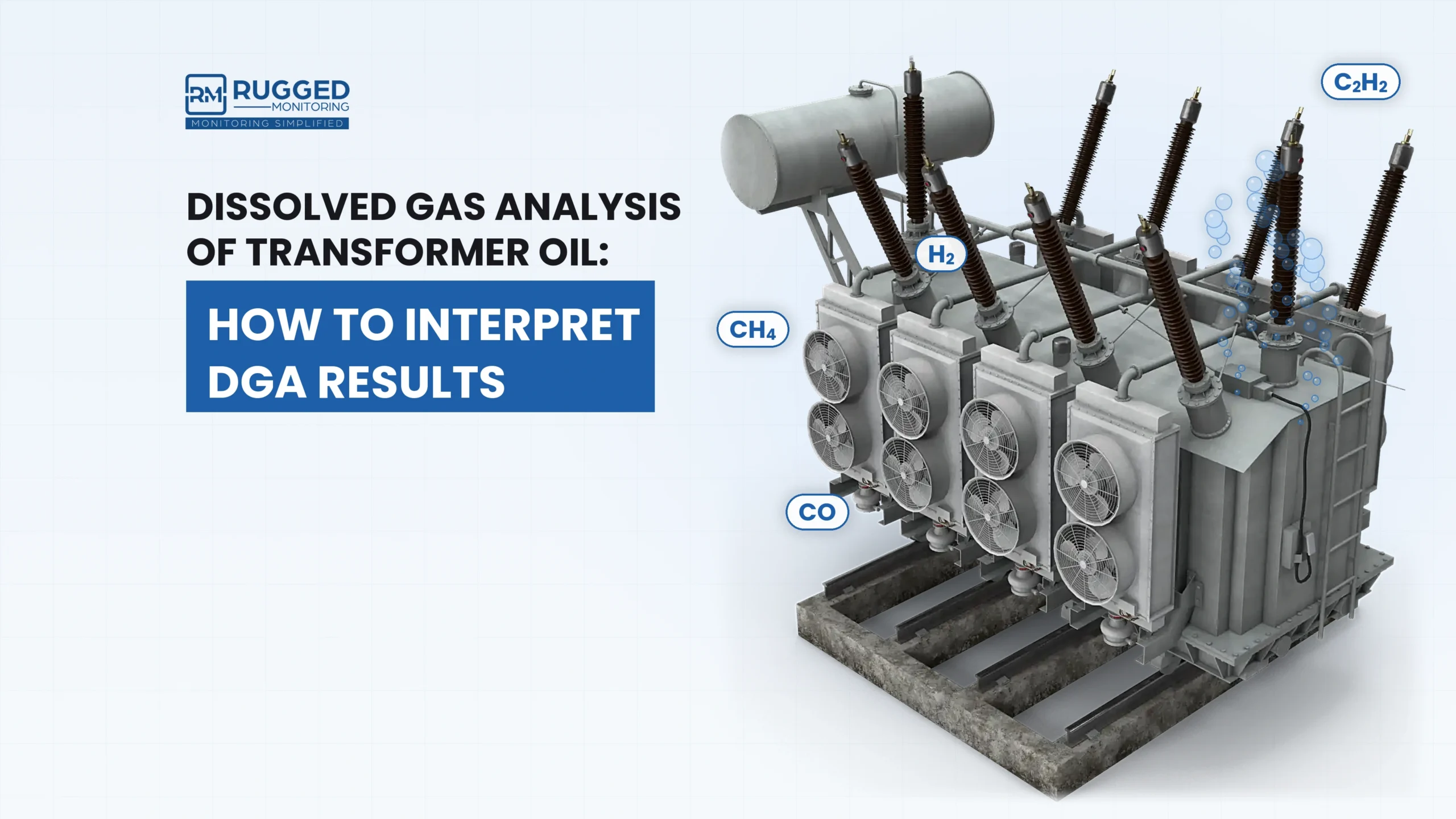
Finding gas in transformer oil is one thing. Understanding what that gas is telling you is another.
Dissolved gas analysis of transformer oil measures gases produced when insulating oil and solid cellulose insulation undergo electrical or thermal stress. But one gas concentration rarely identifies the condition on its own.
The real diagnostic value comes from looking at gas patterns, changes over time, and transformer history together. So, how do you turn a DGA report into useful information about transformer condition?
What is dissolved gas analysis of transformer oil?
Dissolved gas analysis of transformer oil is a diagnostic method that identifies and measures gases dissolved in the insulating oil. Thermal and electrical stresses can decompose the insulating oil and solid cellulose insulation, producing gases that dissolve in the oil. Their concentrations, combinations, and changes over time can provide evidence of developing conditions inside a transformer.
To interpret DGA results, it helps to first understand which gases are being measured.
Which gases does DGA detect in transformer oil, and why are they analyzed?
DGA measures gases associated with different electrical and thermal conditions. Individual gases provide useful clues, but engineers interpret them as part of the overall gas pattern.
| Gas | Symbol | Common association |
| Hydrogen | H₂ | Partial discharge and other low-energy electrical or thermal activity |
| Methane | CH₄ | Lower-temperature oil overheating; can also occur with low-energy electrical discharge |
| Ethane | C₂H₆ | Low- to medium-temperature thermal faults in oil |
| Ethylene | C₂H₄ | Higher-temperature thermal faults in oil |
| Acetylene | C₂H₂ | Arcing and high-energy discharge; small amounts can also occur under very high-temperature thermal conditions |
| Carbon monoxide | CO | Thermal degradation of cellulose insulation |
| Carbon dioxide | CO₂ | Cellulose aging or thermal degradation |
Oxygen (O₂) and nitrogen (N₂) may also appear in DGA results. They are not normally treated as fault gases, but they can provide information about air ingress and transformer sealing.
The gas pattern, generation rate, transformer history, and operating conditions provide the context needed to interpret these measurements.
How do you read the DGA test results?
DGA results become more meaningful when compared with previous measurements and operating history. Three factors are particularly useful:
Gas pattern: Consider which gases occur together rather than assigning a fault from one gas alone.
Rate of change: Rising concentrations indicate ongoing gas generation and may require follow-up. Their significance depends on the gas, rate of rise, and transformer history.
Transformer context: Compare results with the baseline, design, age, loading, operating history, and other condition information.
A high but stable concentration can still be significant. Likewise, a rising concentration does not identify the fault type by itself.
Structured DGA interpretation methods provide additional diagnostic context.
Which DGA interpretation methods do engineers use?
The Key Gas Method, gas ratio methods, and Duval Triangle evaluate DGA results in different ways. They provide complementary diagnostic information when used within their applicable conditions.
| Method | How it works | Role in interpretation |
| Key Gas Method | Identifies the dominant fault-related gas or gas pattern | Provides a quick initial screening of possible fault type |
| Gas ratio methods | Compare selected relationships between fault gases, including Rogers and IEC ratios | Support classification when gas concentrations are sufficient for meaningful ratio interpretation |
| Duval Triangle | Uses relative proportions of selected gases and plots them within defined diagnostic zones | Provides visual classification of discharge, thermal, and mixed fault patterns |
The Key Gas Method provides initial screening rather than a complete diagnosis. Ratio and graphical methods should also be applied only when the relevant gas concentrations allow meaningful interpretation.
For mineral-oil-filled transformers, Duval Triangle 1 uses methane (CH₄), ethylene (C₂H₄), and acetylene (C₂H₂). Its zones cover partial discharge, low- and high-energy discharges, thermal faults, and a mixed electrical/thermal zone.
IEC 60599:2022 provides guidance for interpreting gases in mineral-oil-filled electrical equipment. IEEE C57.104-2019 provides guidance for mineral-oil-immersed transformers, including gas levels, changes between samples, and gas-generation rates.
Ester-filled transformers require different interpretation guidance, such as IEEE C57.155.
What should you do when DGA indicates a possible fault?
When DGA indicates a possible fault, the next step is to confirm the result and evaluate its significance in context. Avoid making an operating or maintenance decision from one gas concentration or interpretation method alone.
- Confirm the result: Where appropriate, repeat the sample or review available online trend data to check whether the result is consistent.
- Assess the likely fault condition: Apply appropriate interpretation methods, such as the key gas method, gas ratios, or the Duval triangle.
- Check the trend: Compare the result with previous measurements to determine whether gas concentrations are stable or changing.
- Cross-check other condition data: Review relevant information such as loading, temperature, and available partial discharge data
- Determine the next step: Consider the DGA interpretation alongside transformer condition, operating context, criticality, and other diagnostic information.
The appropriate response may involve continued monitoring, another sample, additional diagnostics, inspection, or maintenance planning depending on the overall assessment.
Online monitoring can provide additional trend information between laboratory samples. The role of each approach is covered in online vs offline DGA.
Where longer sampling intervals leave gaps in condition visibility, see why monthly DGA testing isn’t enough. DGA results can also contribute to broader DGA maintenance planning when considered with other asset information.
How Rugged Monitoring supports transformer DGA
Rugged Monitoring provides online DGA monitoring for oil-filled transformers. Continuous measurements provide trend visibility between laboratory samples and help teams identify changing gas behaviour over time.
Explore Rugged Monitoring’s DGA monitoring solutions or talk to our team about your transformer monitoring requirements.
Frequently Asked Questions
What are the DGA testing methods?
DGA can use laboratory analysis of transformer oil samples or online monitoring installed on the transformer. Laboratory analysis provides periodic measurements from collected samples, while online DGA monitoring provides trend data between sampling intervals.
What are the limits for dissolved gas analysis of transformer oil?
There is no single DGA limit that applies to every transformer and every fault condition. IEC 60599 and IEEE C57.104 provide guidance for interpreting dissolved-gas results. Assessment should also consider gas patterns, rate of change, transformer history, design, and operating conditions.
Which standards cover DGA of transformer oil?
IEC 60599 provides guidance for interpreting dissolved and free gases in mineral-oil-filled electrical equipment. IEEE C57.104 provides guidance for interpreting gases generated in mineral-oil-immersed transformers. The applicable standard and guidance should be considered for the transformer and test context.
How often should transformer oil be tested for DGA?
DGA frequency depends on transformer condition, criticality, historical results, and the applicable maintenance or monitoring program. Stable historical results may support periodic sampling, while changing gas trends may justify more frequent assessment or additional monitoring.