
Partial discharge measurement gives you a reading. But what does that reading actually tell you about the condition of the asset?
A higher value does not automatically mean failure is approaching. A lower value does not necessarily mean there is nothing to investigate. The result becomes useful when you interpret it in context and compare how the activity changes over time.
This means looking beyond one number. Magnitude, repetition rate, phase relationship, measurement conditions, and trends all contribute to PD signal analysis. Together, they help determine whether measured activity is stable, changing, or requires further investigation.
So, how do you read these values together and decide what they mean?
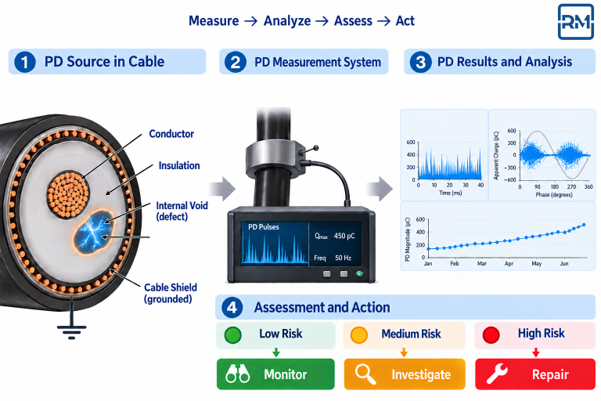
Figure 1 Generated using Co-Pilot.
What is partial discharge measurement?
Partial discharge measurement is a diagnostic technique used to detect and quantify partial discharges, localized electrical discharges that only partially bridge the insulation between conductors (IEC 60270).
These measurements support insulation condition assessment across assets such as transformers, switchgear, power cables, and rotating machines.
To interpret a measurement, it helps to first understand the information a PD test report typically includes.
What values does a partial discharge test report show?
A partial discharge test report includes PD magnitude, repetition rate, phase position, and for applicable tests, partial discharge inception voltage. In totality these values provide different information about the measured discharge activity.
| Value | Typical unit | What it tells you | What to watch |
| Partial discharge magnitude | pC or relative signal units such as mV, depending on method | Magnitude of the measured apparent charge or signal | Change under comparable measurement conditions |
| Repetition rate | Pulses per cycle or second | How frequently measured pulses occur | Persistent changes in pulse activity |
| Phase position | Degrees of the AC cycle | Where measured activity occurs relative to the voltage cycle | Recurring or changing phase-related patterns |
| Inception voltage | kV | Applied voltage at which PD activity becomes detectable under the test conditions | Change under comparable test conditions |
Not every partial discharge report includes all four. Partial discharge inception voltage, for example, is relevant to test arrangements where the applied voltage can be controlled and varied.
The reported magnitude also needs context because different PD measurement methods can use different quantities and units.
What is the difference between pC and mV in partial discharge?
pC (picocoulombs) measures the apparent electrical charge of a partial discharge pulse according to standard calibration. While mV (millivolts) measures the peak voltage or pulse amplitude picked up by a specific sensor or measuring impedance.
IEC 60270 provides the measurement framework for charge-based electrical partial discharge measurements.
The key point is that pC and mV values are not directly interchangeable. Comparisons should consider the measurement method, sensor, instrument settings, and test configuration.
Even when the measurement method remains the same, one result rarely provides the full picture.
Why is one PD reading not enough?
A single partial discharge reading is not enough, as PD activity can be intermittent and is influenced by changing environmental and operational conditions. As a result, a single measurement may not capture the full extent of activity. A snapshot can easily miss active degradation or mistake temporary electrical noise for a critical fault.
One partial discharge reading captures activity under one set of measurement and operating conditions. Repeated measurements provide additional context by showing whether measured activity remains stable, increases, decreases, or newly appears.
Useful comparisons include:
- The asset’s own baseline: Compare current activity with an established reference.
- Previous measurements: Look for changes under comparable measurement and operating conditions.
- Comparable assets: Where appropriate, compare assets measured using equivalent methods and configurations.
A steady rise, sudden change or any new activity may justify further assessment. However, neither the measured level nor the trend should be interpreted without considering the measurement method, asset and operating context.
How to interpret PD results onsite: step by step
Onsite partial discharge analysis combines several pieces of evidence rather than relying on one measured value.
- Confirm the signal before interpreting it. Electrical interference can resemble PD activity. Check whether the measured signal is consistent with PD. See our guide to separating PD from noise.
- Consider magnitude and repetition together. Signal magnitude and pulse activity provide different information. Evaluate both within the measurement conditions.
- Review the phase relationship. Phase-resolved partial discharge (PRPD) patterns can provide diagnostic information about possible discharge mechanisms or defect types. Different types of partial discharge can produce different pattern characteristics.
- Compare the baseline and trend. Look for persistent changes, sudden shifts, or newly appearing activity under comparable conditions.
- Cross-check other condition data. Depending on the asset, this may include temperature, loading, dissolved gas analysis (DGA), or other diagnostic information.
- Record the result and determine the next step. Document the measurement conditions. Then assess whether the activity requires continued monitoring or further investigation.
Once you interpret the result in context, the next question is how to respond.
When should you monitor, investigate or act on partial discharge?
The appropriate response depends on the behaviour of the measured activity, the asset, measurement method, operating context, and other available condition information. A single partial discharge value should not determine the maintenance response on its own.
| What you see | What it may indicate | Next step |
| Stable activity under comparable conditions | No significant change in measured PD behaviour | Continue monitoring and maintain the baseline |
| Sustained rising trend | A changing insulation or operating condition that requires further assessment | Investigate the trend and increase observation where appropriate |
| Sudden change or new activity | A significant change that requires prompt verification | Verify the measurement and investigate using appropriate diagnostics |
A change in partial discharge activity does not automatically indicate imminent failure. Its significance depends on the wider diagnostic context.
For a deeper look at how changing partial discharge activity can influence maintenance decisions, see when to act on partial discharge.
Online partial discharge measurement and digital PD measurement
Digital PD measurement supports signal acquisition, analysis, storage, and trending in both periodic and continuous applications. Online partial discharge measurement allows teams to track partial discharge behaviour while equipment remains energized and operating.
Offline PD testing measures the asset under a controlled test arrangement while it is out of normal service. See online vs offline PD testing for the detailed comparison.
For comparable measurements:
- Keep sensor positions consistent when comparing repeated measurements.
- Document relevant instrument settings and measurement conditions.
- Consider continuous monitoring when asset condition, criticality, or monitoring objectives require ongoing visibility.
Rugged Monitoring provides partial discharge sensors for different assets and measurement approaches, including HFCT, TEV, UHF, and acoustic sensing technologies.
Frequently Asked Questions
What is an acceptable partial discharge level?
There is no single acceptable PD level for every asset or measurement method. Interpretation depends on the asset, insulation system, measurement method, applicable criteria, operating conditions, and previous results. Both the measured level and its trend should be considered in context.
What is partial discharge analysis used for?
Partial discharge analysis helps assess insulation condition by evaluating measured PD activity, patterns, trends, and other available diagnostic information. It can help identify changing conditions and determine whether further investigation or monitoring is required.
How often should partial discharge be measured?
Measurement frequency depends on factors such as asset condition, criticality, previous results, and the monitoring strategy. Changing or newly detected PD activity may justify closer observation, while continuous monitoring can provide ongoing visibility where required.
Can partial discharge be measured while equipment is energized?
Yes. Online PD measurement can assess discharge activity while equipment remains energized. The appropriate sensors and measurement arrangement depend on the asset and measurement method.
Partial discharge measurement becomes more useful when results are interpreted together and compared over time. Magnitude, repetition, phase behaviour, trends, and operating context provide a stronger basis for assessment than any single value alone.
Explore Rugged Monitoring’s partial discharge monitoring solutions or talk to our team about your application.