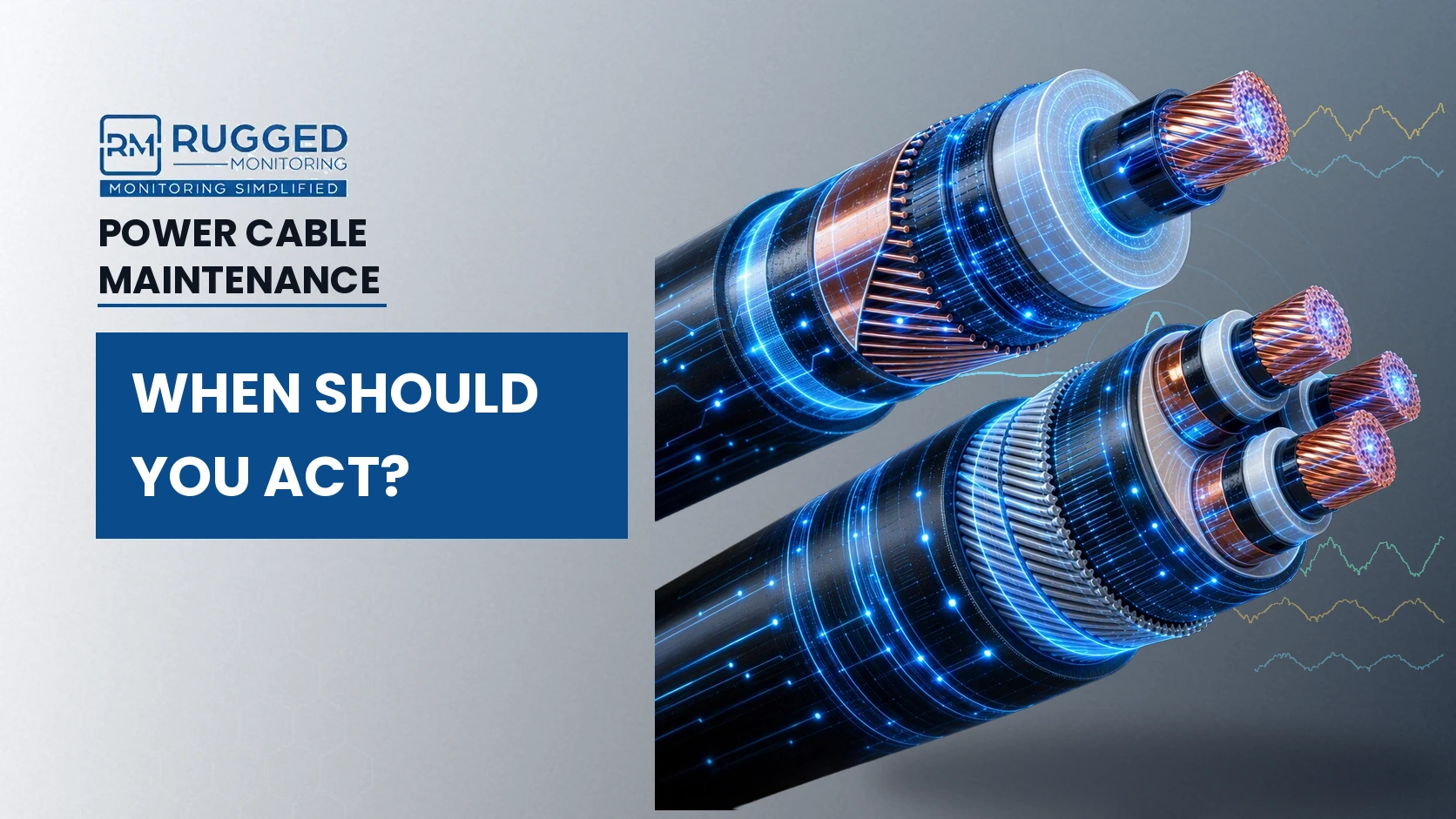
Power cables are designed for long-term operation, but they undergo condition changes throughout their service life. Factors such as electrical stress, thermal cycling, environmental exposure, aging etc can affect on the cables. Insulation, joints, terminations, metallic sheaths, and bonding systems are cable components that are susceptible to damage and deterioration. Some deterioration is visible during inspection. While others might appear first as partial discharge activity, temperature, sheath current or diagnostic test results.
This makes power cable maintenance more complex than responding to a fault or following a fixed maintenance. When an abnormal condition is detected, it must be evaluated. The condition may be operational and temporary, or it may indicate deterioration that requires corrective action. The appropriate response may range from continued monitoring and further inspection to repair or replacement.
This article identifies warning signs that may require maintenance action. It also explains how cable condition, asset risk, and continuous monitoring help guide maintenance decisions.
What Warning Signs Should Trigger Maintenance Attention?
There is often smoke before the fire.
In power cable systems, that “smoke” may appear as a subtle change in electrical, thermal, or physical behaviour long before it develops into a fault.Recognizing these early warning signs gives maintenance teams an opportunity to investigate the change. They can then determine whether intervention is necessary.
The following conditions deserve closer attention:
-
Developing or changing partial discharge activity:
New or recurring partial discharge activity can be an early sign of electrical stress. It may develop in cable insulation, joints, or terminations. The source, pattern, location, and trend of the condition help determine its maintenance significance.
-
Unexplained temperature rise:
A cable, joint or termination that becomes progressively hotter without any load or ambient temperature may indicate problems. Electrical loss, connection problem or deterioration in thermal conditions are a few to name.
-
Localized hotspots:
A hotspot can develop at a joint, termination, or connection even when the overall cable temperature remains within operating limits. A growing temperature difference between comparable phases or components deserves investigation.
-
Abnormal Sheath-current behaviour:
Changes in sheath current should be assessed against cable loading, bonding configuration, grounding conditions, and historical trends. Persistent or unexplained changes may require further investigation.
-
Changes in diagnostic test results:
Changes in diagnostic results, such as increasing partial discharge activity, dielectric-response measurements, or insulation-test findings, should be evaluated over time. Persistent or worsening trends may indicate developing deterioration and require further assessment.
-
Visible physical deterioration:
Cracking, deformation, discoloration, contamination, corrosion, and moisture ingress can indicate cable problems. Damaged accessories and deteriorating bonding or grounding components may require inspection or corrective action.
-
Multiple indicators pointing at the same location:
One abnormal measurement may require verification. When multiple indicators point to the same joint or termination, they provide stronger evidence of a developing problem.
These warning signs indicate the need for further assessment. The next step is to confirm the abnormality, assess its progression, and evaluate its risk.
How Do You Decide Whether a Cable Problem Needs Maintenance?
Identifying a warning sign is only the first step. An abnormal temperature, partial discharge signal, or sheath-current deviation alerts maintenance teams to investigate the cable further, but it does not automatically justify repair.
Maintenance teams can determine the appropriate course of action by evaluating the abnormality through a series of questions.
- Is the indication genuine? Determine whether the change represents an actual cable condition rather than load variation, environmental influence, electrical interference, or measurement noise.
- Where is the problem occurring? Localization helps maintenance teams determine whether the abnormality originates in a joint, termination, cable section, bonding system, or another component. It also helps them assess whether they can repair the problem locally.
- What could be causing it? Connect the condition indicator with a probable mechanism. Partial discharge may point toward an insulation or accessory defect, localized heating toward abnormal losses or a connection problem, and sheath-current changes toward the bonding or grounding system.
- Is the condition stable or progressing? Historical trends help distinguish a known stable condition from one that is increasing in magnitude, frequency, temperature, or another relevant characteristic.
- Does other evidence support the finding? Confidence increases when inspection results, diagnostic measurements, or other condition indicators point toward the same problem.
Together, these questions determine whether an abnormal reading represents a credible cable condition that warrants maintenance attention. The next question is not simply whether to act, but how quickly. That depends on the severity of the condition, how rapidly it is progressing, and the consequence if the cable fails before intervention.
That still does not determine how quickly the team needs to act. A confirmed cable problem on a redundant circuit may present a very different maintenance priority from the same condition on a critical cable with no backup. After identifying the condition, the next step is to evaluate the risk and determine the urgency of the response.
What Determines How Quickly You Need to Act?
Once you identify a cable problem, maintenance urgency depends on more than the condition itself. Engineers also need to understand how quickly the condition is changing and what happens if the cable fails before intervention.
Two cables can show similar deterioration and still require very different maintenance timelines.
Several factors influence that decision:
-
Rate of deterioration:
A condition that remains stable over repeated assessments may allow continued monitoring. Rapidly increasing partial discharge activity, a growing hotspot, or another accelerating condition can justify a faster response.
-
Location of the problem:
Deterioration at a critical joint, termination, or insulation interface may have different consequences from an abnormality associated with a less critical or readily accessible component.
-
Probable failure mechanism:
The nature of the suspected defect matters. A localized connection problem, developing insulation defect, sheath-system abnormality, and environmental issue do not necessarily progress in the same way or require the same maintenance response.
-
Current operating stress:
Load, temperature, voltage, environmental conditions, and operating duty can influence how much additional stress the affected cable experiences before maintenance can be performed.
-
Asset criticality and redundancy:
A cable supplying a critical process with no available backup generally carries greater operational risk than a circuit whose load can be transferred to another cable.
-
Consequence of failure:
Safety implications, production loss, network disruption, repair duration, accessibility, and outage cost all influence how much risk can reasonably be accepted.
-
Repair readiness:
Spare joints, terminations, specialist personnel, test equipment, outage availability, and cable access can affect how quickly an intervention can be executed.
Consider two cable joints showing comparable thermal deterioration. The first belongs to a redundant circuit whose load can be transferred during maintenance. The second supplies a critical process with no practical alternative supply. Even if their measured condition is similar, waiting carries a greater consequence for the second cable.
This is why power cable maintenance should consider both condition and consequence. Condition data establishes what is happening to the asset; risk assessment determines how urgently the organization needs to respond.
That leads to the practical maintenance decision: should the cable continue to be monitored, undergo further inspection, be repaired, or be replaced?
When Should You Monitor, Inspect, Repair, or Replace?
There is no single maintenance response for every abnormal cable condition. Determine the appropriate action based on how well you understand the condition, whether it is progressing, whether you can correct the affected component, and the risk of leaving the cable in service.
Continue Monitoring
Continue monitoring when you understand the condition, it remains stable, and it presents an acceptable level of risk.
Do not ignore the abnormality. The asset remains under observation, ideally with defined escalation criteria that identify what change should trigger reassessment.
For example, a known condition that remains consistent across repeated measurements may continue in service while maintenance teams monitor its trend and prepare for an appropriate maintenance opportunity.
Inspect Further
Further inspection or diagnostics are appropriate when an abnormality is credible, but its source, severity, or maintenance significance remains uncertain.
A thermal anomaly may require thermography or physical inspection. Suspected partial discharge may require additional measurements, localization, or offline diagnostics. Abnormal sheath current may direct inspection toward bonding connections, grounding arrangements, or link boxes.
The objective is to reduce uncertainty before intrusive maintenance is performed.
Repair
Repair is appropriate when a localized, correctable defect has been identified and intervention can restore the required cable-system condition.
For example, monitoring may identify abnormal heating at a termination and inspection may confirm a localized connection problem. If the remaining cable system is in workable condition, repairing the termination may address the defect without replacing the complete cable.
Repair decisions should still consider whether the intervention restores the required reliability and whether supporting condition data indicates deterioration elsewhere.
Replace
Replacement becomes a consideration when deterioration is widespread, defects repeatedly recur, primary cable insulation is significantly affected, or localized repair no longer provides an acceptable reliability outcome.
The decision should consider overall cable condition, failure history, repair feasibility, criticality, remaining service expectations, and the consequence of another failure.
Age alone should not determine replacement.
CIGRE’s guidance on HV cable lifetime strategy emphasizes the importance of considering cable condition alongside criticality and other asset-management factors when determining lifecycle actions.
The distinction is straightforward: monitor a stable condition, investigate uncertainty, repair a defined correctable problem, and consider replacement when broader cable condition and risk no longer support continued service or localized repair.
Why Preventive Maintenance Alone Can Miss Developing Cable Problems?
Preventive maintenance provides a structured approach to cable-system management through inspections, testing, cleaning, and other scheduled activities. Its limitation is that cable deterioration does not always follow the maintenance calendar.
A cable joint measured at 65°C during an inspection provides a snapshot of current condition, but not whether its behaviour is changing. Continuous monitoring adds this missing context. Historical data may show the same joint operating at 50°C, then 55°C, 60°C, and now 65°C under comparable load and ambient conditions. The trend, rather than an individual temperature reading, may indicate developing deterioration.
The same applies to partial discharge, hotspots, and sheath current. Continuous condition data helps determine whether an abnormality is temporary, stable, or progressively worsening between scheduled inspections.
Preventive maintenance asks:
When is the cable due for maintenance?
Condition-based maintenance asks:
What does the cable’s actual condition indicate it needs?
These approaches work best together. Preventive maintenance provides structure, while continuous monitoring delivers visibility between maintenance intervals. CIGRE’s guidance on HV cable-system maintenance highlights the importance of condition assessment within maintenance planning.
Rugged Monitoring supports this approach through continuous monitoring of temperature, hotspots, partial discharge, and sheath current. This enables maintenance teams to identify changing conditions and prioritize inspections based on actual cable health.
For larger cable portfolios, RM EYE extends condition data into an asset-level view, supporting maintenance prioritization based on asset condition, criticality, and operational risk.
Support Condition-Based Power Cable Maintenance
Explore Rugged Monitoring’s power cable monitoring solutions and RM EYE capabilities to transform continuous condition data into smarter, risk-informed maintenance decisions.
FAQ
How often should utilities inspect and maintain power cables?
There is no single maintenance interval appropriate for every power cable. Inspection and maintenance frequency should consider cable design, voltage class, installation environment, operating duty, asset criticality, manufacturer recommendations, applicable standards, maintenance history, and available condition data. Continuous monitoring can supplement scheduled inspections by identifying meaningful changes between maintenance intervals.
What are the signs that a power cable needs maintenance?
Warning signs can include developing or changing partial discharge, unexplained temperature rise, localized hotspots, abnormal sheath-current behaviour, deteriorating diagnostic-test results, moisture ingress, corrosion, and visible accessory damage. Evaluate these indicators in context before determining whether maintenance is necessary.
When can a power cable be repaired or replaced?
Repair the cable when a localized, correctable defect exists and the remaining cable system remains in acceptable condition. Replacement may become more appropriate when deterioration is widespread, defects recur, repair cannot restore acceptable reliability, or lifecycle and risk considerations no longer support continued service.
How does condition-based maintenance work for power cables?
Condition-based maintenance uses actual cable-health information to determine when maintenance is necessary rather than relying solely on fixed time intervals. Monitoring and diagnostic data such as temperature, partial discharge, sheath current, inspection findings, and historical trends can support these decisions.
How do you determine the condition of a power cable before maintenance?
Assess cable condition using a combination of inspection, online monitoring, diagnostic testing, historical trends, operating information, and maintenance records. The appropriate methods depend on cable technology, installation, suspected failure mechanisms, and the condition question engineers need to answer.
Does an abnormal cable condition always require immediate maintenance?
No. First, validate the abnormal condition and assess its source, severity, progression, and risk. A stable condition may justify continued monitoring, while rapidly deteriorating behaviour or a significant defect on a critical cable may require a faster response.
Can continuous monitoring replace scheduled cable inspections?
No. Continuous monitoring and scheduled inspection provide different information and are most effective when used together. Monitoring provides ongoing visibility into selected condition indicators, while inspections and diagnostic tests can investigate conditions that sensors cannot fully characterize.