
Fiber optic sensors use optical sensing technologies to measure physical conditions such as temperature without relying on conventional electrical sensing at the measurement point. This makes them useful where electrical isolation and immunity to electromagnetic interference are important.
A fiber optic monitoring system consists of sensors, optical fibers, monitoring equipment, and software to analyze the collected data. Sensors installed at critical points within electrical assets provide continuous visibility into temperature and hotspots as operating conditions change.
But how does fiber optic temperature sensing work, and why might it be selected over technologies such as RTDs?
What is fiber optic monitoring and how does it work?
Fiber optic temperature monitoring uses optical sensors to measure temperature at critical points within high-voltage electrical assets. Rugged Monitoring uses two fiber optic temperature-sensing technologies: Gallium Arsenide (GaAs) and fluorescence-based sensing.
GaAs-based sensing uses a Gallium Arsenide crystal at the sensor tip. As temperature changes, the absorption characteristics of the crystal change. The monitoring system detects the corresponding shift in cut-off wavelength and correlates it with temperature.
Fluorescence-based sensing uses a temperature-sensitive fluorescent material. The material is excited by light, and characteristics such as fluorescence decay time change with temperature and are used to determine the temperature.
Although their sensing principles differ, both technologies use optical fiber without introducing a conventional electrical sensing path at the measurement location. This characteristic becomes particularly important when operators measure temperature close to energized high-voltage equipment.
Where is fiber optic monitoring used in power systems?
Fiber optic monitoring supports direct temperature measurement across electrical assets that require electrical isolation:
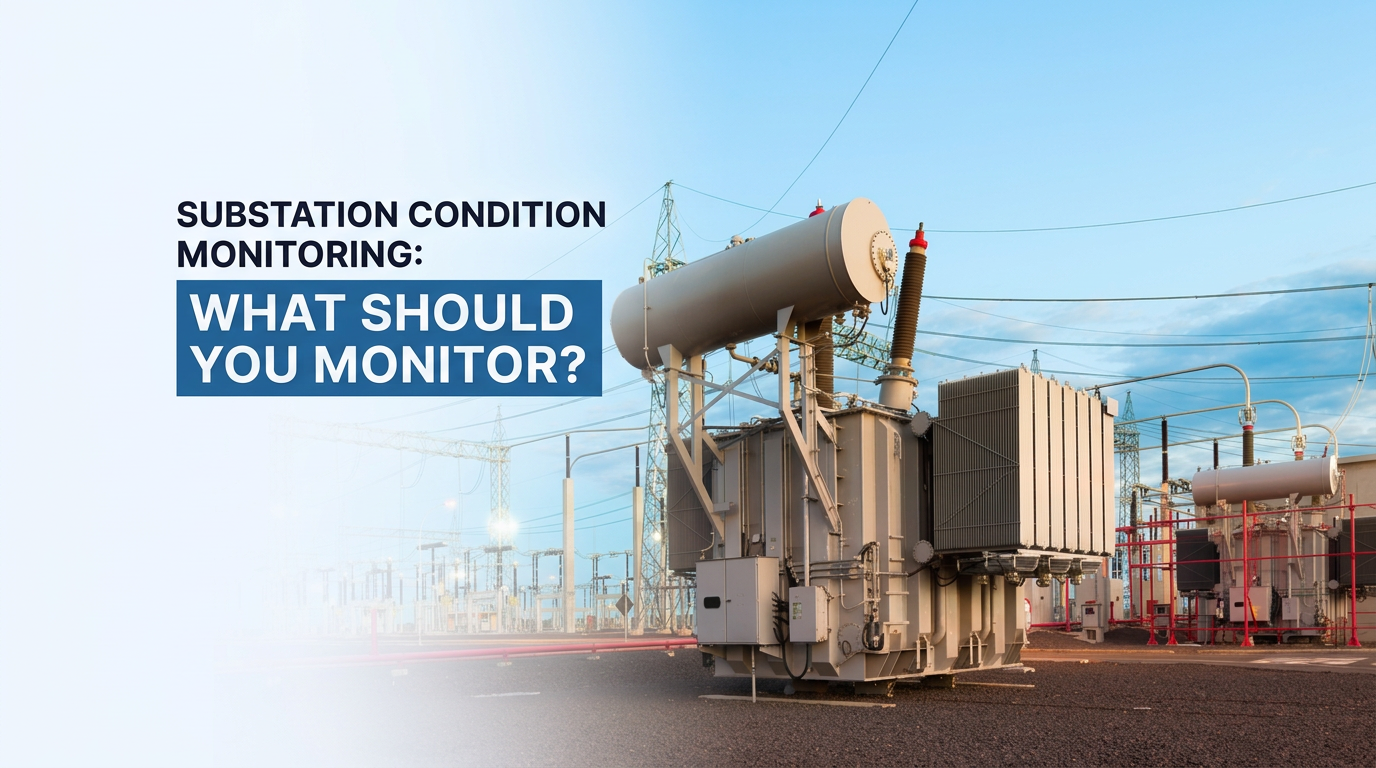
Power transformers: Direct winding and hotspot temperature monitoring under changing load and cooling conditions.
Switchgear and busbars: Temperature monitoring at joints, connections, and other critical points.
Rotating machines: Temperature measurement at selected locations in motors and generators.
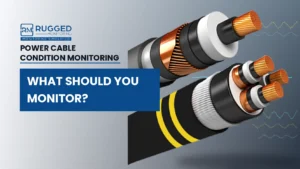
Power cables: Monitoring of cable joints, terminations, and other locations where localized heating can develop.
Circuit breakers: Temperature monitoring at selected connections and critical thermal points.
The measurement locations vary by asset, but the objective remains the same: obtain reliable temperature information from critical locations while equipment operates.
Why are fiber optic sensors used in high-voltage equipment?
These characteristics allow fiber optic sensors to provide reliable temperature monitoring in electrically demanding high-voltage environments.
- EMI and RFI immunity: Electromagnetic and radio-frequency interference does not affect the optical sensing path in the same way as conventional electrical measurement systems.
- Electrical isolation: Dielectric fiber does not create an electrically conductive path at the sensing point.
- Direct temperature measurement: Sensors measure temperature and hotspots directly at selected thermal locations inside electrical equipment.
- Measurement stability: Fiber optic sensing can provide stable temperature measurements in high-voltage and electromagnetically demanding environments where electrical interference can affect conventional sensing methods.
- Fast response: Depending on the sensor design and application, fiber optic temperature sensors can respond quickly to temperature changes, helping capture changing thermal conditions.
- Continuous monitoring: Teams can track temperature changes while equipment is operating rather than relying only on periodic measurements.
Fiber optic temperature sensors vs RTDs
A resistance temperature detector (RTD) is an electrical sensor that determines temperature from changes in the resistance of its sensing element. Both technologies measure temperature, but their sensing and signal paths differ.
| Factor | Fiber optic temperature sensors | RTDs |
| Sensing principle | Temperature-dependent optical response | Temperature-dependent electrical resistance |
| Signal path | Dielectric optical fiber | Metallic electrical conductors |
| EMI/RFI immunity | Inherently immune | Installation must account for electromagnetic interference |
| Electrical isolation | Inherent to dielectric sensing path | Depends on sensor and installation design |
| Typical use | Transformer windings, hotspots, HV equipment | General industrial and process temperature measurement |
RTDs remain widely used for industrial temperature measurement. Fiber optic sensors are particularly useful where high voltage, electromagnetic interference, and electrical isolation make conventional electrical sensing more challenging.
What are the advantages of fiber optic monitoring?
Beyond its suitability for high-voltage environments, fiber optic monitoring provides:
- Direct hotspot visibility at selected critical thermal locations.
- Temperature trends that show how thermal conditions change with loading and operation.
- Earlier indication of abnormal heating through changes in temperature over time.
- Integration with monitoring systems for trends, alarms, and wider asset analysis.
These capabilities turn individual temperature measurements into condition
What should you consider when using fiber optic monitoring?
Effective monitoring depends on appropriate sensor selection, placement, installation, and protection. Because a probe measures temperature at its installed location, representative sensor placement is important.
Embedded sensors are generally easier to incorporate during equipment manufacturing, refurbishment, or rewinding. Optical fibers also require suitable routing and mechanical protection.
Fiber optic monitoring focuses on thermal condition. Other conditions may require technologies such as partial discharge, DGA, or bushing monitoring.
Where Rugged Monitoring fits
Rugged Monitoring provides fiber optic temperature sensors and monitors for high-voltage electrical assets, including GaAs and fluorescence-based sensing technologies and multi-channel temperature monitoring.
Its broader architecture connects:
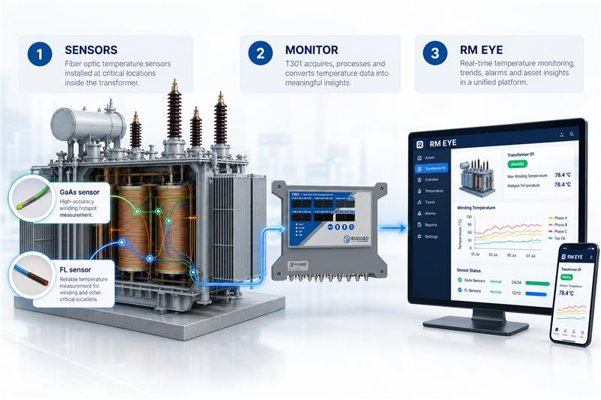
Fiber optic sensors provide temperature and hotspot measurements, while edge devices collect and communicate the data. RM EYE brings this information together with other available asset data for trends, alarms, health and risk views, and fleet-level visibility.
Frequently Asked Questions
What is fiber optic monitoring used for?
In electrical assets, fiber optic monitoring is commonly used for direct temperature and hotspot measurement in transformers, switchgear, busbars, rotating machines, cables, and other high-voltage equipment.
Why use fiber optic sensors instead of RTDs in high-voltage equipment?
Fiber optic sensors provide a dielectric sensing path and immunity to electromagnetic interference, making them useful where electrical isolation and high electromagnetic fields are important. RTDs remain widely used in other industrial temperature applications.
Does fiber optic monitoring only measure temperature?
Fiber optic sensing technologies can measure different physical parameters. Rugged Monitoring’s electrical-asset applications primarily use fiber optic sensing for temperature and hotspot monitoring.
How does fiber optic monitoring contribute to predictive maintenance?
Continuous temperature trends can reveal abnormal heating and changing thermal behaviour. When combined with other condition and asset information, these measurements can contribute to condition-based and predictive maintenance decisions.