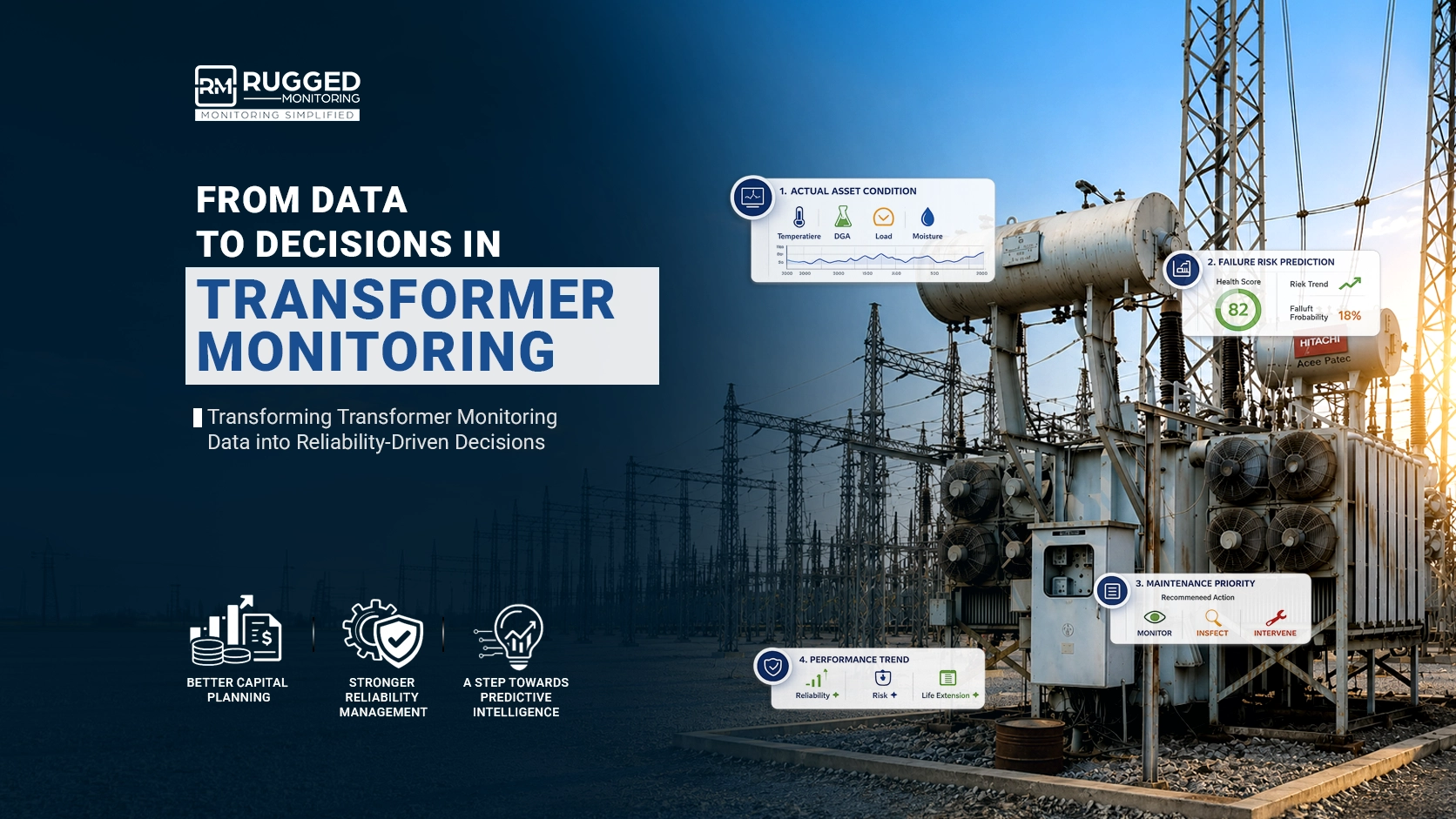
Over the last decade, utilities and industries have heavily invested in advanced transformer monitoring. Assets that were once inspected only periodically can now generate a continuous stream of information related to their health and performance.
Asset teams can open a dashboard directly to review parameters, alarms, inspection records, and test history. That means millions of data points collected every year across asset fleets and timelines.
At least on paper, visibility is no longer a problem. Yet many utilities and industries suffer from inefficiency and maintenance costs.
Data exists, but decisions do not.
A large quantity of the asset data does not naturally lead to decisions. This paradox is where most businesses are struggling, leading to a different set of maintenance problems:
- Difficulty in maintenance prioritization
- Uncertainty around asset replacement
- Growing pressure to improve reliability
Thus, transformer monitoring must evolve from data collection to data-driven decision-making, shifting the focus from visibility to understanding.
What data should transformer monitoring include?
For transformer monitoring to support decisions, the data model has to cover the measurands that drive risk and remaining life not only generic dashboards. In practice, that typically includes:
- Fiber-optic winding hotspot temperature — direct thermal stress and overload risk
- Partial discharge (PD) — early dielectric and insulation deterioration
- Dissolved gas analysis (DGA) — developing thermal and electrical faults in oil-filled units
- Bushing monitoring (C / tan δ) — bushing degradation and failure precursors
- Loading and operating context — how duty cycle and environment amplify stress
- Maintenance, test, and alarm history — what has already been deferred, inspected, or repeated
When these signals stay siloed, teams see activity without shared priorities. When they are correlated, monitoring can support Health, Risk, and Criticality views that operations and asset managers can act on.
Why has advanced transformer monitoring not improved decision-making?
Up until now, the industry has been driven to solve the visibility problem, and along the way, has begun to assume that visibility and understanding are the same thing.
Well, they are not.
Many modern transformer monitoring systems are used primarily to support condition-based maintenance: linking observed conditions to likely failure modes and maintenance triggers. That is necessary, but incomplete. The same systems also generate data on:
- Transformer health
- Diagnostic information
- Maintenance history
- Environmental conditions
- Historical performance records
- Alarm logs
- Transformer trend analytics
- Loading patterns
Yet organizations struggle to make better decisions that improve both operations and maintenance across the entire grid.
When the focus is only on displaying information, data becomes insignificant in explaining why it is happening and what should happen next. Furthermore, as transformer fleets become larger and more complex, this gap will become increasingly difficult to manage.
The Role of Data-Driven Decisions in Transformer Reliability
Imagine two maintenance engineers looking at the same transformer.
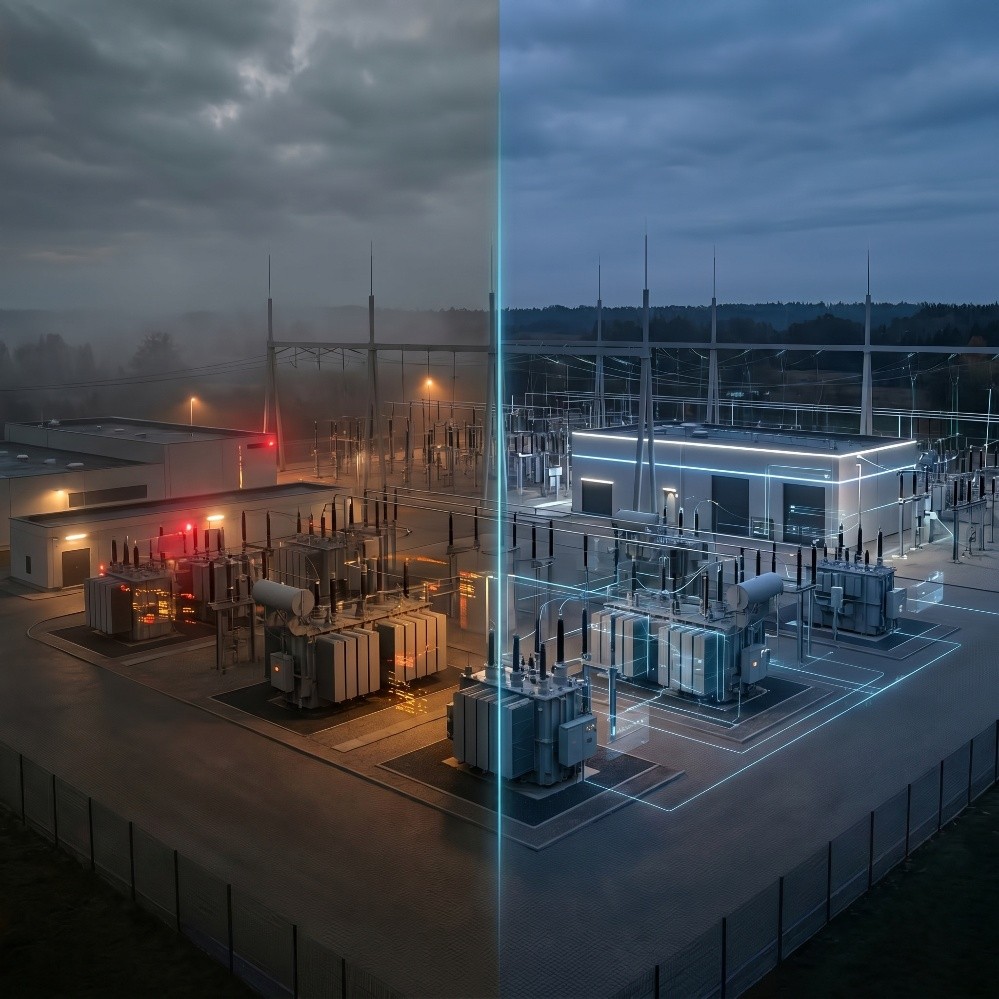
Both see the same readings.
Both have access to the same reports.
Both understand the asset.
Yet they arrive at different conclusions.
One recommends immediate intervention.
The other recommends continued operation.
This is a critical issue across organizations. When data is spread across systems and platforms, it leads to operational inconsistencies, increased undetected risks, neglected transformer behavior, and unidentifiable health patterns. As a result, teams often end up working in isolation, making it difficult to reach collective decisions regarding the asset.
On the contrary, data-driven transformer monitoring solutions, like asset performance management (APM) systems, centralize maintenance activities, condition data, and operational context. Thus, ensuring maintenance teams can:
- Understand transformer health and behavior patterns
- Detect repeated deferrals on the same asset
- Respond to faults early on
- Simulate real-time transformer conditions digitally
- Identify performance trends
- Gain insights into the transformer throughout its entire lifecycle
This ensures transformer monitoring is not treated as a standalone task, but as a continuous contributor to reliability.
How to Shift from Data to Decisions using APM?
When a transformer monitoring system’s data can inform maintenance priorities, asset strategies, and reliability outcomes, its value extends beyond a business investment.
Most maintenance teams already have access to a large volume of transformer data. As a first step in transforming this data into decisions, utilities must invest in an Asset Performance Management System. This seemingly strategic change forces O&M programs to focus on outcomes rather than just measurements.
The second step is to generate context for the now-centralized transformer monitoring analytics. Temperature patterns, maintenance records, or diagnostic test data become more valuable with APM, transforming isolated information into data-driven maintenance decisions.
Finally, utilities should pivot towards a predictive maintenance framework across the entire grid. With APM, they can understand which assets exhibit the greatest reliability, which conditions require interventions, and where resources will deliver the highest return. Thus, enabling the shift towards predictive intelligence and grid modernization initiatives.
Organizations that successfully transform their transformer monitoring with APM reduce decision-making uncertainty, maximize reliability, and achieve the highest ROI.
Impact of Better Decisions on Transformers
The value of a transformer monitoring is not determined by how much data it collects, but by how effectively that data improves decision-making. With APM, the benefits extend far beyond maintenance, creating a measurable impact across the asset lifecycle and the grid’s reliability.
Reduced Unplanned Outages
Data-driven decision-making helps maintenance teams identify emerging risks earlier. Hence, enabling corrective actions before minor issues escalate into forced outages or service disruptions.
Improved Maintenance Efficiency
Transformer analytics and predictive insights help maintenance teams prioritize monitoring and operational resources. This ensures maximized efficiency and higher reliability impact.
Extended Transformer Service Life
When asset teams gain visibility into degradation patterns, operating stress, and performance trends, they can intervene at the right time. Thus, preventing conditions that accelerate aging. Consequently, this maximizes the useful life of critical assets while delaying costly replacements.
Better Capital Planning
One of the most difficult decisions for utilities is determining when to refurbish, upgrade, or replace a transformer. APM provides a clearer understanding of transformer conditions and future risk, allowing organizations to make investment decisions based on evidence rather than assumptions.
Stronger Reliability and Risk Management
Better decision-making creates a more predictive approach to reliability management. Thus, helping organizations identify high-risk assets earlier, prioritize interventions more effectively, and reduce uncertainty across the network.
Greater Organizational Alignment
Centralized visibility into transformer monitoring, health, and performance reduces conflicting interpretations. Therefore, improving collaboration between departments enables faster responses to changing asset conditions.
A Step Towards Predictive Intelligence
Instead of spending time investigating failures after they occur, organizations can focus on improving performance before issues arise. This allows transformer monitoring to evolve from a reporting function into a strategic capability that continuously supports reliability, efficiency, and long-term asset performance.
The Future of Transformer Monitoring in Predictive Intelligence
The next phase of transformer monitoring will be defined by data and decisions. But most utilities and industries already have access to data, but it’s fragmented.
The future of transformer monitoring will be defined by predictive intelligence strategies that support grid modernization, like APM.
In this model, transformer monitoring becomes a strategic function that supports:
- Reliability improvement initiatives
- Predictive maintenance programs
- Asset life extension strategies
- Grid modernization efforts
- Risk-based investment planning
The focus shifts from collecting information to generating foresight.
Organizations that successfully make this transition will be better positioned to manage aging infrastructure, optimize maintenance investments, and improve operational resilience in an increasingly complex energy environment.
Turn transformer condition data into clearer asset decisions.
See how RM EYE brings condition, Health, Risk, and Criticality insights together to support transformer maintenance and asset management.
Book a Demo of RM EYE.