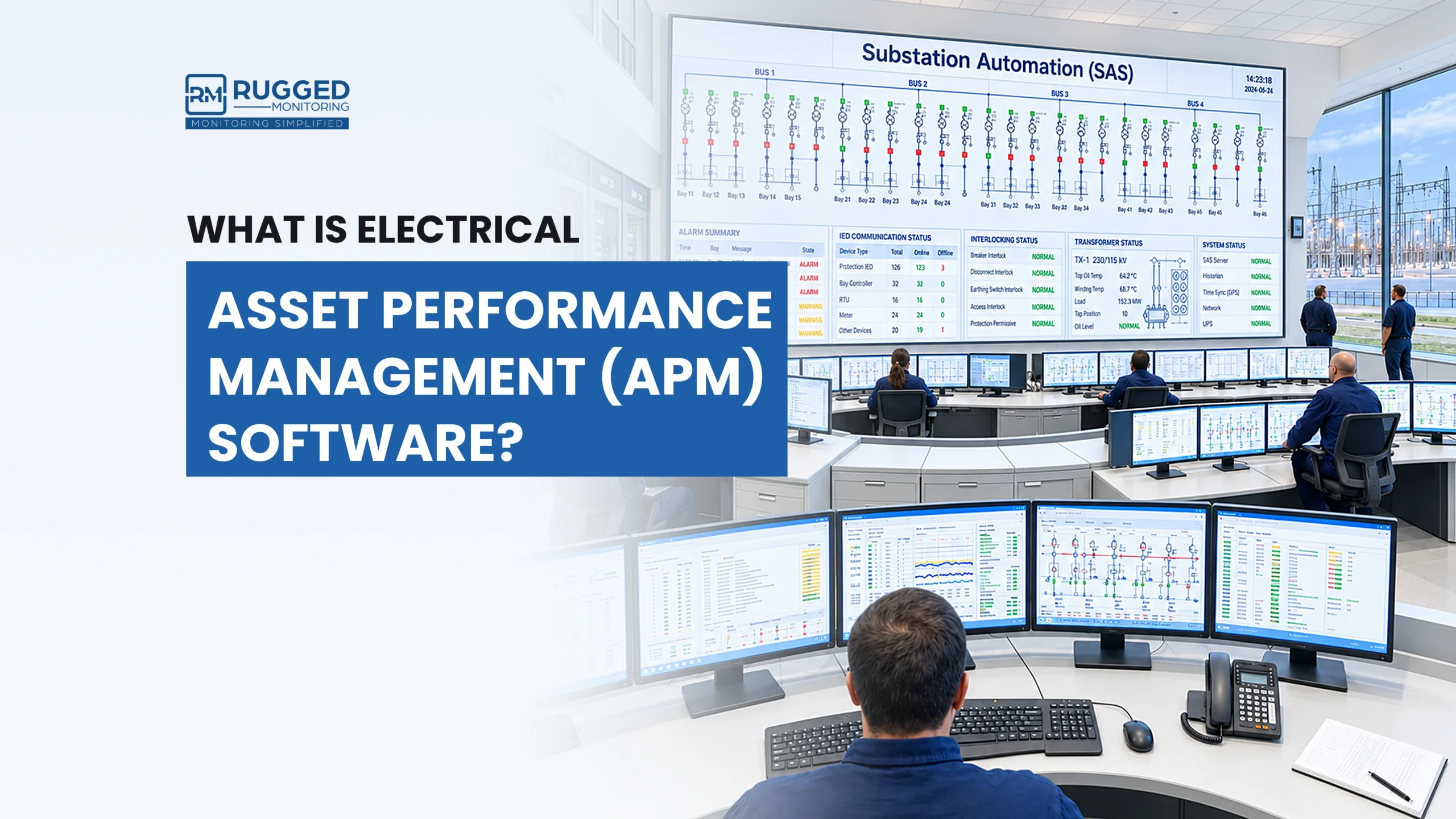
Asset performance management (APM) software turns monitoring data into decisions. It helps teams understand which assets are healthy, which are at risk, and where attention is needed.
For utilities and industrial organizations, APM brings together data like fiber-optic temperature, partial discharge, DGA and bushing condition. It provides a unified view across asset types, fleets, and sites.
Instead of leaving condition data across separate monitoring systems, APM brings it into a centralized environment. Teams can track asset condition, identify emerging risks, and prioritize maintenance. This gives reliability and maintenance teams a clearer view of asset performance, from an individual asset to an entire fleet.
What is APM software?
Asset performance management software centralizes condition, operational, and historical asset data in one environment. It brings together information from monitoring systems, sensors, inspections, tests, and other available sources.
APM applies analytics to this data to provide health and risk views, trends, alerts, and maintenance insights. This helps teams identify developing problems, prioritize attention, and make informed maintenance and lifecycle decisions.
It helps you:
- See health, risk, and criticality across a fleet
- Prioritize work orders with evidence, not guesswork
- Move from calendar-based checks toward condition- and risk-based strategies
- Connect sensors and edge devices to dashboards, analytics, and alerts in one place
Why electrical assets need APM
For electrical assets, APM can combine data such as temperature, partial discharge, DGA, bushing condition, and loading. It brings this information together across transformers, switchgear, cables, circuit breakers, and rotating machines.
This gives reliability and maintenance teams a unified view of asset condition and performance.
How APM software works
APM connects asset-level monitoring with higher-level analytics and decision support:
- IIoT sensors measure condition parameters such as hotspot temperature, partial discharge, DGA, and bushing C/tan δ.
- Edge devices collect, process, and communicate data from the asset to higher-level monitoring systems.
- APM software brings this information together to provide analytics, dashboards, alarms, health and risk views, and fleet-level visibility.
Rugged Monitoring follows this architecture through IIoT Sensors → Edge Devices → RM EYE.
RM EYE serves as the enterprise layer. It brings together condition, operational, and historical asset data across fleets and sites.
Where integrations are available, SCADA and compatible third-party systems can also feed data into RM EYE. This connects asset-level measurements with enterprise-level asset intelligence.
SCADA vs Condition Monitoring vs APM
| Layer | Primary job | Typical output |
| SCADA / DCS | Operate and control the process | Status, setpoints, operational alarms |
| Condition Monitoring (CM) | Detect abnormal asset condition | Trends, thresholds, early warnings |
| APM software | Optimize performance and maintenance decisions | Health / risk / criticality, remaining useful life insights, prioritized actions |
SCADA and condition monitoring serve different purposes, but both can contribute valuable information to APM. Operational context can come from SCADA, while condition-monitoring systems provide evidence about asset condition and deterioration. APM brings these inputs together with historical, criticality, and other asset information to support health, risk, maintenance, and lifecycle decisions.
What good electrical APM covers
A strong electrical APM platform should go beyond monitoring individual assets. It should connect assets, sites, and existing systems while giving teams a consistent view of condition, performance, and risk across the electrical network.
- Multi-asset visibility: Bring transformers, switchgear, cables, breakers, rotating machines, and other electrical assets into one environment instead of managing each asset class separately.
- Multi-site and fleet monitoring: Move from an individual asset view to site, fleet, regional, or enterprise-level visibility to compare condition and identify where attention is needed.
- Integration with existing systems: Connect condition-monitoring equipment, SCADA, sensors, and compatible third-party systems so existing monitoring data can contribute to the wider asset picture.
- Industrial communication: Support protocols such as MODBUS, DNP3, and IEC 61850 so APM can receive and share data with sensors, monitoring devices, and SCADA systems.
- Retrofit capability: Work with compatible installed monitoring infrastructure so existing substations and facilities can adopt centralized APM without necessarily replacing their entire monitoring setup.
- Scalability: Expand from a small group of monitored assets to larger fleets and multiple sites as monitoring and asset-management requirements grow.
- Real-time and historical context: Combine live measurements with historical trends, offline tests, inspections, events, and maintenance records to understand how asset condition is changing over time.
- Health, risk, and criticality insights: Translate asset information into health and risk views that help teams identify developing issues and prioritize maintenance based on both condition and consequence.
Each of the above-mentioned capabilities allows APM to move beyond isolated monitoring. It provides a connected view of asset condition and performance across multi-asset and multi-site environments.
What data does APM software use?
APM software can use both real-time and historical information to build a more complete picture of asset condition and performance. The exact data depends on the asset and monitoring strategy, but common inputs include:
- Real-time sensor measurements — continuously measured parameters such as temperature, partial discharge activity, electrical loading, and other condition indicators.
- Historical condition-monitoring data — previous measurements and trends that help reveal how asset behaviour is changing over time.
- Offline inspections and test results — periodic diagnostic information, laboratory results, and inspection records that add context to online monitoring.
- Asset loading and operating information — operating conditions that help teams understand whether changes in condition are associated with how an asset is being used.
- Alarms and events — threshold violations, abnormal conditions, trips, and other recorded events that provide context around asset behaviour.
- Maintenance and intervention history — records of inspections, repairs, servicing, refurbishment, and previous corrective actions.
- Asset health indicators — calculated health scores or indices that consolidate multiple condition parameters into a higher-level view of asset health.
- Asset criticality — information about the operational or business consequences associated with an asset becoming unavailable or failing.
- Failure history — previous faults and failures that can provide additional context for reliability and risk analysis.
For electrical assets, inputs can include fiber-optic temperature, partial discharge (PD), DGA, bushing condition, and loading data. APM brings these sources together in one environment. This provides a wider view of asset health, deterioration, and risk.
What are the benefits of APM software?
APM software helps asset owners move from reacting to individual alarms and failures toward making maintenance decisions based on asset condition, risk, and performance. For utilities and industrial facilities managing critical electrical equipment, the main benefits include:
Earlier detection of deterioration
APM brings condition indicators and trends together so teams can identify developing problems before they progress into more serious faults. Earlier visibility gives engineers more time to investigate the cause and plan an appropriate response.
Condition-based maintenance
Instead of relying only on fixed inspection or maintenance intervals, teams can use actual asset condition to help determine when attention is required. This supports a shift from calendar-based maintenance toward condition-based and predictive strategies where appropriate.
Better maintenance prioritization
Not every alarm or deteriorating asset requires the same response. APM can combine condition information with asset health, criticality, and risk to help teams identify which assets require attention first and allocate maintenance resources accordingly.
Reduced unplanned downtime
Identifying deterioration earlier creates more opportunity to address problems through planned maintenance rather than emergency intervention. This can reduce the operational disruption and costs associated with unexpected asset failures.
Fleet-wide visibility
APM provides a consolidated view of asset condition across equipment, sites, and asset classes. Reliability and maintenance teams can move from analysing individual devices in isolation to comparing health, trends, and risk across an entire fleet.
More informed lifecycle decisions
Asset condition is also important when deciding whether equipment should continue operating, be maintained, refurbished, or eventually replaced. By combining condition, operating history, maintenance information, criticality, and risk, APM provides a stronger evidence base for lifecycle and investment decisions.
How does APM support predictive maintenance?
Bringing condition, operational, and historical data together gives teams more than a record of what has already happened. APM software can use trends, asset health, and analytics to identify developing deterioration and help determine when an asset may require attention.
This supports a shift from fixed maintenance intervals toward condition-based and predictive maintenance, where intervention is guided by evidence from the asset rather than the calendar alone.
APM and predictive maintenance, however, are not the same thing.
Predictive maintenance for electrical assets is a maintenance strategy that uses condition and operational data, trends, and analytics to anticipate when maintenance may be required.
Asset performance management (APM) is broader. It can combine condition monitoring, asset health, criticality, risk, maintenance history, and lifecycle information to support decisions across individual assets and entire fleets.
In simple terms, predictive maintenance helps determine when an asset may need attention; APM provides the wider context for deciding which assets require attention, why they matter, and what action should be considered.
Where RM EYE fits
RM EYE is Rugged Monitoring’s enterprise asset performance management platform for electrical assets. It brings condition-monitoring data into one environment with AI/ML-supported analytics, dashboards, alerts, and fleet-level visibility. RM EYE supports on-premises and cloud deployment and can work with Rugged Monitoring sensors and edge devices as well as existing monitoring systems where integrations allow.
For teams managing transformers, switchgear, cables, and other critical electrical assets, the value of APM is not simply collecting more data. It is turning information such as hotspot temperature, partial discharge, DGA, bushing condition, and other monitoring signals into clearer views of asset health, risk, and maintenance priorities.
RM EYE brings these capabilities together so teams can move from disconnected monitoring data toward more informed, condition- and risk-based asset decisions.
Ready to move from raw monitoring data to clearer health and risk decisions?
Talk to our team · Explore RM EYE.
Frequently Asked Questions About APM Software
What is the difference between APM and condition monitoring?
Condition monitoring focuses on detecting and tracking changes in an asset’s condition through measurements, trends, and alarms. APM uses condition data together with information such as asset health, criticality, risk, and history to support broader maintenance and lifecycle decisions.
Is APM the same as SCADA?
No. SCADA primarily provides real-time monitoring and control of industrial processes and equipment. APM focuses on understanding asset condition, performance, and risk to support maintenance and asset-management decisions. SCADA data can be one of the inputs used by an APM platform.
Does APM replace condition monitoring?
No. Condition monitoring provides much of the asset-condition information that APM relies on. APM builds on that information by adding context, analytics, health and risk views, and fleet-level decision support.
Which electrical assets can APM software monitor?
Electrical APM software can support assets such as power transformers, AIS and GIS switchgear, circuit breakers, power cables, and rotating machines. Depending on the asset and monitoring system, it can bring together data such as temperature, partial discharge, DGA, bushing condition, loading, alarms, and historical test results.
Can APM software integrate with existing monitoring systems?
Yes, depending on the platform and available interfaces. APM software can integrate data from sensors, edge devices, SCADA, and existing condition-monitoring systems. Industrial protocols such as MODBUS, DNP3, and IEC 61850 can support data exchange in electrical monitoring environments.