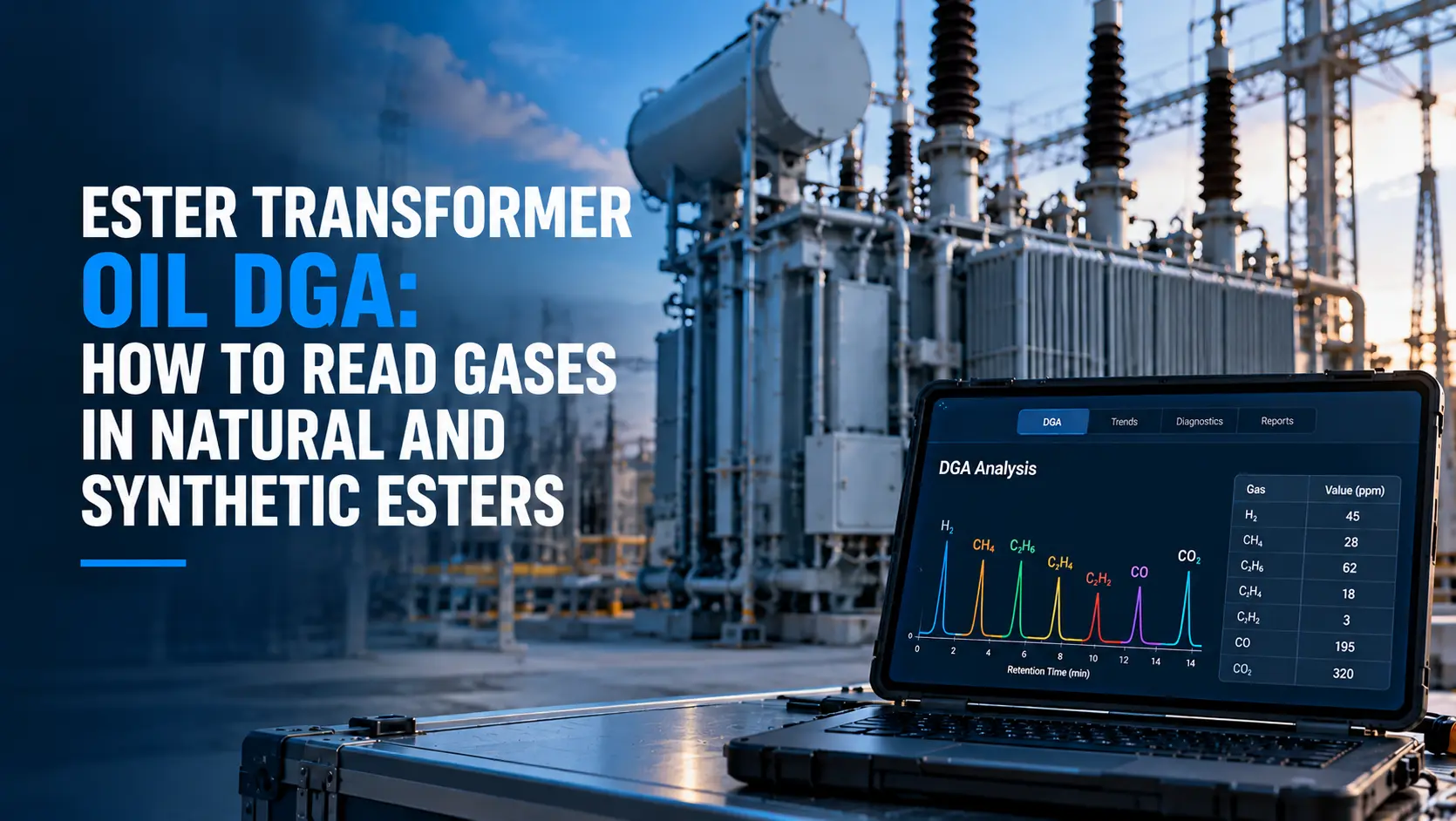
Ester transformer oil DGA analyzes dissolved gases in transformers filled with natural or synthetic ester fluids. Many of the same fault gases can appear, but their concentrations and relationships can differ from those in mineral oil. Applying mineral-oil criteria directly can therefore lead to misleading interpretations.
With IEC 63585:2026 now providing specific guidance for DGA in natural and synthetic esters, engineers have a clearer framework for interpreting these results.
But before looking at what changes in DGA interpretation, it helps to understand why ester fluids are becoming more relevant in transformer applications in the first place.
Why are more transformers using ester transformer oil instead of mineral oil?
Their fire-safety and biodegradability characteristics make ester fluids an alternative to mineral oil for new transformers and selected retrofill applications. Two broad types are used:
- Natural ester transformer oil, generally derived from vegetable-based feedstocks.
- Synthetic ester transformer oil, a manufactured organic ester (IEC 61099), typically a polyol ester.
In India, the Central Electricity Authority (CEA) has advised all Central, State and Private Transmission Utilities to use ester oil in at least 10% (preferably 5% natural and 5% synthetic ester) of new transformers, reactors and similar equipment procured or installed at 33 kV and above.
Why can’t you use mineral-oil DGA limits on ester-filled transformers?
Insulating liquid influences how fault gases are generated and appear, so ester-filled transformers can show different gas concentrations and relationships from mineral-oil units under comparable faults.
IEC 60599 and IEEE C57.104 address mineral-oil-filled equipment, and applying their criteria directly to ester results can lead to misleading conclusions.
The principles of DGA interpretation still apply; what changes is how results are interpreted for the fluid.
What does IEC 63585:2026 change for ester transformer oil DGA?
IEC 63585:2026 (Edition 1.0, published July 2026) specifically addresses the DGA interpretation in natural esters complying with IEC 62770 and synthetic esters complying with IEC 61099. Its published scope covers:
- gas generation in natural and synthetic ester-filled transformers;
- DGA interpretation methods and gas concentration guide values;
- interpretation of results and recommended actions; and
- examples of faulty equipment.
This gives engineers fluid-specific IEC guidance rather than mineral-oil guidance alone. It should be used alongside transformer design, fluid type, and operating history, not as a substitute for engineering assessment.
How is IEC 63585 different from IEEE C57.155?
Both IEC 63585 and IEEE C57.155 provide guidance for interpreting gases in ester-filled equipment, but they come from different standards frameworks.
| Reference | Status | Scope | Fluids covered |
| IEC 63585:2026 | Published July 2026 (Ed. 1.0) | Interpretation of DGA in natural and synthetic esters | Natural esters (IEC 62770) and synthetic esters (IEC 61099) |
| IEEE C57.155-2014 | Inactive reserved since March 2025; revision in progress | Interpretation of gases generated in natural and synthetic ester-immersed transformers | Natural and synthetic esters |
Which reference applies depends on the equipment, fluid, and standards framework used by the organization.
What is stray gassing in natural esters, and how can it cause false alarms?
Stray gassing is the formation of gases by the insulating fluid at normal operating temperatures, without an electrical or thermal fault. In natural esters, it typically appears as ethane and sometimes hydrogen, largely through oxidation, and often settles at a level specific to the unit. Synthetic esters generally show much less.
A mineral-oil interpretation might therefore read stray gas as a fault. Establish a baseline after commissioning or fluid change and observe how gas behavior develops; a change from that pattern can be more informative than a single concentration. That does not mean changing gas levels should be ignored.
How should online DGA be set up for an ester-filled transformer?
Online dissolved gas analysis for an ester-filled transformer should start with the fluid type and the unit’s own baseline, not mineral-oil limits:
- Confirm the ester fluid: natural or synthetic.
- Establish a baseline under known operating conditions.
- Set fluid-appropriate alarms using applicable ester guidance.
- Track the trend against the baseline.
- Confirm significant changes with laboratory samples or other diagnostics.
Online monitoring adds trend visibility between laboratory samples; our guide to online vs offline DGA explains how the two differ.
What should utilities check when retrofilling mineral oil with ester?
The CEA advisory notes that utilities adopting ester oil should confirm transformer design suitability, OEM certification or recommendation, compliance with applicable standards, and the availability of appropriate testing, filtration, maintenance, and monitoring facilities. These checks are especially relevant for a transformer originally designed for mineral oil.
For DGA, a retrofill breaks the transformer’s history, so establish a new post-retrofill baseline rather than reusing mineral-oil data. Residual mineral oil can remain in the insulation after a retrofill, so early DGA results may reflect a fluid mixture rather than pure ester. Confirm interpretation with the fluid supplier or OEM where needed.
Does an ester-filled transformer need different temperature monitoring?
Temperature monitoring should reflect the transformer’s thermal design, insulating fluid, loading, and cooling arrangement, whether the transformer was originally ester-filled or later retrofilled.
Rugged Monitoring’s TSENS fiber-optic temperature sensor is compatible with all types of transformer oil, including ester-type fluids, and is designed for direct temperature measurement at points such as windings, cores, and tap changers.
Where fiber-optic probes are installed in the windings, typically during manufacture or rewinding, direct measurements can provide winding hot-spot information.
The relationship between direct winding measurements and calculated temperature is covered further in transformer hot-spot monitoring.
Reliable condition assessment in an ester-filled transformer depends on matching the interpretation method, baseline, and monitoring approach to the insulating fluid and transformer design.
Rugged Monitoring supports transformer condition monitoring across online DGA and fiber-optic temperature and hot-spot measurement, helping teams build a more complete view of transformer condition.
Changing from mineral oil to ester changes more than the insulating fluid. It also changes the context in which dissolved gases and their trends need to be interpreted.
For an ester-filled transformer application, connect with Rugged Monitoring to discuss the monitoring approach for your transformer.
Frequently Asked Questions
Do natural and synthetic esters produce the same fault gases as mineral oil?
Many of the same gases can occur, but their concentrations and relationships can differ. Ester-specific interpretation guidance should therefore be used.
Is IEC 63585 mandatory?
That depends on the applicable regulatory, contractual, and organizational requirements. IEC 63585 provides international guidance specifically for DGA interpretation in natural and synthetic esters.
Can an online DGA monitor be used on an ester-filled transformer?
Yes, where the monitor is compatible with the ester fluid and application. Alarm criteria should also reflect ester-specific gas behavior.
Does CEA require ester oil in new transformers in India?
The CEA advisory recommends ester oil in at least 10% of new transformers rated 33 kV and above, subject to its stated conditions.
Changing from mineral oil to ester changes more than the insulating fluid. It also changes the context in which dissolved gases and their trends need to be interpreted.