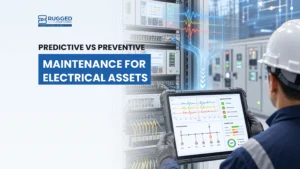
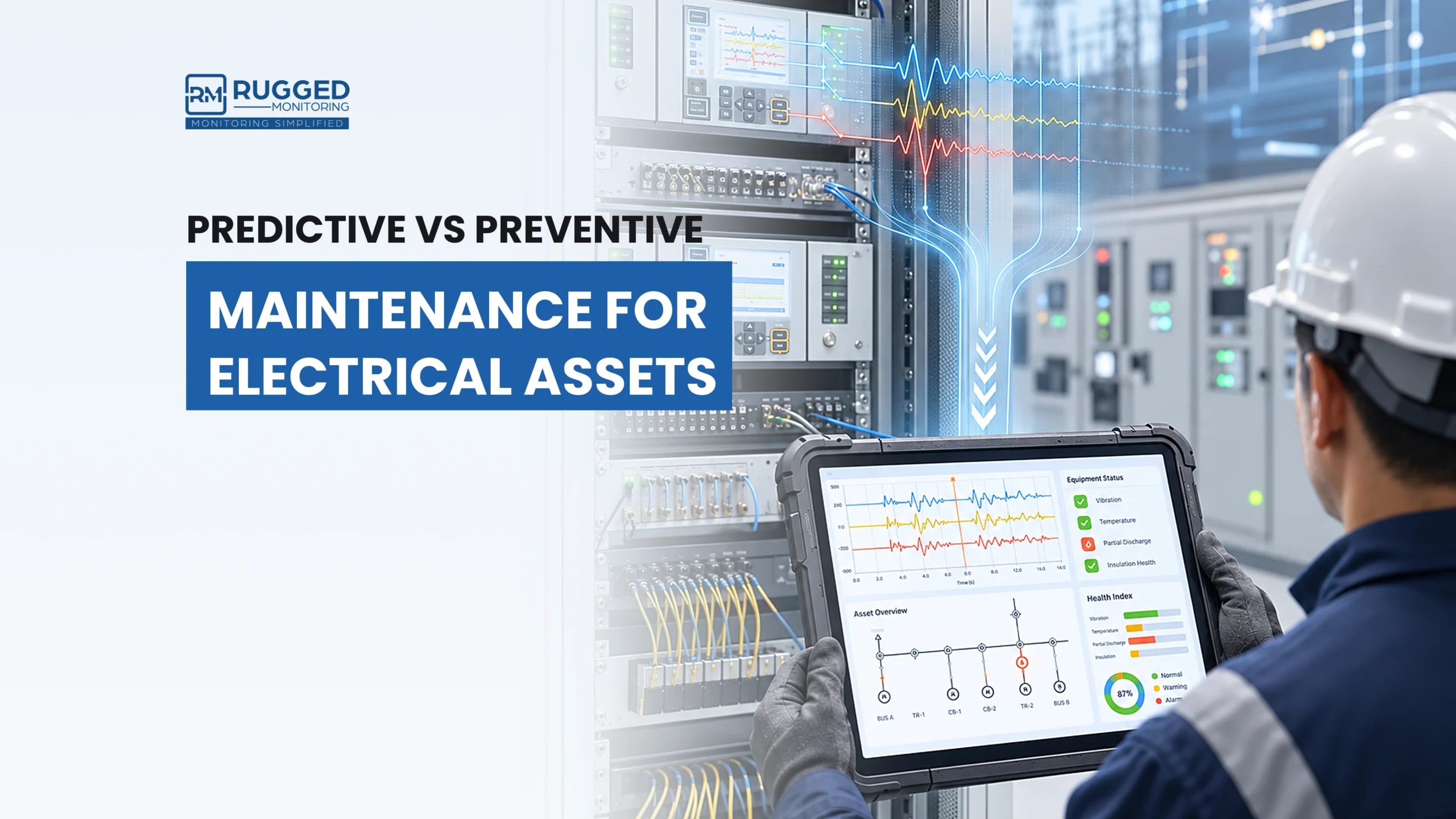
Electrical assets rarely move from healthy operation to failure without showing changes in condition along the way. Temperature may rise, partial discharge activity may develop, dissolved gases may change, or a bushing may show signs of deterioration.
Predictive maintenance uses these changes to guide maintenance decisions. Instead of relying only on fixed intervals, teams can review asset condition, operating information, and historical trends. This helps them identify developing issues and determine when an asset requires attention.
This article focuses on predictive and preventive maintenance for electrical assets, with proactive and predictive maintenance forming a separate part of the wider maintenance strategy.
What is predictive maintenance?
Predictive maintenance uses condition, operational, and historical asset data. It helps identify developing deterioration in electrical assets. It also helps maintenance teams determine when to act.
Predictive maintenance does not aim to predict the exact date an asset will fail. Instead, it uses changing asset condition to help teams make earlier and better-informed maintenance decisions.
How does predictive maintenance work for electrical assets?
Predictive maintenance turns changing asset conditions into information that can guide maintenance decisions.
A typical predictive maintenance process follows five stages:
Monitor → Collect → Analyze → Assess → Act.
- Monitor: Sensors measure parameters such as temperature, partial discharge, DGA, and bushing
- Collect: Edge and monitoring devices collect and communicate the measurements.
- Analyze: The system analyzes current data against historical trends, thresholds, and operating conditions.
- Assess: Teams determine whether a change is significant and requires further investigation or maintenance.
- Act: Depending on condition and risk, teams can plan maintenance, perform additional diagnostics, adjust operation, or continue monitoring.
For example, a transformer shows increasing hotspot temperature alongside changes in other condition indicators. These changes help teams assess the asset’s condition and decide whether to investigate earlier. These trends can also provide valuable evidence when assessing the risk of transformer failure
Predictive vs Preventive maintenance
Both strategies aim to improve reliability, but they determine maintenance timing differently.
| Factor | Preventive maintenance | Predictive maintenance |
| Trigger | Fixed schedule or interval | Asset condition and developing trends |
| Data requirement | Limited condition data may be needed | Reliable condition and historical data |
| Timing | Work occurs at predetermined intervals | Intervention is considered when condition indicates a need |
| Best suited for | Scheduled inspections, statutory work, known service intervals | Assets with measurable indicators of deterioration |
| Main consideration | Healthy equipment may receive unnecessary intervention | Requires suitable monitoring, data quality, and analysis |
The approaches are complementary. Scheduled inspections and mandatory maintenance can continue while predictive strategies are used for failure modes that provide measurable early indicators.
How Does Condition Monitoring Support Predictive Maintenance?
Condition monitoring provides the evidence needed for predictive maintenance. This can include fiber optic temperature and hotspots, partial discharge activity, DGA, bushing condition, and other measurements.
However, collecting condition data alone does not make maintenance predictive. Predictive maintenance combines condition data with trends. It considers asset history, operating conditions, and other relevant information. This helps identify developing issues and determine when intervention may be needed.
In simple terms, condition monitoring shows what is changing; predictive maintenance uses those changes to guide when to act.
How APM turns condition data into predictive intelligence
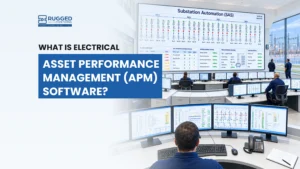
Asset performance management (APM) brings condition data together with operational, historical, risk, criticality, and other asset information. For a utilities-focused view, see Asset Performance Management for Utilities.
The information flow can be understood as:
Condition data → Asset context → APM analytics → Health and risk insights → Maintenance decision
For example, transformer temperature rise can indicate more when considered alongside loading, maintenance history, and other condition indicators. Together, these inputs help assess the significance of the change and prioritize action.
The same approach can scale across transformers, switchgear, cables, circuit breakers, and rotating machines, allowing teams to compare condition and risk across assets and sites.
Where RM EYE fits
RM EYE is Rugged Monitoring’s enterprise APM platform. It connects with asset-level monitoring through Rugged Monitoring’s architecture:
IIoT Sensors → Edge Devices → RM EYE
RM EYE provides centralized trends, alarms, health and risk views, and multi-asset visibility across sites. This helps teams use condition information to identify developing issues and prioritize maintenance.
Considering predictive maintenance for your electrical assets? Talk to our team about your asset monitoring requirements and explore the right approach for your application.
Frequently Asked Questions About Predictive Maintenance
Is predictive maintenance better than preventive maintenance?
Neither approach is suitable for every maintenance activity. Preventive maintenance remains useful for scheduled or mandatory work, while predictive maintenance is useful when deterioration produces measurable condition indicators.
Is condition monitoring the same as predictive maintenance?
No. Condition monitoring measures and trends asset condition. Predictive maintenance uses that information with historical, operational, and analytical context to determine when to act.
What data does predictive maintenance use for electrical assets?
Inputs can include temperature, partial discharge, DGA, bushing condition, loading, alarms, historical trends, inspections, and maintenance information depending on the asset and failure mode.
Is predictive maintenance the same as APM?
No. Predictive maintenance is a maintenance strategy. APM is the broader system that brings asset information together and provides the analytics and context used to enable predictive maintenance.