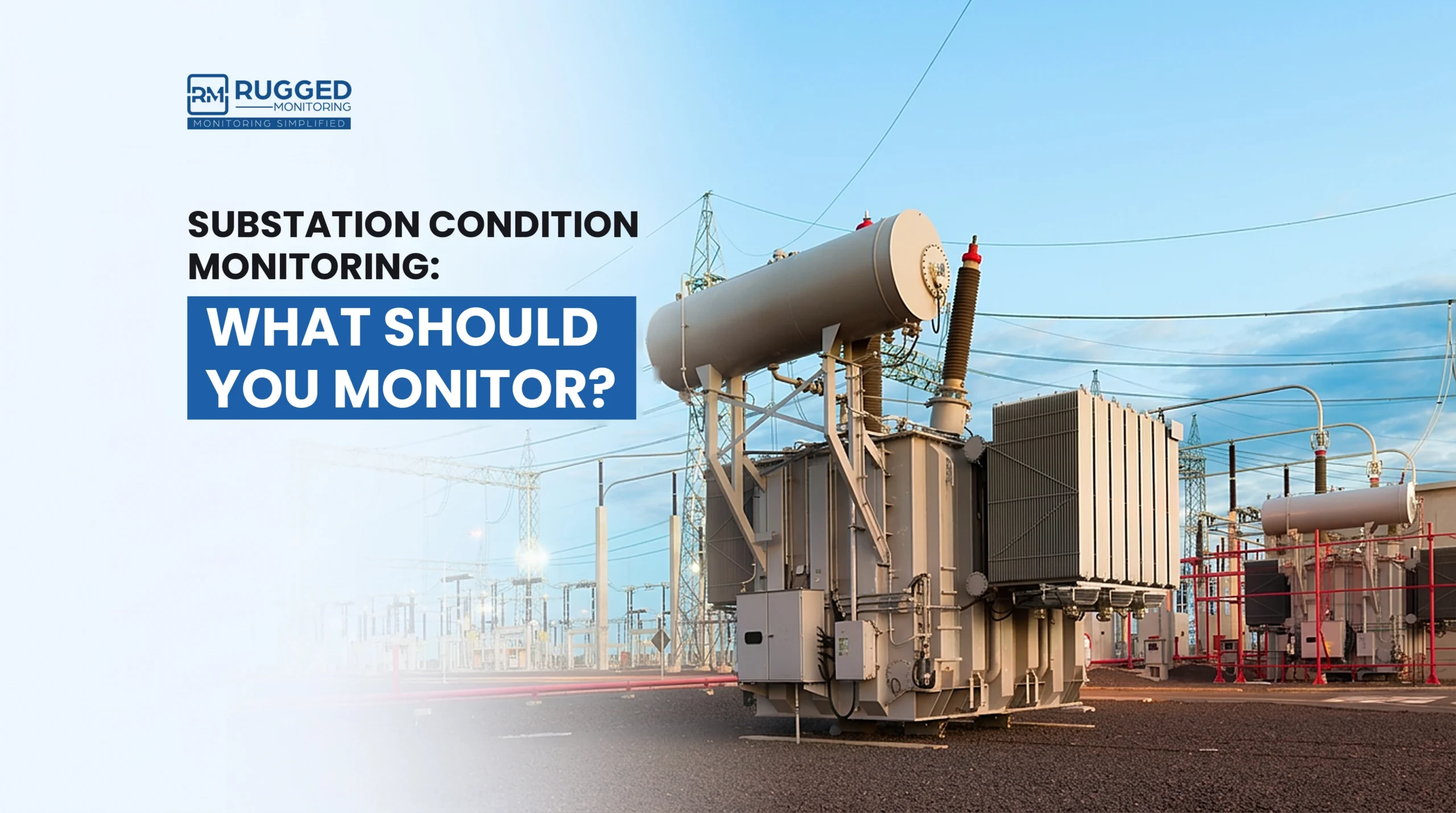
A single equipment failure in a substation can lead to costly downtime, unplanned maintenance, and disruptions across the power network. Many developing equipment problems, however, produce measurable changes before failure.
Equipment may continue operating without visible signs of distress while deterioration progresses. By the time abnormal behaviour is identified during a routine inspection, the condition may have advanced, resulting in expensive repairs, reduced asset life, or an unexpected outage.
Continuous monitoring provides visibility into these developing changes, helping utilities identify abnormalities earlier and make more informed maintenance and operational decisions. As substations become increasingly critical to reliable grid operations, real-time visibility into the condition of critical assets is becoming increasingly important.
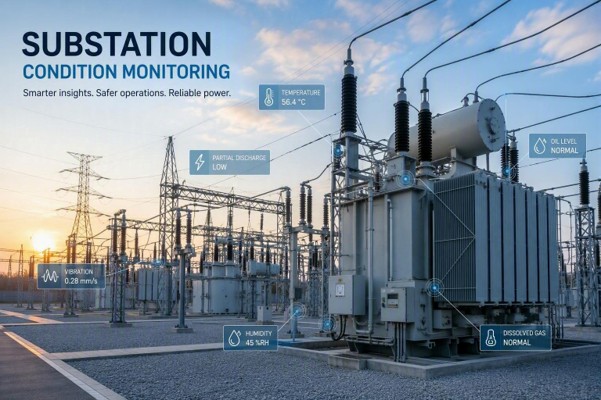
Used Co-pilot to generate this image
What Is Substation Condition Monitoring and Why Does It Matter?
Traditional maintenance often relies on scheduled inspections at fixed intervals. Online condition monitoring of electrical assets adds continuous visibility by tracking condition-related parameters while equipment is in operation.
Depending on the asset and its failure mechanisms, these may include temperature, partial discharge, bushing parameters, mechanical operating characteristics, gas or oil-related measurements, and other conditions.
Tracking these measurements over time helps engineers identify abnormal behaviour and developing changes that may not be apparent during periodic inspections. This supports a shift from primarily calendar- or inspection-driven maintenance toward a more condition-informed approach.
CIGRE’s work on Asset Health Indices follows a similar principle at the asset-management level. Its methodology uses condition information to help characterize changing likelihood of in-service failure and support maintenance, refurbishment, and replacement planning.
Effective condition monitoring therefore starts with selecting the parameters that correspond to the asset and the deterioration mechanisms being monitored.
What Condition Parameters Should You Monitor Across a Substation?
Different substation assets require different condition parameters. An effective substation monitoring system therefore monitors parameters relevant to each asset and its failure mechanisms.
Temperature
Temperature is one of the most widely applicable condition indicators. Increased resistance at electrical connections or contacts can create localized heating, while changes in thermal behaviour can indicate abnormal equipment conditions.
Temperature trends are particularly useful. A connection that gradually begins operating hotter than adjacent phases under comparable loading, for example, may warrant further investigation
Partial Discharge
Partial discharge (PD) can provide an indication of developing insulation abnormalities. Depending on the equipment and installation, partial discharge can be detected using methods such as UHF, HFCT, and TEV.
Mechanical and Operating Parameters
For switching equipment such as circuit breakers, operating time, coil current, mechanism movement, and other operating characteristics can help identify changes in mechanical or electrical performance.
Operating and Environmental Context
Condition measurements should be interpreted alongside factors such as load, ambient temperature, and equipment operating state. This helps distinguish normal operating changes from conditions that may require further investigation.
Asset-specific parameters, such as transformer gas-in-oil measurements or bushing capacitance and dielectric loss, may also be monitored where applicable.
These parameters become most useful when applied to the assets and failure modes they are intended to monitor.
Which Substation Assets Should Be Condition Monitored?
Not every substation asset requires the same monitoring strategy. Monitoring priorities should consider asset criticality, consequences of failure, known failure modes, equipment age and condition, operating duty, accessibility, and maintenance strategy.
Power Transformers
Power transformers contain several subsystems with different deterioration mechanisms, including windings and insulation, bushings, cooling systems, and on-load tap changers. Monitoring may therefore target different transformer subsystems and failure mechanisms rather than treating the transformer as a single monitored component.
Medium and High-Voltage Switchgear
Switchgear combines current-carrying connections, insulation systems, and switching components within compact assemblies. Monitoring can target abnormal heating at connections and contacts and developing insulation abnormalities, depending on the equipment design and failure modes of concern. Continuous monitoring can be particularly valuable for enclosed locations that are difficult to access or assess during normal operation.
Circuit Breakers
Circuit breakers must operate reliably when required. Trending operating characteristics across successive operations can help identify changes in the operating mechanism or control circuit that warrant further investigation.
Power Cables and Cable Terminations
Cable-system defects can develop at joints, terminations, and insulation interfaces. Monitoring can target insulation abnormalities, thermal behaviour, and other condition indicators appropriate to the cable system and installation.
The objective is to match relevant asset failure mechanisms with condition parameters capable of revealing meaningful change. Once those parameters have been selected, tracking how the measurements change over time and interpreting those changes against operating conditions provides deeper insight into developing asset condition.
How Does Continuous Monitoring Reveal Changes in Asset Health?
Periodic inspections provide information about equipment condition at specific points in time. Continuous monitoring adds visibility into how condition-related measurements change between those inspections.
This is important because developing abnormalities may appear gradually or become evident only under particular operating conditions. By maintaining a history of measurements such as temperature, partial discharge activity, or operating characteristics, a substation condition monitoring system can reveal trends, deviations from established behaviour, and changes that may warrant investigation.
The measurements also become more meaningful when interpreted alongside operating conditions. A change that appears during higher loading, for example, may have a different significance from one that develops under comparable load and environmental conditions.
In this way, monitoring moves beyond individual measurements and alarm thresholds toward:
Measurement → history → trend → operating context → condition insight
This gives engineers more information to determine whether a change is temporary, operating-condition related, persistent, or developing over time.
How Does Condition Monitoring Support Substation Reliability?
Condition monitoring provides information about how equipment condition changes in service, supporting maintenance and asset-management decisions such as:
- Earlier identification of abnormalities: Detect developing changes between scheduled inspections and identify equipment that requires further assessment.
- Condition-informed maintenance: Use actual equipment condition to support inspection, testing, and maintenance decisions.
- Maintenance and outage planning: Where condition information provides sufficient warning, maintenance can be planned and, where appropriate, coordinated with scheduled outages.
- Asset lifecycle decisions: Use historical condition data to support maintenance, repair, refurbishment, and replacement planning alongside asset criticality and consequences of failure.
How Rugged Monitoring Enables Centralized Substation Condition Monitoring
Rugged Monitoring provides condition monitoring across transformers, switchgear, circuit breakers, power cables, and other critical electrical assets using technologies such as fiber-optic temperature, partial discharge, transformer bushing, and other asset-specific monitoring solutions.
Sensors installed across these assets connect to monitoring systems that acquire and process condition data. This information can then be integrated into RM EYE, providing a centralized environment for viewing and tracking condition information across multiple assets and monitoring technologies.
By connecting sensing, monitoring, and centralized condition visibility, utilities and industrial operators can identify changes in asset behaviour over time and use that information to support condition-informed maintenance and asset-management decisions.
Explore Rugged Monitoring’s Substation Monitoring Solutions to see how centralized condition monitoring can provide visibility across critical electrical assets.
You can also learn more about Electrical Asset Condition Monitoring for Substations and Digital Solutions for Substations.
Or Contact Rugged Monitoring | Get in Touch with Our Team
Frequently Asked Questions About Substation Condition Monitoring
What is substation condition monitoring?
Substation condition monitoring is the process of measuring and evaluating condition-related parameters from electrical assets to identify abnormal behaviour and changes in asset health. It can include temperature, partial discharge, bushing parameters, mechanical characteristics, and other measurements depending on the equipment.
What equipment should be monitored in a substation?
Monitoring is commonly applied to critical assets such as power transformers, switchgear, circuit breakers, GIS, power cables, cable terminations, busbars, bushings, and other equipment whose failure could affect substation reliability. The monitoring scope should be based on asset criticality, known failure modes, operating duty, equipment condition, and consequences of failure.
What parameters are monitored in a substation condition monitoring system?
Common parameters include temperature, partial discharge, leakage current, capacitance, power factor or tan delta, mechanical operating characteristics, gas-related parameters, load, and environmental conditions. The appropriate parameters depend on the asset and the deterioration mechanisms being monitored.
How does condition monitoring help prevent substation equipment failures?
Condition monitoring can identify changes associated with developing abnormalities before they become obvious during routine inspection or progress into more serious equipment problems. By tracking condition over time, maintenance teams can investigate unusual trends, prioritize testing or maintenance, and intervene when appropriate. Condition monitoring cannot prevent every failure, but it can reduce important blind spots between periodic inspections.
What is the difference between condition monitoring and routine substation inspection?
Routine inspection evaluates equipment at specific intervals and provides a snapshot of its condition at the time of inspection. Continuous condition monitoring collects measurements between those inspections, making it possible to observe trends and identify developing abnormalities.
The two approaches are complementary. Inspection provides valuable visual, physical, and diagnostic information, while continuous monitoring provides ongoing visibility into parameters that can change between inspection intervals.