Underground power cable defects are difficult to identify because the insulation system is largely inaccessible once the cable is in service. Partial discharge (PD) can provide an early indication of insulation defects, but detecting it on an energized cable brings challenges of its own.
So, how is online partial discharge measurement performed without taking the cable out of service? This guide walks through the practical process, from HFCT sensor installation and noise management to signal analysis and PD measurement during cable soak testing.
What Is an Underground Power Cable?
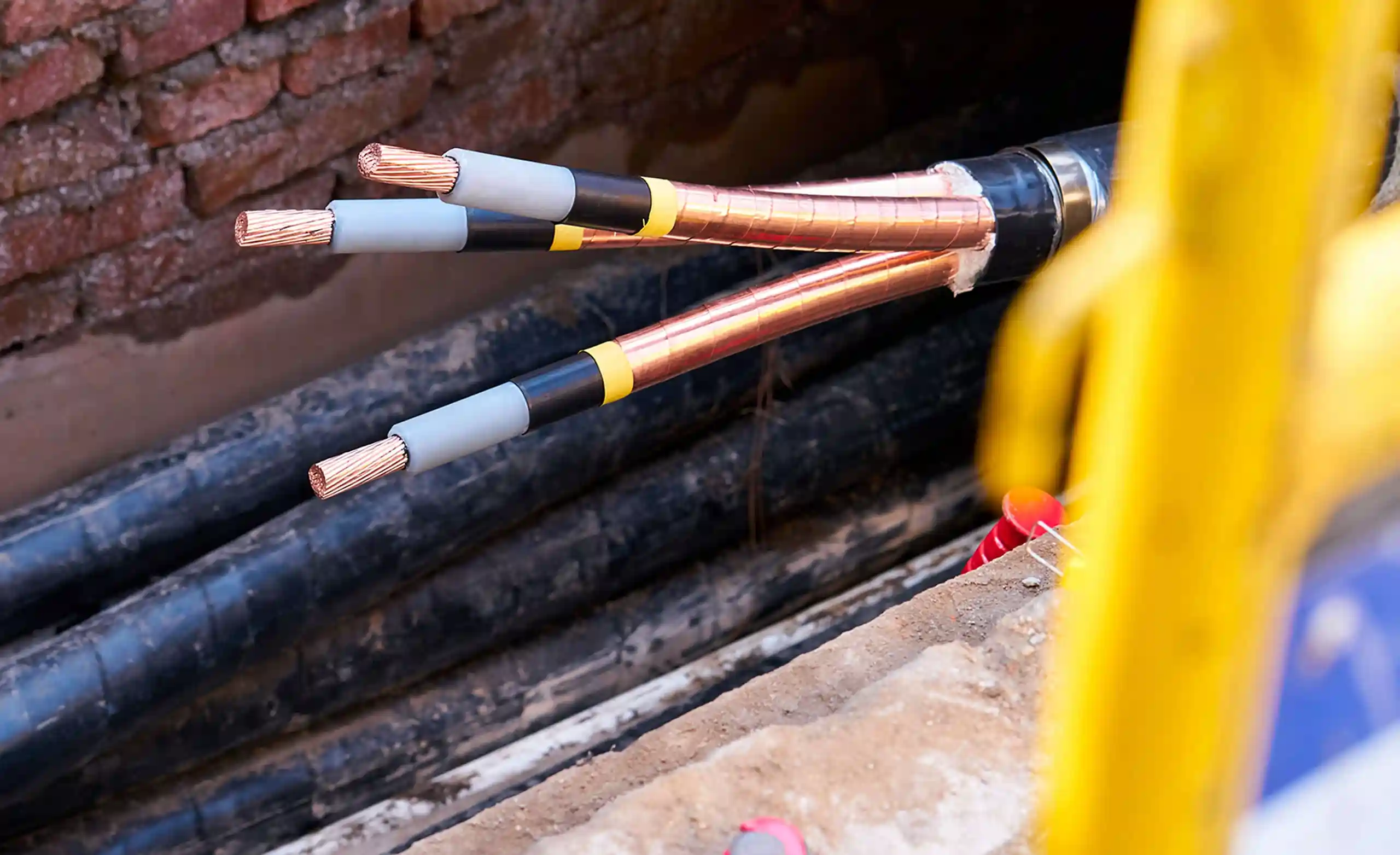
An underground power cable consists of a conductor surrounded by multiple layers designed to provide electrical insulation, control the electric field and protect the cable. Depending on the cable design, these typically include conductor and insulation screens, the main insulation, a metallic screen or sheath, and an outer protective sheath.
The insulation system must withstand the electrical stress between the high-voltage conductor and the grounded metallic screen or sheath. Defects within the insulation or cable accessories can create localized areas of increased electrical stress and may lead to partial discharge activity.

Basic Structure of Power Cable
Why Do Partial Discharges Occur in Power Cables?
Partial discharge is a localized electrical discharge that only partially bridges the insulation between conductors. In power cable systems, PD can occur at insulation defects such as voids, contaminants, interfaces, joints and terminations.
In a cable without significant insulation defect, the insulation between the high-voltage conductor and metallic screen or sheath behaves primarily as a capacitive dielectric system.
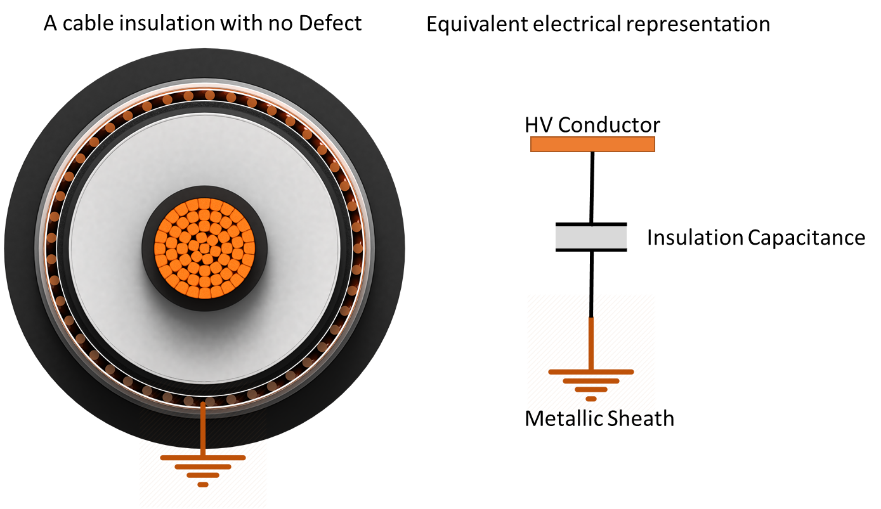
Electrical Representation of Power Cable Insulation in Absence of Defect
However, in presence of a defect, e.g., a cavity in insulation, the equivalent electrical representation of power cable will change. Due to series capacitance of cavity, overall capacitance and hence dielectric strength of power cable insulation will decrease.
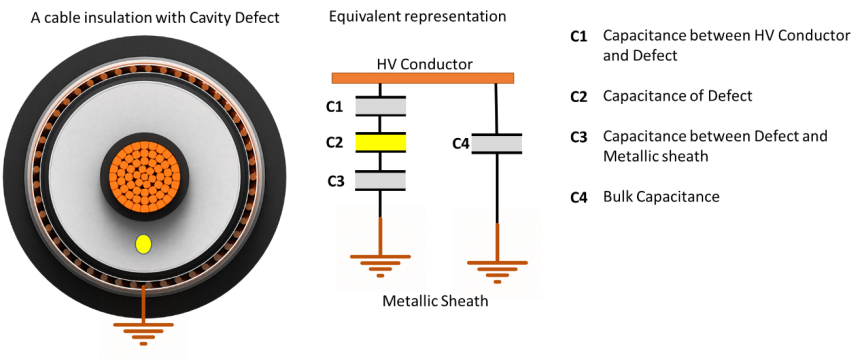
Electrical Representation of Power Cable Insulation in Presence of Defect
When the electric field within the cavity exceeds its breakdown strength, a localized discharge can occur. Repeated discharge activity can progressively degrade the surrounding insulation and contribute to further deterioration.
PD also produces fast electrical pulses that can propagate through the cable system. These high-frequency currents can be detected at suitable screen, sheath or grounding connections using a High-Frequency Current Transformer (HFCT), making HFCT measurement a useful technique for cable partial discharge detection.
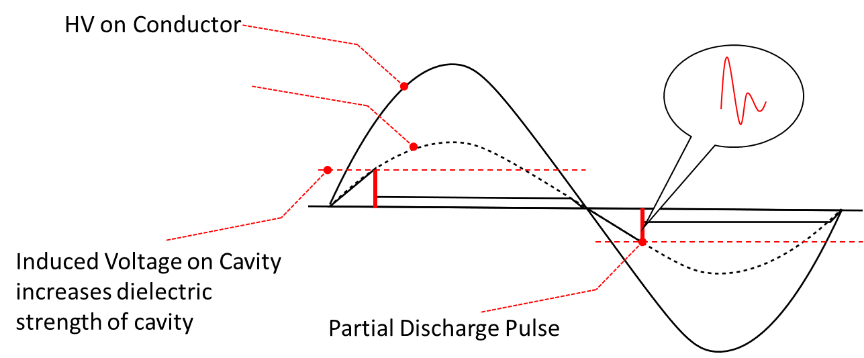
Real Reason Behind Partial Discharge Phenomenon
How Is Online Partial Discharge Measurement Performed?
Online partial discharge measurement assesses PD activity while a power cable remains energized under normal operating conditions. This makes online PD testing of cables useful where taking an asset out of service solely for PD measurement is undesirable.
However, online measurements are exposed to electrical and environmental interface, and reliable results depend on correct sensor installation and signal analysis. In some installations, temporary de-energization may still be necessary to establish safe access for sensor installation.
A typical cable partial discharge test procedure includes the following steps.
1.Installation of High-Frequency Current Transformer (HFCT) Sensors
An HFCT sensor is a clamp-on inductive sensor used to detect high-frequency current pulses associated with PD. For cable measurements, the HFCT is installed around a suitable grounding or bonding conductor connected to the cable’s metallic screen or sheath.
The conductor being measured must pass through the HFCT before reaching the relevant grounding or bonding connection. The exact arrangement depends on the cable bonding configuration and accessible conductors.
HFCT orientation should be applied consistently according to the sensor’s reference direction and measurement setup. Maintaining a known orientation is important when pulse polarity or direction is used during subsequent signal analysis.
Where suitable grounding connections are available, HFCTs can be installed on individual phases to compare signals and help determine whether detected activity is associated with a particular cable phase or is common to multiple measurement points.
For cable terminations associated with metal-clad switchgear, a Transient Earth Voltage (TEV) sensor can provide an additional measurement. Comparing HFCT and TEV signals can help determine whether detected activity is propagating through the cable system or originates locally around the termination or switchgear.
HSENS-H HFCT sensor and HSENS-T TEV sensor incorporates transient overvoltage protection to help protect connected monitoring electronics.

Application of Hsens-H (one phase is shown) and Hsens-T
2.Managing Electrical Noise During Online PD Measurements
One of the biggest challenges in online partial discharge testing is separating genuine PD signals from electrical and environmental noise.
Because the cable remains connected to an operating electrical system, interference may originate from the power system, nearby electrical equipment, switching devices, communications or the surrounding environment. Noise conditions can also vary considerably from one site to another.
Effective noise management therefore requires more than a single fixed filter. Sensor placement, frequency selection, filtering and signal comparison can all help improve the signal-to-noise ratio and distinguish possible PD activity from interference.
HPM601 Partial Discharge Monitor provides software-configurable band-pass filtering, allowing the measurement frequency range to be adjusted according to site conditions.
Filtering should be used carefully: the objective is to suppress unwanted interference while retaining the PD signals required for analysis.
3.Selecting a PD Monitor for Signal Analysis
Online measurements can contain signals from multiple PD sources as well as external interference. A suitable PD monitor should therefore help engineers capture, filter and analyze high-frequency signals while distinguishing potential PD activity from background noise.
Phase-Resolved Partial Discharge (PRPD) plots are commonly used to analyze discharge activity in relation to the AC voltage phase. These patterns can provide useful insight into PD activity when interpreted alongside other signal characteristics and knowledge of the asset.
For periodic cable testing, the HPM601-P is a portable partial discharge monitor designed for online and offline PD measurements. Compatible with HFCT, TEV and other high-frequency sensors, it supports signal acquisition, filtering and analysis for field PD measurements.
4.PD Measurement During Cable Soak Testing
A soak test may be performed after the installation or repair of a power cable system by energizing the cable for a specified period before normal operation. The required duration and test conditions depend on the applicable utility, project or commissioning requirements.
Where PD measurement is included in the commissioning or diagnostic plan, monitoring during the soak period can provide additional information about insulation activity in the cable, joints and terminations while the system is energized.
Continuous measurement can also help capture intermittent PD activity that might not appear during a shorter test. Detected signals should be assessed according to their characteristics, pattern, trend and the applicable diagnostic or acceptance criteria rather than assuming that the purpose of the soak test is to demonstrate that the entire cable system is completely “PD-free.”
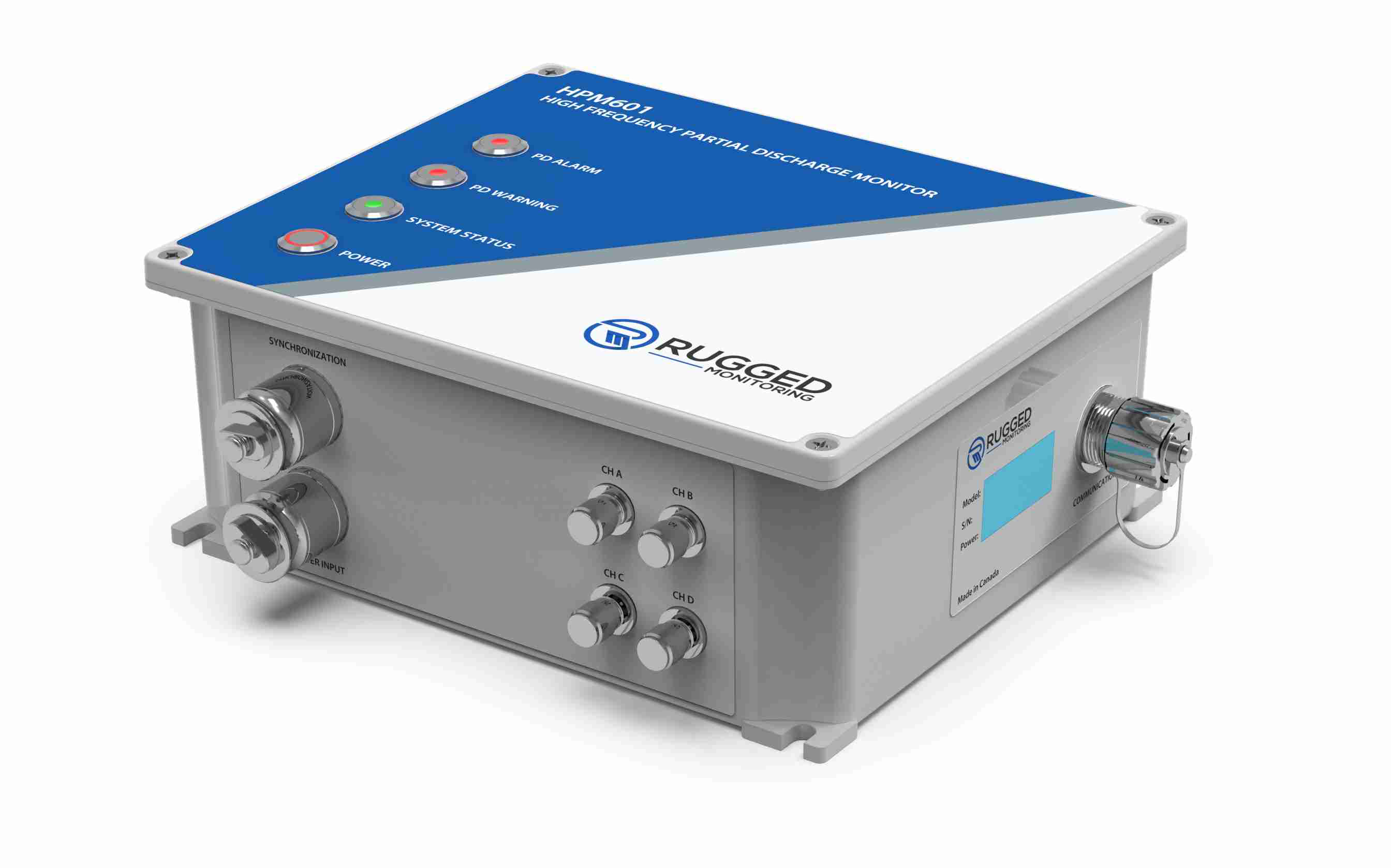
HPM601 Rugged Partial Discharge Monitor
Online PD Testing Solutions for Underground Power Cables
Reliable online partial discharge measurement requires more than detecting high-frequency signals. Engineers need the right sensors, effective noise filtering, accurate signal acquisition and tools to analyze PD activity under real operating conditions.
HPM601-P is a portable partial discharge monitor designed for periodic online and offline PD measurements on power cables and other high-voltage assets. It can be used with compatible HFCT and TEV sensors to capture high-frequency PD signals and investigate activity at cable terminations and other measurement points.
The HPM601-P supports software-configurable band-pass filtering to help manage site-specific electrical noise, while acquired data can be analyzed using tools such as PRPD patterns. It can also record PD activity over extended measurement periods, which is useful when investigating intermittent activity or monitoring cables during applicable soak tests.
By combining suitable sensors with signal acquisition, filtering and analysis, engineers can build a more reliable picture of cable insulation condition and make better-informed decisions about further investigation or maintenance.
Contact Rugged Monitoring to discuss the right partial discharge measurement solution for your power cable application.