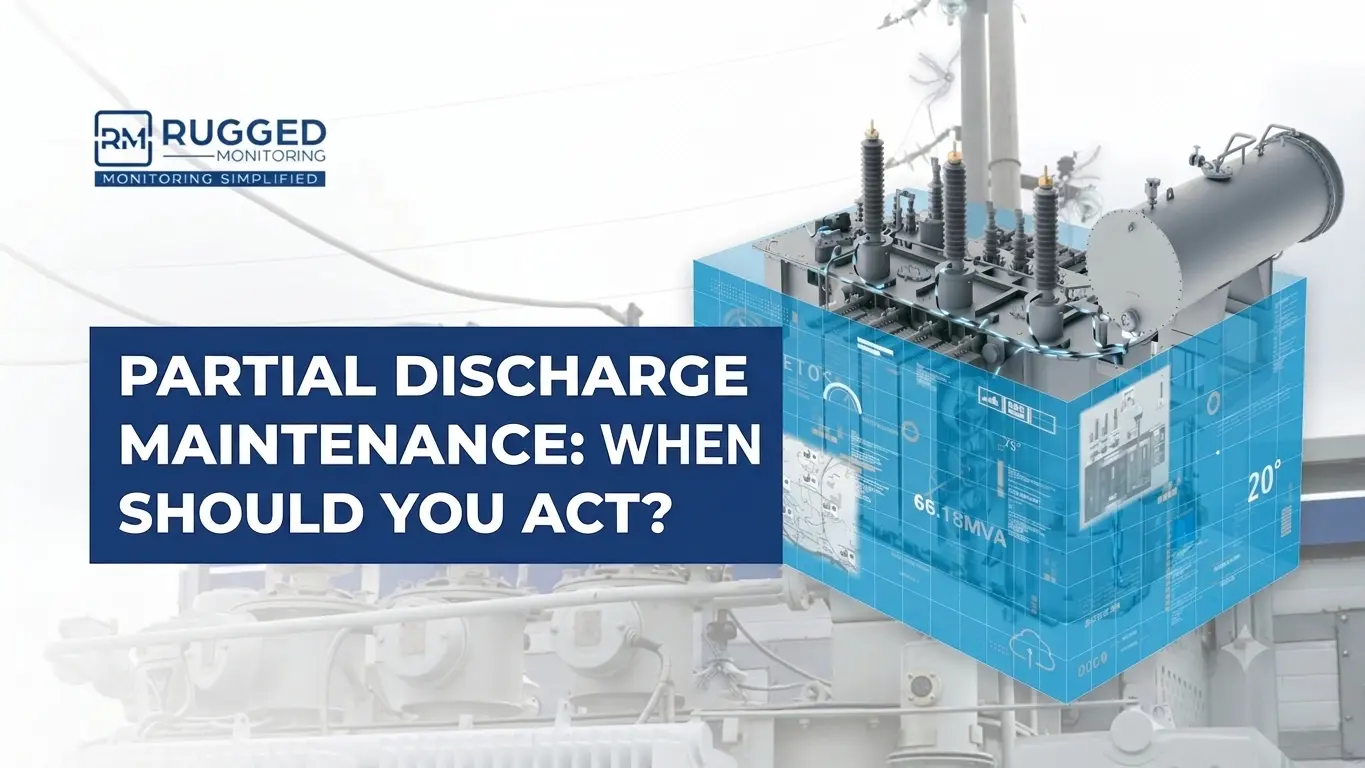
Maintenance team has found that there has been a partial discharge in one of the electrical assets. This leads to a set of difficult questions such as: does it require maintenance right away or is continued monitoring enough?
While partial discharge is an important indicator of insulation degradation, the presence of discharge alone does not automatically mean equipment must be repaired or taken offline.
The appropriate response depends on factors such as discharge severity, trend progression, asset criticality, the location of the defect, and the operational risk involved.
This article explains how maintenance teams can determine whether to continue monitoring, conduct further investigation, plan maintenance during a scheduled outage, or escalate the issue for immediate action.
So, When Does Partial Discharge Require Maintenance?
Partial discharge requires maintenance when the data indicates that insulation deterioration is progressing, discharge activity is increasing over time, or an identified defect creates an unacceptable risk to reliability or safety. A single partial discharge measurement rarely provides enough information to determine the correct response.
Rather than relying on a universal threshold, maintenance teams typically follow a decision pathway:
Monitor → Investigate → Plan Maintenance → Escalate
The appropriate response depends on factors such as defect severity, historical behaviour, asset criticality, and the likelihood of insulation failure. The first step is understanding what each of these response levels means in practice.
Partial Discharge Has Been Detected. What Should You Do Next?
Detecting partial discharge does not automatically mean equipment must be repaired or taken offline. The appropriate response depends on the severity of the condition, how the discharge is changing over time, and the risk it presents to the asset.
After Partial Discharge is detected, maintenance teams typically choose one of four response levels:
-
Continue Monitoring
Monitoring is appropriate when the source of the activity is understood, discharge levels remain stable, and the associated risk is considered acceptable.
At this stage, there is little evidence that the defect is progressing toward failure, so the priority is to establish a baseline and track future changes.
Continue monitoring when:
-
- Partial discharge activity remains relatively consistent between inspections.
- Trend data shows no significant deterioration.
- The asset is operating normally.
- The suspected source presents a low immediate risk.
-
Investigate Further
Further investigation is required when partial discharge is suspected or confirmed, but its source, location, or significance remains unclear.
Additional testing can help determine whether the condition represents a minor issue or a developing insulation defect.
Further investigation may be appropriate when:
-
- Partial Discharge levels are higher than expected.
- Trend data is limited or inconclusive.
- The source of the discharge cannot be confidently identified.
- Multiple defect locations are possible.
-
Plan Maintenance
Planned maintenance becomes appropriate when evidence suggests a genuine insulation defect and the condition is deteriorating over time.
The risk may not justify an immediate shutdown, but delaying action indefinitely could increase the likelihood of failure. Maintenance can therefore be scheduled during the next suitable outage window.
Indicators include:
-
- Increasing Partial Discharge activity.
- Confirmed insulation defects.
- Repeated abnormal test results.
- Growing concerns about future reliability.
- Escalate
Escalation is necessary when evidence suggests rapid deterioration, a critical defect, or an unacceptable level of asset risk.
In these situations, waiting for a planned outage may expose the organization to safety concerns, unplanned downtime, or significant equipment damage.
Potential escalation triggers include:
-
- Sharp increases in Partial Discharge activity.
- Evidence of severe insulation degradation.
- Defects affecting critical assets.
- Indications that failure may occur in the near term.
Responses may include urgent inspections, accelerated maintenance, temporary load reduction, or asset removal from service.
How an Asset Can Move Between Response Levels
An asset’s maintenance response is not fixed. As new condition data becomes available, the appropriate response may change.
For example, a discharge condition that initially appears stable may only require monitoring. If trend data later indicates increasing activity or additional testing confirms an insulation defect, the response may shift toward planned maintenance. If the condition subsequently deteriorates rapidly or begins affecting a critical asset, escalation may become necessary.
This highlights an important principle: maintenance decisions are rarely based on a single partial discharge measurement. They evolve as engineers learn more about the condition, its progression, and the risks it presents.
So how do maintenance teams determine whether a discharge condition justifies monitoring, investigation, maintenance, or escalation? The answer lies in understanding both the severity of the defect and the risk it creates for the asset.
How Do You Determine Whether Partial Discharge Is Serious?
Once partial discharge has been detected, the next challenge is determining whether the condition is stable, concerning, or severe enough to require intervention.
Many maintenance teams immediately look for a numerical threshold that will tell them whether action is required. However, partial discharge is rarely that straightforward.
Is There a Dangerous Partial Discharge Level?
The short answer is no. There is no universal partial discharge level that automatically indicates when maintenance is required.
A Partial Discharge measurement only has meaning within its operating context. The same reading may represent an acceptable condition in one asset and a significant concern in another.
Several factors influence how Partial Discharge data should be interpreted, including:
- Asset type and voltage class
- Insulation design and age
- Measurement technology and sensor configuration
- OEM recommendations
- Applicable standards
- Historical baseline performance
- Long-term trend behavior
It is also important to distinguish between an alarm threshold and a failure threshold.
An alarm threshold is intended to trigger additional attention, investigation, or monitoring. It does not necessarily indicate that failure is imminent.
A failure threshold, by contrast, would imply a point at which the asset is approaching an unacceptable level of risk. In practice, there is rarely a single Partial Discharge value that accurately predicts failure across all assets and operating conditions.
For this reason, maintenance decisions should never be based solely on one pC, mV, or dB measurement.
What Factors Influence Partial Discharge Severity?
Instead of relying on a single number, maintenance teams assess several indicators to determine the severity of a discharge condition.
Partial Discharge Type and Defect Mechanism
Different forms of partial discharges can indicate different insulation problems. Surface discharge, internal void discharge, corona activity, and floating electrode discharges may present different levels of risk depending on where they occur and how they are developing.
Source Location
Where the discharge occurs often matters as much as the discharge itself. Partial Discharge located within critical insulation systems generally warrants greater attention than activity occurring in less vulnerable areas.
Persistence and Repeatability
A single isolated event may be insignificant. Consistent discharge activity observed across multiple measurements is more likely to indicate a genuine insulation defect.
Trend Behaviour
Trend behaviour is often more valuable than an individual measurement. Stable activity may justify continued monitoring, while increasing activity can indicate ongoing insulation deterioration.
PRPD Pattern Evolution
Phase-resolved partial discharge (PRPD) patterns can reveal whether a defect is remaining stable or changing over time. Shifting patterns may indicate evolving insulation conditions that require further investigation.
Correlation with Operating Conditions
Maintenance teams frequently assess whether partial discharge activity changes with:
- Load
- Voltage
- Temperature
- Humidity
- Switching events
- Environmental conditions
These relationships can provide valuable clues about the underlying defect and the conditions that may be accelerating it.
Supporting Condition Evidence
Partial discharge data is rarely assessed in isolation. Confidence in maintenance decisions increases when the findings align with:
Visual inspection results
Thermal anomalies
Insulation testing data
Maintenance history
Historical asset performance
The Key Takeaway
Partial discharge severity is an assessment, not a single measurement.
Effective maintenance decisions depend on understanding the defect, its location, its behaviour over time, and the level of risk it presents to the asset.
Once severity has been assessed, the next step is to understand how that condition is changing. In many cases, the trend of the discharge can have a greater impact on maintenance decisions than the Partial Discharge measurement itself.
Why the Partial Discharge Trend Can Change the Maintenance Decision?
A single Partial Discharge measurement provides a snapshot of asset condition. Trend data provides the story behind it.
This distinction is important because an asset with relatively high Partial Discharge activity may represent less immediate risk than an asset with lower but rapidly increasing discharge levels.
Consider two examples:
Asset A
- Higher overall Partial Discharge levels
- Stable PRPD pattern
- Consistent measurements over time
- No supporting signs of deterioration
Asset B
- Lower Partial Discharge magnitude
- Increasing activity across successive inspections
- Changing discharge patterns
- Growing correlation with load or environmental conditions
Although Asset B has lower measured Partial Discharge levels today, many maintenance teams would consider it the higher-priority concern because the condition appears to be deteriorating.
When evaluating trends, engineers commonly look for:
- Changes in discharge magnitude
- Changes in repetition rate
- Evolution of PRPD patterns
- Emerging operating correlations
- Increasing defect persistence
These indicators help determine whether insulation degradation is stable, progressing slowly, or accelerating toward failure.
This is one reason why continuous condition tracking often delivers more value than isolated measurements. Meaningful maintenance decisions depend on understanding not just what Partial Discharge is occurring today, but how it is changing over time.
Asset Condition Alone Does Not Determine Maintenance Priority
Even when Partial Discharge data confirms insulation deterioration, maintenance priority is not determined by asset condition alone.
The second part of the decision is understanding the consequence of failure.
Consider two assets displaying similar Partial Discharge characteristics.
The first asset serves a non-critical process with built-in redundancy. If it fails, another unit can assume the load with minimal operational disruption.
The second asset performs a critical function with no backup equipment available. Failure could result in safety risks, production losses, significant outage costs, or lengthy repair times.
Although both assets show similar condition indicators, the maintenance response may be very different.
Factors commonly considered include:
- Asset criticality
- Operational importance
- Network redundancy
- Safety implications
- Outage consequences
- Repair duration
- Spare-part availability
- Business impact
This is why maintenance decisions are rarely based on technical condition data alone.
In practice, maintenance priority is determined by combining evidence of deterioration with an understanding of what happens if the asset fails.
A Practical Partial Discharge Maintenance Decision Framework
A structured process helps ensure maintenance decisions are consistent and risk based.
When Partial Discharge is detected, many organizations follow a sequence like the following:
Step 1: Confirm Genuine Partial Discharge
Differentiate genuine Partial Discharge activity from electrical noise, interference, and measurement anomalies.
Step 2: Identify the Probable Source
Determine where the discharge is occurring and identify the most likely defect mechanism.
Step 3: Establish Current Severity
Evaluate the nature, persistence, and characteristics of the discharge activity.
Step 4: Compare Against Historical Behaviour
Assess whether the condition is stable, improving, or deteriorating.
Step 5: Review Supporting Condition Indicators
Consider inspection findings, thermal information, insulation testing results, and other relevant condition data.
Step 6: Assess Asset Criticality
Evaluate the operational and business consequences of failure.
Step 7: Assign the Appropriate Response
Based on the available evidence, determine whether the asset should be:
-
- Monitored
- Investigated Further
- Scheduled for Maintenance
- Escalated for Immediate Action
This framework shifts the focus away from isolated Partial Discharge values and toward informed maintenance decision-making.
From Periodic Partial Discharge Decisions to Continuous Maintenance Intelligence
Throughout this article, one principle has remained consistent: effective maintenance decisions are rarely based on a single partial discharge measurement. They depend on understanding how an asset’s condition changes over time.
The challenge is that periodic inspections provide only snapshots of asset behaviour. A condition that appears stable during one test may deteriorate significantly before the next scheduled assessment, making it difficult to determine whether the risk is increasing or remaining under control.
Continuous monitoring helps overcome this limitation by providing ongoing visibility into:
- Long-term Partial Discharge trends
- Developing defect behaviour
- Operating-condition correlations
- Early warning signs of insulation deterioration
- Emerging maintenance priorities
This historical context allows maintenance teams to move beyond reactive maintenance and fixed inspection intervals. Instead, they can identify developing issues earlier, assess risk more accurately, and make better-informed decisions about when to monitor, investigate, plan maintenance, or escalate.
This is the foundation of a predictive maintenance approach, where maintenance activities are guided by actual asset condition rather than assumptions or predefined schedules.
Turning Partial Discharge Condition Data into Actionable Asset Intelligence
While detecting partial discharge is important, effective maintenance decisions require more than defect detection alone. Maintenance teams must also understand how asset condition affects reliability, operational risk, and business performance.
Rugged Monitoring’s continuous partial discharge monitoring solutions provide the visibility needed to track insulation health over time, helping organizations identify developing defects before they lead to unplanned failures.
However, condition data becomes even more valuable when it is viewed within the broader context of asset management.
RM EYE helps connect partial discharge information with wider asset intelligence, including asset criticality, operational impact, historical performance, and risk considerations. This enables maintenance teams to move beyond condition monitoring and support a more predictive, risk-informed maintenance strategy.
The result is a clearer decision-making process:
Partial Discharge Detection → Trend Analysis → Condition Assessment → Asset Risk Evaluation → Maintenance Prioritization
By connecting condition data with asset context, organizations can focus maintenance resources where they deliver the greatest value, prioritize high-risk assets, and intervene before insulation defects develop into costly failures.
Learn more about Rugged Monitoring’s partial discharge monitoring solutions or discover how RM EYE helps transform asset condition data into actionable maintenance intelligence.
FAQ Section
When does partial discharge require maintenance?
Partial discharge requires maintenance attention when engineering assessment indicates that the activity represents a significant or deteriorating insulation condition and the resulting asset risk is unacceptable. The decision should consider Partial Discharge source, trend, operating conditions, equipment criticality, and consequence of failure rather than the presence of Partial Discharge alone.
How do you determine the severity of partial discharge?
Partial Discharge severity is assessed by considering the discharge mechanism, source location, measurement trend, pattern characteristics, operating conditions, and asset history. Applicable equipment standards, OEM guidance, baseline measurements, and supporting diagnostic results should also be considered.
Does detecting partial discharge mean equipment needs immediate shutdown?
No. Partial Discharge detection does not automatically mean an asset requires immediate shutdown. Some conditions may justify continued monitoring or planned investigation, while rapidly changing activity associated with a critical insulation defect may require faster escalation.
What partial discharge level is considered dangerous?
There is no single Partial Discharge magnitude that is universally dangerous across all electrical assets and measurement systems. Acceptable values and alarm criteria depend on equipment type, measurement method, calibration, defect characteristics, applicable standards, and historical behavior.
What should you do after partial discharge is detected?
First confirm that the signal represents genuine Partial Discharge and determine its probable source and type. Then evaluate its trend, supporting condition information, asset criticality, and failure consequences before deciding whether to continue monitoring, investigate further, schedule maintenance, or escalate.
Is increasing partial discharge always evidence that failure is imminent?
No. Changes in measured Partial Discharge can also be influenced by voltage, load, temperature, humidity, sensor configuration, and noise. A sustained or significant change should prompt engineering assessment, but remaining life or failure timing should not be inferred from Partial Discharge magnitude alone.
How can continuous Partial Discharge monitoring improve maintenance planning?
Continuous monitoring establishes how Partial Discharge behavior changes between periodic inspections. This allows maintenance teams to identify developing trends earlier, compare current activity with historical behavior, and prioritize further investigation or maintenance based on condition and risk.