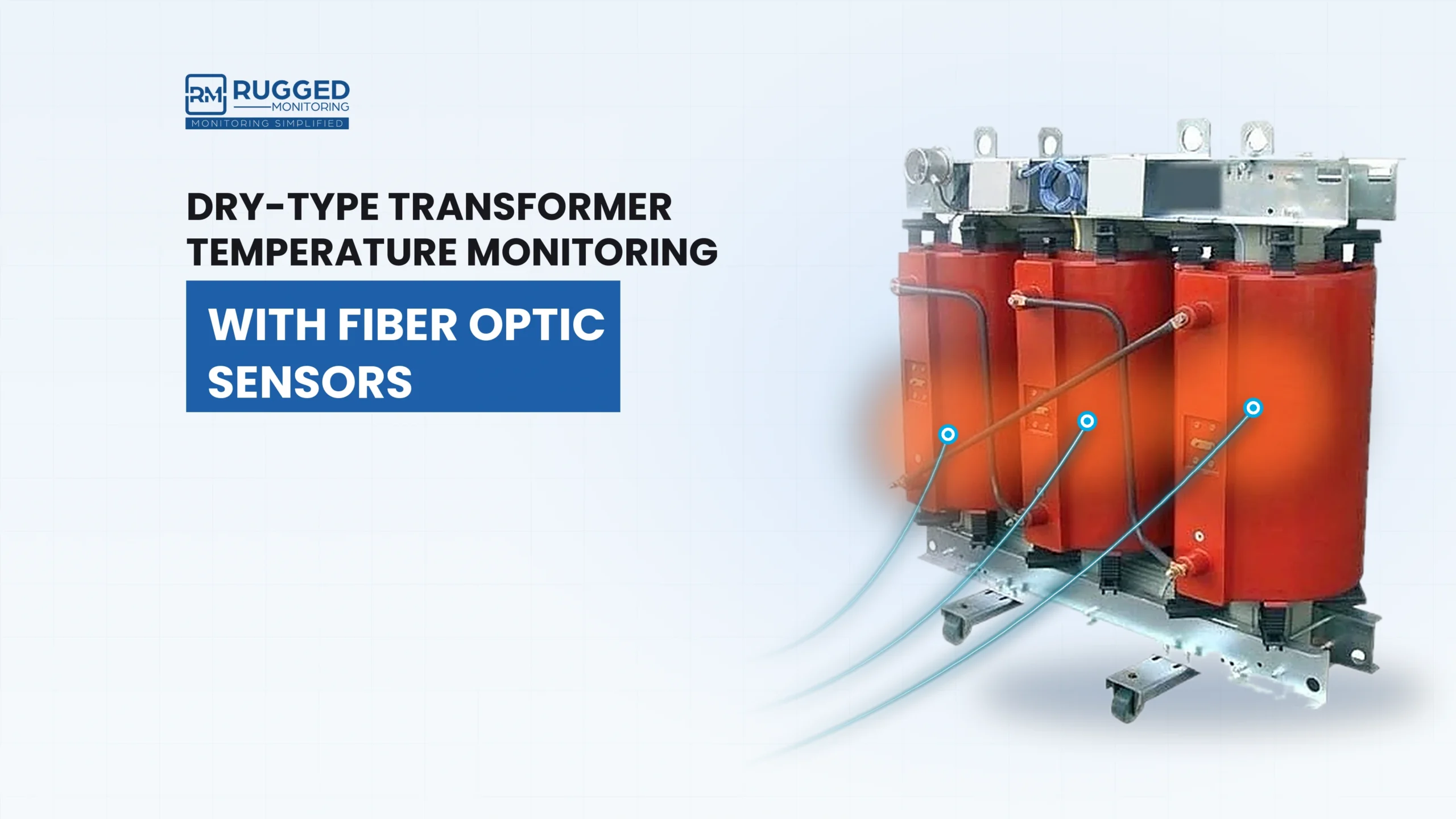
A dry-type transformer, unlike the traditional transformer, has no insulating oil. This insulating oil circulates around its windings to transfer heat. So, how does one know what is happening to the hottest part of the winding?
Dry type transformer temperature monitoring measures temperature at selected winding locations. These measurements provide visibility into changing thermal conditions and can support alarm, cooling, and protection decisions.
Why is temperature monitoring important in a dry-type transformer?
Heat develops within transformer windings as they carry load. In a dry-type transformer, this heat is transferred to the surrounding air through the transformer’s cooling arrangement.
This makes dry type transformer winding temperature an important condition parameter. Ambient temperature alone does not show what is happening at the hottest part of the winding.
Winding construction also matters. Cast-resin transformers encapsulate the winding in solid resin, while vacuum-pressure-impregnated (VPI) transformers use an impregnated insulation system. Their construction affects thermal behaviour and how winding temperature can be measured.
Direct temperature measurement provides information from selected winding locations rather than relying only on an estimated temperature. This becomes particularly important when the objective is winding hot spot temperature monitoring.
What temperature should be monitored, and what are the limits for each insulation class?
Not every temperature measurement tells you the same thing.
Ambient temperature describes the environment around the transformer. Winding temperature shows how the winding responds to load and cooling conditions. The dry-type transformer hot spot is the winding location expected to experience the highest temperature.
IEC 60076-11:2018 defines temperature classes and associated winding-temperature-rise limits for dry-type transformers:
| Average winding rise | Maximum hottest-spot winding temperature |
| 80 °C | 150 °C |
| 115 °C | 180 °C |
| 150 °C | 220 °C |
These values provide thermal-class context; they are not automatically alarm, fan-start, or trip settings. Operating setpoints still need to reflect the individual transformer and manufacturer requirements.
IEC 60076-11:2018 provides the dry-type transformer thermal-class framework. IEEE C57.12.01-2020 provides additional general requirements for dry-type distribution and power transformers.
Knowing the temperature limit is only useful when the sensor measures a location that represents the winding’s thermal condition.
Where should temperature sensors be placed in a dry-type transformer?
There is no single probe location for every dry-type transformer. Sensor placement should reflect the transformer’s thermal design and expected hot-spot locations.
For direct winding measurement, consider:
- Phases: Measurements may be required across phases rather than relying on one winding location.
- LV and HV windings: Their construction, current, losses, and cooling conditions differ. The critical measurement location therefore depends on the transformer design.
- Winding construction: Cast resin transformer temperature monitoring and VPI transformers may require different probe arrangements.
- Transformer design: Embedded probe locations are best established during transformer design and manufacture where possible.
Direct fiber optic probes measure temperature at the selected winding location, while calculated hot-spot approaches estimate temperature from other measurements and transformer parameters. See transformer hot spot monitoring for the distinction.
A fiber optic temperature sensor for transformer windings can provide direct temperature measurements at these selected locations. For general probe placement and fiber routing, see fiber optic monitoring in power systems.
How should alarm, fan-control and trip settings be set?
Once winding temperature is being measured, the next question is what should happen when it changes?
A dry-type transformer temperature controller can use temperature measurements to support alarm, cooling, and protection functions.
Setpoints should consider:
- The transformer’s insulation and thermal class;
- Manufacturer-defined operating limits;
- Sensor location;
- Normal operating temperature;
- Cooling-system design; and
- The required alarm and protection philosophy.
An alarm can provide warning when temperature reaches a defined condition. For dry-type transformer fan control, a controller can initiate cooling where the transformer design supports it.
This also makes transformer cooling monitoring relevant, since the response depends not only on detecting rising temperature but also on whether the cooling system is operating as intended. A separate trip function may provide protection at another defined condition.
The important distinction is that maximum hottest-spot temperature is not automatically the alarm, fan-start, or trip setpoint. These settings should reflect the individual transformer and manufacturer guidance rather than a generic temperature table.
Where is dry-type transformer temperature monitoring used, and why does it matter in data centers?
Dry-type transformers are used in commercial buildings, industrial facilities, infrastructure, renewable-energy installations, and other indoor or application-specific environments.
The monitoring principle remains the same across these applications. However, loading, cooling, ventilation, installation conditions, and the importance of the connected load can differ.
These considerations become particularly relevant even in data center monitoring, where dry-type transformers can supply UPS systems and other power-electronic loads. Harmonic-rich loads can influence transformer losses and thermal behaviour, while indoor enclosure design and ventilation can affect heat removal.
Redundant electrical architectures add another consideration. When the electrical system is reconfigured or another supply path becomes unavailable, transformer loading can change.
Direct winding-temperature measurements provide visibility into how the transformer responds to these operating and cooling conditions. However, data-center transformers do not require one universal set of temperature limits. Alarm and cooling settings should still reflect the individual transformer, its loading, thermal class, cooling arrangement, and manufacturer requirements.
How does Rugged Monitoring support dry-type transformer temperature monitoring?
Rugged Monitoring supports dry-type transformer monitoring using fiber optic sensing for direct winding-temperature measurement.
The TSENS-FL uses a 2 mm fluorescence-based probe with a -40 to +250 °C measurement range. Its optical sensing approach is immune to EMI, partial discharge, and high-voltage electric fields.
For applicable installations, the D501FL supports 1 to 6 temperature channels, four programmable relays, and 4–20 mA outputs. This allows winding-temperature measurements to support monitoring, alarm, and control functions.
These solutions form part of Rugged Monitoring’s broader range of fiber optic temperature monitors for electrical asset temperature monitoring.
Frequently Asked Questions
Can fiber optic probes be fitted to a cast-resin winding after manufacture?
Probe installation within a cast-resin winding is generally best planned during transformer design and manufacture. Whether an existing transformer can be retrofitted depends on its construction and available measurement locations. The transformer manufacturer should confirm what is technically suitable.
What is the maximum hottest-spot temperature for a Class F or Class H dry-type transformer?
The applicable hottest-spot temperature depends on the transformer’s insulation system, thermal design, rating, and governing standard. IEEE C57.96 provides loading guidance for dry-type transformers, while IEC 60076-11 provides thermal-class context. Use the transformer manufacturer’s limits when setting operating criteria.
Do data-center transformers need different temperature alarm settings?
Potentially. Alarm settings should reflect the individual transformer’s thermal class, loading, cooling arrangement, installation environment, and manufacturer requirements. They should not be changed simply because the transformer is installed in a data center.
What does a temperature controller for a dry-type transformer do that a fiber optic monitor doesn’t?
The fiber optic sensing system provides the temperature measurement. A controller can use those measurements for operational functions such as alarms, relay outputs, fan control, or trip logic, depending on the system configuration.
Direct winding-temperature monitoring gives operators visibility into how a dry-type transformer responds to its load and cooling conditions. The value comes from measuring at meaningful winding locations and applying limits and control actions suited to that transformer.
Explore the right monitoring approach for your transformers and strengthen your maintenance strategy. Contact Rugged Monitoring to know more.